Lighting predictions

Charles, surely even the big shows eventually run out of puff when it comes to balancing windows.

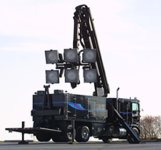
It's easy to have a row of windows down a wall with half a megawatt of light coming through them - I mean - seriously - even Hollywood would struggle.

Unless... oh. I see.
lrx_II.JPG
 
And maybe this going even more off topic - but the biggest "struggle" in my part of the world is making those "producers" (those wannabe hollywood one's with very little actual knowledge) understand or "see" ahead of time why budgets need to be bigger when more powerful lights are needed for certain set ups. Perhaps some of the marketing for LED's tungsten equivalency is aimed at these folks.
 
Phil, this all relates back to that clip I posted a few weeks ago: http://www.dvxuser.com/V6/showthrea...s-Whedon-and-Chris-Pine&highlight=joss+whedon

In the ensuing discussion you took some exception to my describing the lighting package as "scaled down". That was a perfect example of having barely enough firepower to balance against a wall of windows. A mandate of house-power only, limited crew and budget forced my hand in that instance. With a more substantial budget I would have requested a condor with two 18K's for the windows plus probably four M40s for the interior to bring up the interior level. Philosophically, one could argue that the resulting spot would have not been any funnier or effective so what would have been the point, but the responsbility of the DP working at a certain level is to be able to cover any reasonable eventualities and give the director flexibility rather than limit their scope. For example, once the daylight started to go we had to force our setups to avoid seeing windows, which ended up being several scenes in the piece.

Mark, as to your concern about explaining to producers why one sometimes needs large lights: even I hear from time to time "I thought cameras were sensitive enough now that you don't need lights". In a daylight scenario, my answer is simply "the sun hasn't gotten any less bright". At some point (soon), dynamic range will increase to where we will be able to manage blazing sun outside windows and relatively dark interiors without all of the hassle--anyone who used to shoot video 10 years ago or more knows that things have already gotten far better on this front.
 
At some point (soon), dynamic range will increase to where we will be able to manage blazing sun outside windows and relatively dark interiors without all of the hassle--anyone who used to shoot video 10 years ago or more knows that things have already gotten far better on this front.
Is "able to manage" equivalent to, it will have the same quality? Say you're doing a basic shot where the subject is well lit with say 1K of light, but the window in the distant background is 5 stops brighter than they are. But your camera has 15 stops of dynamic range and the window is not blown out, so it's all good. Or is it? You'll still need to bring down the brightness of the window in post so it isn't (much) brighter than the subject where you want the focus to be on. So is lowering the exposure of the window in post resulting in the same quality as if you added light to balance out with the window while on set?

Maybe because I don't shoot RAW, but I find with the C100 and C300 Mark II lowering a window's exposure in post (using a mask) typically doesn't look as good as balancing it out on set. The bright spot gets washed out the further you push it.


And in cases where the subject/camera is moving, directly in front of windows, then you'd have a lot more masking work to do in post as well, compared to say a static interview where the window is not overlapping with the subject.


I'm kind of curious if physiologically, in relation to eye strain, etc., if humans would be better off with indoor environments that were as bright as outdoor sunlight. Perhaps a future where homes are filled with lots of bright and soft light, such that when you step outside, your eyes don't need to adjust to the sunlight.
 
Last edited:
Eric, if your properly balanced subject is already at least one stop above the midpoint of those 15 stops, your exteriors are now pegging in the very top of the range, so whether or not they actually reach clip they will still be reading as hot tones and as you noted, trying to suppress them rarely reads well. I try not to rely on masking of windows unless I am really forced into it by the situation for this reason (and if it's a lockoff, I'll do a separate exposure pass for the windows...we'll make notes to post three different ways and I'll still arrive at the color session and find no-one knows where that exposure pass clip is...groan).

My usual modality is to ride the iris until I find a look for the windows that I like, then light the ambience appropriately. Or, if we have the ability to ND the windows, I'll note the resulting T-stop and do the math; so if the windows look good at T11, I'll request ND.9 for the windows and shoot at a T4, for example. I could do it with a meter or guesswork (I usually have a sense of what ND is going to be needed at this point) but a lot depends on what is seen outside the windows, sun direction etc. so I prefer to do it visually. Sometimes you want the exterior to read hotter than other times. There are no hard and fast rules.
 
With a more substantial budget I would have requested a condor with two 18K's for the windows plus probably four M40s for the interior to bring up the interior level.

I think that's sort of the point. That's not "more substantial." That's "galactically huge."

These things, like light, are relative. Unfortunately, the audience reation isn't!
 
Mark, as to your concern about explaining to producers why one sometimes needs large lights: even I hear from time to time "I thought cameras were sensitive enough now that you don't need lights". In a daylight scenario, my answer is simply "the sun hasn't gotten any less bright". At some point (soon), dynamic range will increase to where we will be able to manage blazing sun outside windows and relatively dark interiors without all of the hassle--anyone who used to shoot video 10 years ago or more knows that things have already gotten far better on this front.
Thanks Charles, I'm glad you didn't give the standard "educating the client" spiel. :) And yes, I've been shooting for over 10 years, so am completely amazed at what I can now get using my camera's 12+ stop of dynamic range -and some post "tricks" and a quite small lighting budget (compared the the beta cam days and deck to deck editing). So, maybe this isn't a thread hi-jack at all... if camera's continue to "see" with more latitude / better dynamic range and our displays catch up as well... perhaps the future of lighting will continue to make our jobs easier. One can hope ...
 
But if our jobs become too easy then it won't be fun anymore, nor will it pay better than minimum wage.


(and if it's a lockoff, I'll do a separate exposure pass for the windows...we'll make notes to post three different ways and I'll still arrive at the color session and find no-one knows where that exposure pass clip is...groan).
That's a cool trick which I haven't thought to do.

In most cases these days I find my LED lights are bright enough to handle window backgrounds in terms of balancing with the subject; back when I was CTBing tungsten lights I pretty much avoided windowed backgrounds, shutting curtains, etc. Of course the openness and depth that windows give to a shot is generally preferable. Sometimes I still do need more power, though.
 
Last edited:
I'm forced to point out that the vast majority of filmmaking that goes on in the world probably isn't paid at more than minimum wage.

The only alternative point of view involves redefining the term "filmmaking" to suit one's own purposes.
 
I think that's sort of the point. That's not "more substantial." That's "galactically huge."

These things, like light, are relative. Unfortunately, the audience reation isn't!

I think it's better to rate "these things" in terms of the industry as a whole rather than from one's personal perspective on it, as I strive to do. Understood that the setup I described may seem "galactically huge" to you but there are much, much bigger setups being done on larger projects as I'm sure you are aware. I suppose keeping it in the astronomical vein you could up "galactically" to "universally" in that instance, but I'm not sure anyone would get the distinction!

if you are inclined to think that my perspective is already somewhat rarified, understand that I spent many years working with truly humble gear and budgets on small jobs like many users here. Three years shooting local commercials with a Lowel kit and some redheads...short films where I'd go scrounging around location looking for something white to improvise a bounce into, or rigging up a dishrack on a stand to make an improvised gobo. These days I do get a certain amount of toys to get the job done but I'm not shooting shows like "Game of Thrones" or "Westworld" which in television terms are indeed "galatically huge"--they have literally 30 times the budget of my last series.

So, in the case of the scenario we are discussing, the version with the condor would have cost production something like $4-5K additional, gear and manpower. Too much for that job, but manageable with some negotiation for another job, and a non-brainer for a much bigger job. That's truly relative.
 
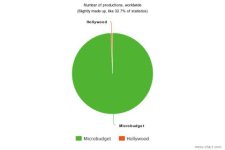
I tend towards the view that the world looks like this:

chart.jpg

Yes, if you consider what we're discussing in terms of a linear progression from "student film" to "Transformers," it's fairly far down the scale. However, if you consider it in relation to the number of people in the world who actually get involved in anything remotely approaching filmmaking, good grief, you're on Mars.

Nigeria, for instance, has a thriving film industry. Average budget equivalent to around US$10,000. I don't suspect they see many skypanels, but they do reportedly make about 600 films a year.

(Which, I'm forced to admit, is probably more than we do here)
 
... At some point (soon), dynamic range will increase to where we will be able to manage blazing sun outside windows and relatively dark interiors without all of the hassle ...
Aren't we (and, by "we", I mean those with access to he latest high end gear) kind of, sort of there?

Having read some general sensor info, I recall that 20 stops is the differences between the oncoming car headlights and complete darkness. In that respect, hot windows ought to be in the 16-18 range. Modern sensors + a dual exposure HDR camera should pretty much get you there. The worst case scenario is that you need a very moderate amount of lights to fill in the shadows.

PS. I saw this on Newshooter a while ago. A 120w 1x1 panel with ~ 22,000 lux at 1 meter at 5600K, retailing for about $1,100. For a fill-in, a single diffused panel ought to do the trick.

 
Collimation, or to put it another way, the difference between intensity and total flux.

We can, in theory, take any arbitrarily low-powered light source and achieve any arbitrarily high intensity by focusing the output of the source into a suitably small area.

In practice this tends to mean using LEDs with a very narrow beam angle, which will achieve more lux at more distance for the same power than a wider beam angle. Of course, all else being equal, the actual amount of light emitted is identical and which is best depends on application (though I tend toward the point of view that a narrow beam can be widened more easily than a wide beam can be narrowed.)

Actually the Astra is fairly well collimated as it is, with each emitter housed in a little parabolic reflector, but I haven't used the Lupo Superpanel so I can't really comment on it specifically. Whenever I've evaluated lighting, I've provided a reading in lux at one metre, but with the caveat that the reading is only meaningful in conjunction with the beam angle, usually given as the angle through which the beam is at least half the peak intensity. Some LEDs have a complex radiation pattern that can only really be described narratively.

Needless to say, all of this is fully exploited by manufacturers, very many of whom make absolutely absurd claims about the effectiveness of their products; truly it is a jungle out there.

P
 
Astra is 46 degree angle, and the Lupo is 40. That will account for some, but not all of the reasons for the greater lux reading at 1 meter. I'm curious too how they did it. It's a pretty amazing leap. I have no reason to be skeptical though given the types of tests that Alard did on Newsshooter.

I want one, but I just picked up a Lightstorm LS1s and I really don't want to become any more panel-rich/COB-poor. I need some focusable lights too.
 

Not a prediction but, perhaps, a belated observation of a trend - with the battery technologies coming along nicely, it seems like the day of power generators is nearing its end. An Anton Bauer 25 lb 560 Wh pack is under three grand and it will keep that Lupo 1x1 working for about four hours. Outside of large outdoor shoots, half a dozen of those should do the trick.
 
Not a prediction but, perhaps, a belated observation of a trend - with the battery technologies coming along nicely, it seems like the day of power generators is nearing its end. An Anton Bauer 25 lb 560 Wh pack is under three grand and it will keep that Lupo 1x1 working for about four hours. Outside of large outdoor shoots, half a dozen of those should do the trick.

I'm assuming you mean smaller gennies, like 6500w puttputts, because I would not expect to see towable plants going away for large-scale productions for a very long time. I prefer to minimize how many things related to camera or lighting are battery powered whenever possible. I consider the tradeoff of taking time and energy to string cable vs having to keep an eye on the charge status of multiple batteries is generally worth it, because having units shut down mid-take is a real no-no and that will always happen with batteries.

I feel the same way about running multiple little batteries all over a camera rig rather than cabling back to a single larger battery. One fuel gauge to watch instead of multiples.
 
I'm assuming you mean smaller gennies, like 6500w puttputts, because I would not expect to see towable plants going away for large-scale productions for a very long time...
Right. I mean, if you can afford a large outside shoot, then you can afford a few lighting trucks too. Plus, the heat issue goes away as well (mostly).

And for Sam, here's another review of Lupo (skip to 3:30 for the measurements, if you want to avoid some of the shtick)


PS. While surfing the Tube, I also found a few reviews of the 485w Intellytech Light Cannon Fresnel. It seems to be well liked ... by its spokespeople. Comparable to the 600-800w HMI's but with a lot less heat. (the manufacturer claims ~ 1,200W HMI performance but skeptics frown on those claims).
 
Back
Top