Lighting predictions

rob norton

Veteran
I was on a shoot this week where one shot needed a 2K tungsten open face, 4ft Kino w/CTO, Area 48 remote phosphor (with 3200 panel), and several HMIs - it was like a lighting technology timeline, the old and new working together! I'm not claiming these statements to completely be my own, they're more a compilation of trends I'm noticing and think it'll be interesting to speculate what things will look like in the near and distant future.

Do you think the rigid LED "panel" is done for? I know there are endless panels to choose from but it looks like were going back towards traditional Fresnel housing now too. At the moment I see the race for a flexible 4x4 light mat style LED. On professional productions, 4x4 frames are standard and are often the smallest frames DPs want to push lights through (I know there are exceptions). These would be great to just clip onto existing diffusion frames and would live with all other frames.

With LEDs in general, it seems to me the norm will become bi-colour/RGB lights. Once that becomes standard, tungsten or daylight only lights will become unacceptable, unless a larger fixture is used for pure output, which could only be achieved with a dedicated colour temperature (I'm making this up). If all lights can be any colours, surely we'll see a trend that involves colours in images (at least on smaller productions). For example shallow depth of field was everywhere when DSLRs became popular or aerial footage is in abundance now that drones are in.

Lights like Mole Richardson's Tener/Hive 1000w are impressive but I think HMIs will be the high output/large throw/daylight standard for a while yet, until we're blown away by their eventual replacement. When I say blown away I mean that if a lighting company has hundreds of thousands of dollars invested in ancient HMIs that continue to work, solutions in the form of LED/Plasma/RP can't only come close, they need to far exceed what we have access to now.

Also, any systems or lighting tech that you can't wait to leave behind? I'm glad it's getting easier to avoid weak, green 1x1 panels.

Aside from just something like a "10K v-lock powered light the size of an Arri 650w", if you had to invent a lighting product, what would it be?
 
While the newer flexible LED assemblies are interesting, to me LED arrays are only useful when they can be diffused to where the individual elements blend into a continuous source. While one could directly attach the flexible panel to a very thick diffusion that would achieve this, a lot of intensity will be thrown away in the process. It's much more efficient output-wise to use a lighter diffusion with a prescribed distance inbetween, which starts to defeat the purpose of the flexibility. It will be interesting to see what technology will be required to create a blanket light that is thin, easily rolled or folded and yet delivers a smooth, continuous field of light.

Another useful tool will be an affordable wireless control system for multiple style units. Presumably this would be a DMX interface but there will be probably be other protocols incorporated in an effort to shake things up. I've been using the Luminaire system on an iPad for a few years and while it does fantastic things, it still requires a significant amount of hardware to interface various types of units, and the software isn't quite ideal. For those who have not had the opportunity to control all of their instruments onto a remote panel, it's an absolute revelation for speed and flexibility.

The new trend of RGB capable units that also deliver high performance white output is a great one. Even if "party gel" colors aren't required, at a minimum adding a green/magenta control on top of color temperature is a great asset.

I think it will be great to have multi-purpose light engines that can be configured into a variety of fixtures as a kit, so a single base element can be turned into a fresnel, leko, par or soft source. This can cut down the number of instruments required on a given job.
 
Fusion powered by the moisture in the air (Doesn't work in space? This light sucks in space!), controlled remotely by your brainwaves, bi-color with RGB control. Size of source is based on how the nanobots lay out the source, which are millions of micro lights, so the source can be instantly made to a 100 ft. x 100 ft. source, and sized down to a .1 inch x .1 inch Fresnel source. Brightness is as bright as legally allowed for fear of blinding people. Weighs 2 ounces. Has intelligent A.I. and presets for creatively lighting things, akin to Magic Bullet Looks.

Later becomes outdated for film use by the ease of use of post lighting software which eliminates the need to light anything (other than enough so the actors can see) during production.
 
What I would like to see is LED people stop doing sneaky marketing.

Simply they may have high CRI but often still have a green shift which means you cant really mix them with others sources like natural daylight.

Personally I think that LED fresnels are getting to the point where they will overtake HMI if you are running of domestic power and HMI will still rule generator/3phase world for a while.

As for 1.1 panels.. they are kind of good, but not really a big source and not really small to plop in a bag

My led dedo 4.1 fits in an 80-200 pouch and the softbox crams somewhere. A 1.1 panel requires another bag to check if you are flying.

Im currently interested by maybe 12in by 6 in panels which can be kind of easily hidden on set and also powerful LED fresnel fixtures which would bring most bang for the watt on a domestic circuit.

S
 
While the newer flexible LED assemblies are interesting, to me LED arrays are only useful when they can be diffused to where the individual elements blend into a continuous source....
Couldn't one just take a flexible LED panel and shape into a concave form where the beams will overlap at a given distance, thereby rendering it a quasi continuous source?

Anyhow, my not-so-professional take is that, for large outdoor shoots with the full production crew, HMI will present a tangible option for quite some time. Indoors, the efficiency and the convenience will rule over the small losses in performance. Pro sets can choose between LED and plasma but everything on a budget will be strictly LED.
 
Couldn't one just take a flexible LED panel and shape into a concave form where the beams will overlap at a given distance, thereby rendering it a quasi continuous source?

I can't present a scientific reason why that would or wouldn't work but–I don't think that works. If nothing else, raw LED's are really tough on the talent's eyes.

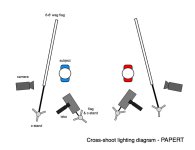
I shot a series called "Playing House" last year that required me to regularly cross-shoot scenes between two characters so they could improvise, and move very quickly on location, so rigging wasn't practical. I used the setup diagrammed below, where a wag flag (ultrabounce material wound onto an aluminum rod, rolled down to the desired length and mounted on a single c-stand) is positioned above a given actor and a source 4 leko is boxed onto the bounce, repeated on both sides. This gives a big soft source that wraps from the far side of the face and into the eyes, and it's very easy to make adjustments since everything is on the floor, i.e. if you want to eliminate some of the frontal fill, you just squeeze the shutter in on the leko.

cross-shoot.jpg

The main issue with that setup is that it requires a lot of gear in a small area: the stand for the wag, the leko and a bottomer (because Lekos always have a little spill from the lens regardless of shutter position, you need to protect the actor below the wag flag from getting raw light) and the camera.

My dream version of this would be a flexible LED array roughly 8' x 2' that can roll up to a tight diameter of 8" or so, with individual dimming control over three sections from left to right. This would of course eliminate the leko and associated hardware and provide even more delicate control over the balance of "key" and "fill" (in quotes because the sources are effectively continuous). However, I need the LED's to be properly diffused, which complicates the flexibility factor (required for storage).

The stopgap measure is to use two or three Litemat 4's on a menace arm or Matthews Max arm. This would give me the control and output required, plus the bonus of being able to add egg crates and angle in the far fixture. However it's a big bulky setup that takes a while to rig, and that starts to defeat the purpose.
 
Charles, I would totally get in line to buy that large flexible diffused LED array with indiv dimming control over 3 sections as well.... be handy in many situations. Let us know if it ever exists!! :happy:
 
The most versatile light is a 180 point source that can also be controlled be with reflectors, doors, and diffusion. A diffused light source can't be turned into a point source. That should make point-souce LEDs cheaper because more of them will sell. However, point-source LEDs have a heat issue. The 200w LED heat sinks are quite big and at some point, fans won't be enough. Manufacturers will have to go to more exotic technologies such as radiators ( as seen in gaming PCs). Just how far this can go.... we'll see.

LED lights started out with the 1x1's because that was the first technology available; and array of currently available single LEDs. They are not a point source and they stink as a diffused source. So the next step was the 50-200w LED arrays that are now coming out as point sources. The diffused remote phosphor panels have their place, but are not as versatile as the point-source LEDs now coming out. A 4x4 remote phosphor may not be practical in cost and handling, but a point source with a soft box is, even though it wastes lumens.

Point-source LEDs will continue to develop with better color rendition and versatility. The bi-colors were always a compromise in versatility vs lumens@color. The RGB LED point source makes the most sense in giving versatility while limiting the compromise of power/lumens at a given color.

The market will tell manufacturers what to build with their dollars. A quiet 200w LED is plenty for most of my applications, but of course, many of you out there need something on the order of a 500w or even a 1000w LED. Anything is possible. It's just a matter of what we are willing to put up with and what steps it will take to get to the next advancement. When they work out the kinks on 200, they will go to 500w and when they work out the kinks on that, then 1000w and so on.

Marvelous stuff.
 
Couldn't one just take a flexible LED panel and shape into a concave form where the beams will overlap at a given distance, thereby rendering it a quasi continuous source?

Theoretically putting light sources next to each other is essentially the same thing as diffusing. You are shortening the distances between many different light sources creating one larger light source, however, this would be very hard to pull off practically with a single flexible LED panel. Diodes would be facing different directions and would be at difference distances from each other. That being said, if you get a whole bunch of panels and put them next to each other and shoot wide, the distance between the diodes become less relevant since everything is far away distance to subject relative to distance between diodes becomes less significant. Her is an example of about 20'x1' non-diffused Aladdin bi-flexes to create a continuous (and horizontal diffused) light source to light a group of 10 guys:

003.JPG


In contrast, here is a single 1x1 Aladdin bi-flex close to the subject eye. Here you can see the separate LED diodes:

002.JPG
 
While the newer flexible LED assemblies are interesting, to me LED arrays are only useful when they can be diffused to where the individual elements blend into a continuous source. While one could directly attach the flexible panel to a very thick diffusion that would achieve this, a lot of intensity will be thrown away in the process. It's much more efficient output-wise to use a lighter diffusion with a prescribed distance inbetween, which starts to defeat the purpose of the flexibility. It will be interesting to see what technology will be required to create a blanket light that is thin, easily rolled or folded and yet delivers a smooth, continuous field of light.

I think it will be great to have multi-purpose light engines that can be configured into a variety of fixtures as a kit, so a single base element can be turned into a fresnel, leko, par or soft source. This can cut down the number of instruments required on a given job.

So maybe the blanket light will have so much output where it's bright enough even through very thick diffusion, that its output loss will be unimportant?

When you say multi-purpose light engines that can be configured differently (Fresnel, leko, par etc.), how does this cut down the number of instruments? i.e. we'd still need all the different configurations?
 
So maybe the blanket light will have so much output where it's bright enough even through very thick diffusion, that its output loss will be unimportant?

Maybe for some instances, but say you need to work in an environment with windows that can't be gelled, so you need all the oomph you can get. And it seems wasteful to lose 70% of the output of a light to diffusion, which would be likely the case with a thick enough diffusion that it would work when virtually adjacent to the LED's. I find the sweet spot to be something like 1.5 to 2.5" distance from the LED's for a given diffusion before the fixture becomes too thick. But maintaining this distance is not feasible with flexible panels, nor are accessories like eggcrates especially floppy ones like snapgrids.

When you say multi-purpose light engines that can be configured differently (Fresnel, leko, par etc.), how does this cut down the number of instruments? i.e. we'd still need all the different configurations?

Let's say a user typically carries a small lighting kit with a few soft sources and a backlight. If they were able to fit one more head that could variably have the control of a Leko (throwing a gobo pattern or a controlled shape without requiring flags), a Fresnel (clean hard light that can be easily cut to shape), a par (tight and powerful for throwing a lot of punch to recreate a sunsplash), an open face (again punchy and able to fill a bounce nicely)--you get the idea. Instead of investing in four different lights and having to add those to the kit, a single engine that has four attachments would be both cheaper and more space-efficient. We've had versions of this over the years, like the Joker lights that had multiple configurations.

In a larger scenario such as my typical lighting packages we have multiples of each kind of unit that add up to dozens of lights, but we may only use 1/4 to 1/3 of them on any given setup. So the above scenario could be even more effective, as we could cut down the number of heads significantly with multi-use units. One of the biggest issues I have trying to work in LED's is that the ones that have equivalents in the tungsten world (fresnels, Lekos, pars) tend to rent for a significant amount more than their counterparts so budgets rarely allow me to include them. This scenario could help things.
 
We are a pretty considerable distance from LED being able to compete on anything like the power level of HMI. We barely have LEDs of a few hundred watts. It'll happen, probably, but it'll be a pain to keep cool quietly.

My biggest concern are the outright lies being told by manufacturers - even quite reputable manufacturers, often - about the power capability of these things. It's now completely normal to claim a 10:1 efficiency benefit over tungsten, which is an absolute absurdity.

Perhaps we bring it on ourselves, though; how many people ever actually bother metering lighting these days, and therefore who's ever going to even notice?

P
 
Perhaps we bring it on ourselves, though; how many people ever actually bother metering lighting these days, and therefore who's ever going to even notice?
Pretty much everybody notices if they can't achieve the same f-stop, ISO, and shutter speed using the LED powered (marketing) equivalent of their previous tungsten lights. At the end of the day it boils down to whether or not the LED lights are bright enough for what one does. For me, Astras are bright enough for most interview situations.

If I need more light, I can double them up, get a brighter LED like a Skypanel, or use an HMI.
 
How much light does a camera like this really need?

If one is lighting from scratch, such as in a controlled environment like a studio or a night exterior, you can take advantage of the sensitivity of the newer cameras and work at high ISO's, which effectively stretch the output of LED's further. However if you are augmenting an existing ambient level in day interiors or exteriors, the output of your units is the same concern it always has been.
 
Too true.

Also I find a frequent need to overwhelm existing light, such that a less-than-ideal location can be "allowed to fall into blackness" in the way people always assume it will, but often find it doesn't.

P
 
If one is lighting from scratch, such as in a controlled environment like a studio or a night exterior, you can take advantage of the sensitivity of the newer cameras and work at high ISO's, which effectively stretch the output of LED's further. However if you are augmenting an existing ambient level in day interiors or exteriors, the output of your units is the same concern it always has been.
Which, I guess, makes the "windows" discussion a part of this thread too. What are the most hassle-free ways to contain the window light? Or, once you face very large sizes - and high numbers of them - you just have to fight it all the way through?

PS. I don't know if this is related but I wonder if anyone has seen Coppola's "live movie" experiment.
 
The simpler the technology the better as on the set stuff breaks - and breaks at the worst possible moment as we all know. So i don't see the simple thungsten lights going away any time soon.
 
The simpler the technology the better as on the set stuff breaks - and breaks at the worst possible moment as we all know. So i don't see the simple thungsten lights going away any time soon.

While I have found LED lights to be less reliable (two of mine died and had to be sent in for repair or replacement), most shoots have backup/spare lights should a light die, and unlike tungsten, LED lights don't have bulbs randomly die on a fairly often basis, which probably makes LED lights more reliable in terms of not dying randomly on set as often.

I've also had fires from tungsten lights delay production on one or two occasions.
 
Which, I guess, makes the "windows" discussion a part of this thread too. What are the most hassle-free ways to contain the window light? Or, once you face very large sizes - and high numbers of them - you just have to fight it all the way through.

Seems we are wandering off-topic a bit but briefly: once the windows become too large to gel and there are no shades or similar treatment available, you have to start from the desired exterior exposure and then determine what it will take to lift up the interior exposure. If you don't have firepower at your disposal, it helps to know how to extract the greatest dynamic range out of your camera and how to work with it in post.
 
Back
Top