light noob starting a no-budget feature- a few questions.

Roel,

There is no such thing as 'pretty light' or 'cinematic light'. Light is light. There is only light that feels right, and light that feels wrong. Cinematography cannot exist without a story. Photography can and does exist without a story. Take a still frame from a movie that you like - take something shot by Roger Deakins or Harris Savides or Lance Acord or Matty Libatique. Compare it to an Ikea catalog. It might look underexposed, flat, boring, ugly, etc. compared to the Ikea catalog. That is because the Ikea catalog's whole purpose is to show how great the furniture looks. Cinematography's purpose is completely different. It doesn't exist to make the subjects look great and the room and furniture look great. It exists to tell a story. Everything from your lens choice, the lighting, the camera movements, the film stock, the type of camera you are using, it should all strengthen and support the story and make it stronger. If it makes the story weaker.... that is where you have a problem. Imagine if Black Swan was lit using the traditional Hollywood method of backlight, fill, kicker? Read the American Cinematographer article on Black Swan and you will see that their approach was much different from traditional lighting methods. Imagine if it was shot on Millenium XL with Primo lenses on ultra crisp stock? I felt that Black Swan was very beautifully lit even though some people might regard some scenes as 'ugly' from the traditional standpoint.

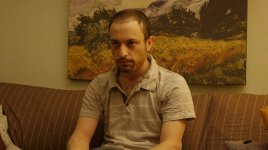
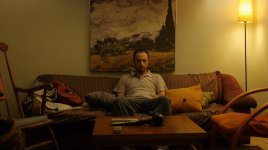
Roel, I have seen images like that in a lot of movies - the orange really warm glowing living room might be appropriate for some kind of party scene. Just make sure to hide anything that looks weird and unnatural like those cables on the top left corner. And also that shadow underneath the painting is kind of weird too. If the story calls for it, then the living should be fine the way it is lit now. Same with the kitchen.

I'd say: As long as the light looks natural, your camera has enough exposure, and it strengthens the story---go for it! Have fun!
 
For the Kitchen shots, top light with enough flat fill from behind the camera to soften the shadows from the top light.

Concerning your post on fill light.... j1clark, try reading this post by Roger Deakins.

http://www.deakinsonline.com/forum2/viewtopic.php?f=6&t=310

He says, "Fill light! I don't really understand using a light for fill. Try lighting without a 'fill' light as such. If you want something in the shadows try using a piece of poly. or a soft silver reflector."
 
Roel, I have seen images like that in a lot of movies - the orange really warm glowing living room might be appropriate for some kind of party scene. Just make sure to hide anything that looks weird and unnatural like those cables on the top left corner. And also that shadow underneath the painting is kind of weird too. If the story calls for it, then the living should be fine the way it is lit now. Same with the kitchen.

I'd say: As long as the light looks natural, your camera has enough exposure, and it strengthens the story---go for it! Have fun!

i think i get your point, thanks.
i am mainly concerned in 'nailing' the feel i captured more or less in the stills, while being able to keep the shot with enough light for using it with the DSLR codec limitations when underexposed (which means avoiding 1600 iso if possible, currently NOT possible in the living-room).
 
If I was to light that living room I would put a china ball on top of the practical lamp. Depending on how it looks, I would just use only the china ball use just that one light for the scene, and then i would fill in the shadows using a large white fabric like a bedsheet or just a couple 4ftx4ft foamcores. To me that would look natural and beautiful.

But you don't need to buy a china ball.

If you can spot the 800w (if it is a fresnel or other lens type fixture) Use the 800 (scrim down if necessary) and bounce in into muslin into the corner where the lamp is or on the ceiling above the lamp. Make sure that the practical lamp is not creating a shadow (that would be unnatural). Use a large white fabric to fill in the shadows. If it is an open face light then you will have problems focusing your light into the corner. The best like actually for this is the source 4 leko (that Lance Acord likes to use) because they come with these little cutter in the light and you can actually shape the light beam so that it fits into all corners of a bounce board or square fabric.

The problem with owning lights is that you almost feel forced to use them at all times, on every setup. But the truth is you are probably going to end up using a lot of different lights on each setup at all times, or perhaps none of your lights at all! It will be useful to have a couple china balls on hand at all times though - for those natural looking night interiors.
 
Concerning your post on fill light.... j1clark, try reading this post by Roger Deakins.

http://www.deakinsonline.com/forum2/viewtopic.php?f=6&t=310

He says, "Fill light! I don't really understand using a light for fill. Try lighting without a 'fill' light as such. If you want something in the shadows try using a piece of poly. or a soft silver reflector."

A 'fill' can come from a bounce board, or a set of lights. The main thing is to soften any 'moonscape' effect of a dominant light on the talent, all the while preserving 'depth' in the image.

In the Deakins article, he referenced "No Country for Old Men"(2007). He mentioned that he used the 'practicals' with some small amount of 'bounce' from additional lighting. He was using a ISO 500 stock,
and a nearly wide open lense of 2.0.

I personally don't have a lens that fast, and I'm just doing some tests on using ISO 400 with the GH-1 to see if 'noise' is a problem for me. So, with film's wider latitude, perhaps Deakins could stand to have
less light in the shadows, because it would still register on the film. Where as with the digital, and the GH-1 end of digital, that may be a problem relative too much contrast.

I don't think making the scene look like a TV sitcom/soap opera is the answer, but something to get the values up is in order. I'm not so much of a Pre-Raphelite as to want to eliminate any sense of chiaroscuro...
 
Last edited:
Concerning your post on fill light.... j1clark, try reading this post by Roger Deakins.

http://www.deakinsonline.com/forum2/viewtopic.php?f=6&t=310

He says, "Fill light! I don't really understand using a light for fill. Try lighting without a 'fill' light as such. If you want something in the shadows try using a piece of poly. or a soft silver reflector."

Why do you keep quoting all these DPs who are generally talking about very specific things? I doubt very much any of them would argue much with the general info being given in the thread. (And as Clark pointed out, Deakins isn't saying not to use fill -- that would be silly.)

It's true that seasoned pros break "the rules" a lot, but they know the rules, and know when and how to break them. They know how light works, moves, and behaves, and they know how to make it do what they want, because they know the basics. Throwing a bunch of those kinds of quotes at someone with no previous knowledge or experience, and saying, in effect, "do whatever you want, it's all good" will only be very, very confusing.
 
Let's say for instance that you dont' have a china ball and you must insist on lighting that scene with the 800w.

You need to gel the 800w so that it will have that orange saturated look.
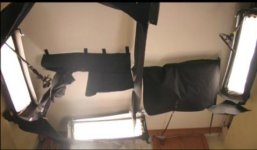
You can bounce off the ceiling and then skirt the ceiling like the image provided.

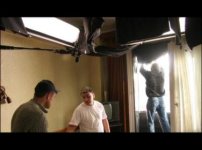
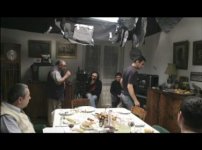
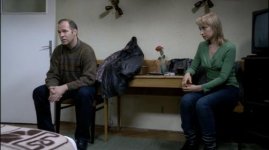
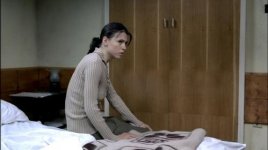
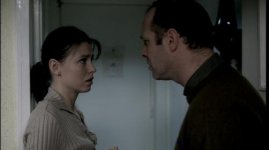
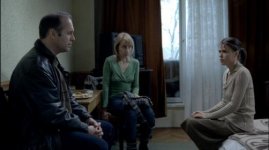
EDIT: Just wanted to note that the stills are from the 4 Months, 3 Weeks, 2 Days DVD from the actual film and from the behind the scenes.
 

Attachments

  • screenshot4.jpg
    screenshot4.jpg
    15.7 KB · Views: 0
  • screenshot5.jpg
    screenshot5.jpg
    14 KB · Views: 0
  • screenshot7.jpg
    screenshot7.jpg
    14.6 KB · Views: 0
  • screenshot2.jpg
    screenshot2.jpg
    16.6 KB · Views: 0
  • screenshot3.jpg
    screenshot3.jpg
    16.2 KB · Views: 0
  • screenshot8.jpg
    screenshot8.jpg
    11.6 KB · Views: 0
  • screenshot.jpg
    screenshot.jpg
    17.7 KB · Views: 0
Last edited:
@j - Yeah definitely. When I was just starting out studying lighting (heck I am still a student) I was trying to find ways to keep ALL the light off walls. But the photos of "4 Months" behind the scenes shows that even just a gradation of darkness to light is quite nice. See screenshot of man on left and woman on right - you can actually see where the duvetyne is cutting off the light. The gradation isn't that smooth but it's quite sharp - even if it's not that smooth it still looks nice. And looks a lot nicer than if it wasn't flagged off at all! Also I found it interesting to see how they laid out the duve on the ceiling. It's quite an art to it.
 
thanks once again..
i'll try to use the 800w as spot on the ceiling corner above the lamp. bit i'll probably have to dim it cause this lamp is about 40w..

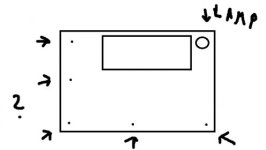
room sketch.jpg

edit: where should i place the 800w spot tripod ? and at what height?

*later today:

ok, this is the 800w spot test targeted on ceiling corner above lamp , placed diagonal to the lamp (opposite corner), about 2m height. camera WB set at 4200K.
the long shot is nice.. do i need to add an appropriate orange gel? also maybe cut the spot even smaller?
problem: this is 800 iso, (2.8- 5.6), and a lot of noise and maybe mud in the dark areas.
spot 800w B test 1.jpgspot 800w test 1.jpg
 
Last edited:
thanks once again..
ok, this is the 800w spot test targeted on ceiling corner above lamp , placed diagonal to the lamp (opposite corner), about 2m height. camera WB set at 4200K.
the long shot is nice.. do i need to add an appropriate orange gel? also maybe cut the spot even smaller?
problem: this is 800 iso, (2.8- 5.6), and a lot of noise and maybe mud in the dark areas.
View attachment 31675View attachment 31676

Your light position and light height look good.

The long shot does look nice and natural. As far as the ratio in the frame, I like it a lot. I like your ratio of the bright areas to the shadow areas. It's all about balance.

The closer shot needs some attention. Because it's a much closer shot, you are able to bring in a lot more equipment closer to the subject. The closer shot looks kind of brighter than the long shot. You want your brightness levels to be as consistent as possible. If you want to film from this angle, then you will need some darker shadow areas (if that's what you are going for). You can achieve darker shadows by placing a black flag/duvetyne/black blanket, etc just out of frame (just out of frame left)- this will deepen you shadows. Also I would place a flag between the subject and the lit corner so that you can darken some of the background (darken only the background and let the light hit the subject as it was before)

If you want to change the closeup angle more, then it might be look better. I prefer to shoot with the main light (in this case the 800 spot on the corner) is lighting the far side of the actor's face. So basically the side of the face that is facing away from camera is where the main light hits. And the side of the face that is closer to camera can be more shadowy. I like the look of this more than near side key, which is how you have it now. However, with some more darker shadow areas, you can make that same closeup that you shot look nice.

You don't need an orange gel. You can modify the look of the color by adjusting your white balance in camera. Because you did camera WB to 4200K, it's pretty much like you stuck a 1/4 CTO gel already on the light.

if you want to shoot at higher iso then you have to try and find different ways to make your room brighter. You can try walking your light in closer. Also you can take your lamp from spot closer to flood (make the light beam wider) the wider your beam gets, the brighter your room will get.

The main technical obstacle you have to get through is your lens. It's had to shoot with variable aperture lenses because the f-stop changes as your zoom in. I prefer to shoot with primes because they are usually faster and have consistent aperture but you gotta work with what you can get. In interior lamp motivated sequences I usually find myself shooting at around T2.0, which is a stop brighter than what you are shooting with, which would most likely allow you to shoot at a much lower ISO (giving you an extra stop would alow you to shoot at approximately 400 ISO). Whereas if you had T1.3 or T1.4 lenses then you could shoot that scene above with around 200 ISO.

But thing is, it is more fun working with what you have (and cheaper too) - it's fun challenging yourself. Also make sure you are shooting wide open (at an f2.8) because you need as much light entering the lens as possible.
 
@ noel - disregard my talk of near side and far side in the above post. It's a bunch of mumbo jumbo. The best kind of light is the light that is right for your story.
 
Last edited:
thanks so much for your detailed input Ronald.

of course i use only primes, most of the time limited to 2.8 fastest.

but the main problem, as this is not film, is how much i can underexpose in a shot like this, to try avoiding any codec limitations (the lower sofa area).
the tricky part is -
i have to overexpose and blow some highlights inside the lamp for a proper exposure.. but how much should i blow?

the CU shot was darker because the lamp is not in frame. i have to adjust it more properly.
 
What I like to do is I like to put a dimmer on the lamp and you pick the fstop and iso you want and then dim the practical to exactly where you want it.

The reason why you are seeing so much noise is because of your ISO. If you brighten up 800w light in the corner then you might be able to lower your iso, thus reducing the noise. Of course, once you bring up the 800w light in the corner some parts of the room will get brighter while your shadows will still remain the same (because no light is hitting the shadows). So then you can put up a bedsheet (near the left side of the room) and angle it so that it fills in some of the shadow areas. Make the shadow areas however bright you want them.

thanks so much for your detailed input Ronald.

of course i use only primes, most of the time limited to 2.8 fastest.

but the main problem, as this is not film, is how much i can underexpose in a shot like this, to try avoiding any codec limitations (the lower sofa area).
the tricky part is -
i have to overexpose and blow some highlights inside the lamp for a proper exposure.. but how much should i blow?

the CU shot was darker because the lamp is not in frame. i have to adjust it more properly.
 
the CU shot was darker because the lamp is not in frame. i have to adjust it more properly.

Actually the CU shot looked a lot brighter to me than the wide shot. It looks like you probably opened up the iris on the lens a little bit for the CU. If you are not changing any of the lights and you are keeping the lighting the same (same light positions), then I wouldn't change anything in the camera (fstop, iso, etc). But let's say if you wanted to add flags, change the posiition of the light, etc, then you might want to tweak with the camera settings like fstop to get it the brightness to where you want it.
 
And also Roel. I want to tell you this because I went through the exact same situation before, where I was so overly concerned about noise that I couldn't think about anything else.

I now prefer a noisy natural looking well lit image rather than a perfectly clean poorly lit unnatural looking image. That's just my opinion.

If you have to choose between a noisy image and an image that looks unnatural, I would choose the noisy natural looking footage.
 
the truth is i am less concerned about actual natural noise. in fact i like it.
it's the codec mud in the dark, less detailed areas i'm worried about.
 
Back
Top