Komodo is Officially On Sale

Was thinking about contrast and the appearance of "sharpness", so I took a screen shot from some Komodo footage on YouTube, one that had a little bit of a hard edge look to it, but otherwise good lighting on a person with generally good skin.

I don't know that is worth trying to fix the lighting in post, but this is less about the grade and more about how contrast and light film grain can improve the smoothness of skin. These are from the same screen shot, one had a little contrast added, and the other had the midtone contrast altered towards smooth. However both maintain similar exposure and have similar black points, I hope. All adjustments were made with contrast curves, saturation/hue, and film grain, there was nothing else used. No power windows, and no blur or noise reduction or anything like that. .

Top image is a little more similar to the original image. The lower one is the one I effected:
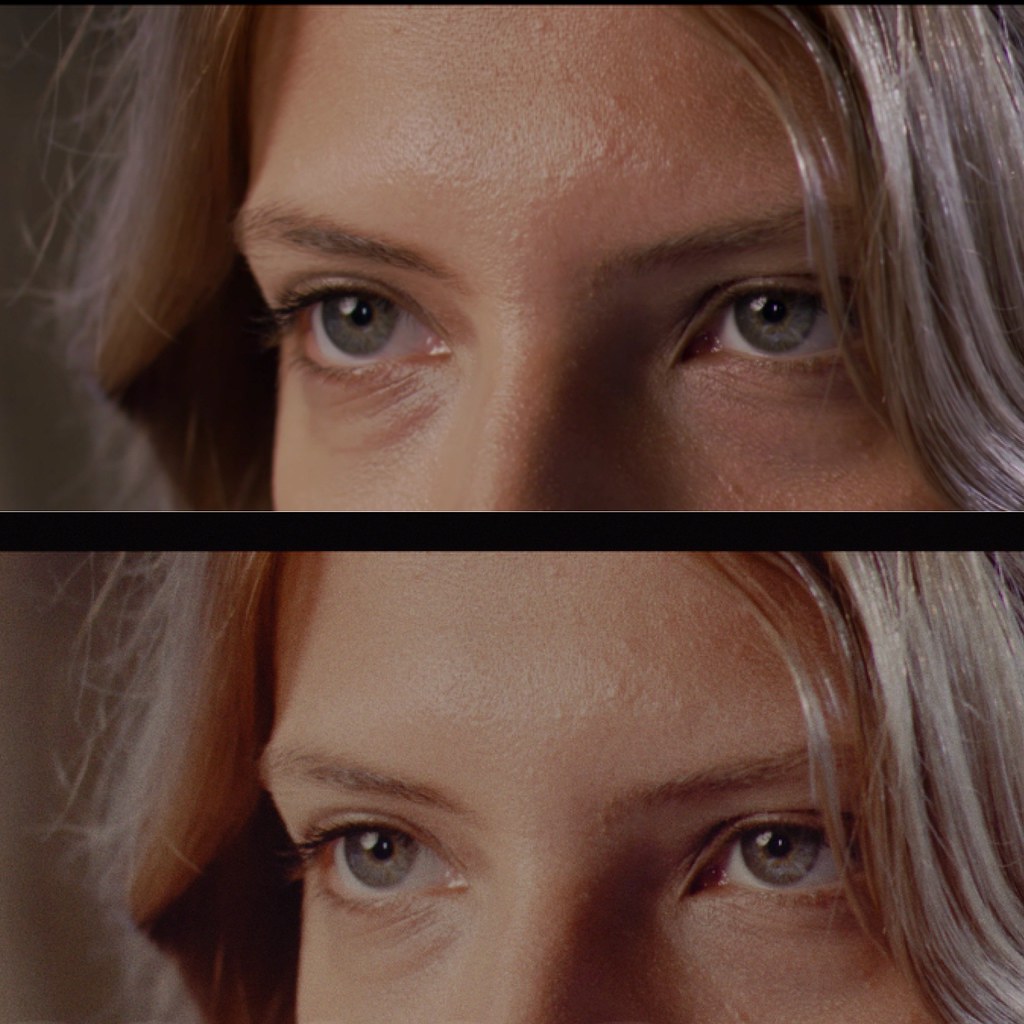
50658874953_155fbc161a_b.jpg


Only problem, is to get the midtones like that, the camera has to have a bit more DR, otherwise going to clipping is awkward. Or have to dig into the shadows and possibly chroma noise, which also kind of changes the exposure. But ETTL can help, just doesn't always provide the best exposure.

Lower DR cameras always have somewhat compromised or "video" midtones, or ugly highlights. Shoot within the DR of the camera and all is good. A lower DR camera with a soft highlight roll off is stealing contrast from somewhere.

Anyway, this was just a technical exercise, and isn't so much about what looks better. Just how midtone contrast effects "sharpness" and looking too revealing. These were screenshot from a 1080p YouTube video.


EDIT - just want to reiterate, this is not a grading tutorial, but simply showing how the blunt use of contrast and noise can smooth out roughness, sharpness, ...or... add sharpness and roughness, and texture. There are many more specialized tools for grading that can be utilized to get good results, and my example image above is not to showcase grading technique specific to Davinci Resolve or any other program. It is purely an exercise to highlight the effect of contrast on the appearance of texture and sharpness.
 
Last edited:
Anyways, will be cool to see how people use the Komodo. Already some incredible things like FPV drone shots etc, and a lot of good stuff. And to be honest, Jason Momoa shot some of the best looking Komodo footage so far.
 
Here we are seeing, that the Fx6 and C300III (and therefor perhaps the Canon C70) are keeping up with the Komodo in DR, and not far behind in colour.
-4 stops (under exposed)
View attachment 141452
+4 stops (over exposed)
View attachment 141453
https://www.youtube.com/watch?v=6Z-xB5dnIfk

From this test, it could be argued that the Fx6 and C70 have more dynamic range than the Komodo.... and that means they are up there with the Dragon and Helium as well.

Of course, the web streaming hides a lot of the nuance in cameras, so it may be that there is more going on there, and to me it shows that the Komodo is at least doing really well where it matters most to cinema shooters. ...But it isn't the giant gap in image quality that gave Red its reputation back in the day.

So, Red has to tighten up their over all quality to stay relevant in the High end, especially with Sony now being a serious contender. And Red has no lower end to go to, because as of 2020, the low end is starting to look very good and very competitive. Is that nebulas owner op, music video world big enough? It might be. They better hurry up before Chinese cameras catch up.

I wouldn't read too much into those tests, as half of the cameras haven't been exposed correctly. Both the Canon and the Komodo appear to be pretty much a full stop underexposed (according to 18% grey on that colour chart). So you need to give the Canon and the Red both a stop less in the highlights, and a stop more in the shadows, than the Sony's are showing at each comparison point.
 
I wouldn't read too much into those tests, as half of the cameras haven't been exposed correctly. Both the Canon and the Komodo appear to be pretty much a full stop underexposed (according to 18% grey on that colour chart). So you need to give the Canon and the Red both a stop less in the highlights, and a stop more in the shadows, than the Sony's are showing at each comparison point.

Interesting. Which chart of the cameras is showing a stop difference in exposure? I'm seeing them as fairly similar.

8A05D9B8-A724-43FB-93E1-DE402D4C9E94.jpg


On the recovered frames, things are likely to get wonky, as there is no certainty what standards they are using to pull back the exposure. So, I wouldn't look at the charts too hard on the 4 or 5 stops under over, except to see noise and colour shift.
 
Yeah, I like the bottom one more. Less harsh, and I guess I still like a little film grain ;)
Appreciate you saying that! I wasn't going for the best grad in the world (with an YouTube screenshot), but I wasn't going for the worst grade either. =)

Reducing shine on a forehead with curves is not the most natural looking grade, hence the crop. Digital cameras tend to have a steep angle in contrast, and that can generally be seen in the shadows under the eyes and possibly brow, depending on the bone structure. One of the things a liked about the F35, was that I didn't really have to adjust that aspect of its tone curve. Just had it right out the gate. Alexa does too. Red has improved with its contrast and roll off settings, but those sill feel a little generic and not as purpose built.
 
EDIT: Ignore all this below, youtube's shading of the frame when paused has skewed the results (debunk posted below)


Interesting. Which chart of the cameras is showing a stop difference in exposure? I'm seeing them as fairly similar.

On the recovered frames, things are likely to get wonky, as there is no certainty what standards they are using to pull back the exposure. So, I wouldn't look at the charts too hard on the 4 or 5 stops under over, except to see noise and colour shift.

The neutral (0 EV) examples are the only ones it makes sense to measure. I used the 0 EV overexposure frame as the higher contrast with the background makes things easier to judge.

If we drop Davinci's new False Colour tool on top of the frame we get this:

False Colour 0 EV_1.8.2.jpg

Middle grey on the Sonys is coming in pretty much spot on at 50 IRE (both have their 18% grey chip sitting at the top edge of pink). And middle grey on the Canon is sitting just inside the green, with Komodo just underneath it (with green being a stop under pink).

If we factor in correct exposures across all four cameras (for the sake of comparison), I think the ultimate conclusion is basically just that they're all VERY similar in overall dynamic range. With the only real standout being the C300iii's incredible handling of underexposure (thanks to it's DGO sensor).
 
Last edited:
The neutral (0 EV) examples are the only ones it makes sense to measure. I used the 0 EV overexposure frame as the higher contrast with the background makes things easier to judge.

If we drop Davinci's new False Colour tool on top of the frame we get this:

View attachment 141498

Middle grey on the Sonys is coming in pretty much spot on at 50 IRE (both have their 18% grey chip sitting at the top edge of pink). And middle grey on the Canon is sitting just inside the green, with Komodo just underneath it (with green being a stop under pink).

If we factor in correct exposures across all four cameras (for the sake of comparison), I think the ultimate conclusion is basically just that they're all VERY similar in overall dynamic range. With the only real standout being the C300iii's incredible handling of underexposure (thanks to it's DGO sensor).
Appreciate the follow up.
Yeah, we're on the same page.

Don't worry, my comment about the Red's highlights was not a slight on the Sony, it was only to point out that the Komodo might not be that far behind the Fx6 in DR. (remains to be seen how well the Komodo noise cleans up).
 
The neutral (0 EV) examples are the only ones it makes sense to measure. I used the 0 EV overexposure frame as the higher contrast with the background makes things easier to judge.

If we drop Davinci's new False Colour tool on top of the frame we get this:

View attachment 141498

Middle grey on the Sonys is coming in pretty much spot on at 50 IRE (both have their 18% grey chip sitting at the top edge of pink). And middle grey on the Canon is sitting just inside the green, with Komodo just underneath it (with green being a stop under pink).

If we factor in correct exposures across all four cameras (for the sake of comparison), I think the ultimate conclusion is basically just that they're all VERY similar in overall dynamic range. With the only real standout being the C300iii's incredible handling of underexposure (thanks to it's DGO sensor).

Keep in mind that if you're grabbing a screenshot while paused, YouTube adds a grey gradient on the bottom portion of the frame.

With scrub bar and gradient:
YN9QWdZ.jpg


Without scrub bar and gradient:
aXldFUC.jpg


Komodo is still under by bit but the C300 matches up damn near perfectly now.

Grey chips isolated against 50% grey:
fmw4oAX.jpg


Scopes of isolated chips:
ZKHkOzH.jpg
 
Keep in mind that if you're grabbing a screenshot while paused, YouTube adds a grey gradient on the bottom portion of the frame.

Gosh, I hate that dimming on almost every streaming player in existence. I pause shots a lot to analyze composition and imaging, but that darkening at pause pops up everytime!


I am noticing Grug cropped off the lower portion of his screen shot, so it is possible he grabbed a paused image. Mine were not paused. But at the end of the day, Grug is not wrong, we can't read too much into images and tests from YouTube. I know a friend with a Komodo that loves the image... but once it is uploaded to YouTube, it loses all that lush quality.

.... which goes back to my original point, if we are all uploading to streaming, how different are all these cameras anymore? So, they should be looked at from a function standpoint, and less of an image quality standpoint these days. Gemini, Venice, Monstro, and our fair child Arri all are noticeably better image quality, but Komodo, Fx6, C70 are all looking really close. Getting a Komodo makes sense for me, because I have high frame rate options with the Gemini, and usable sensitivity for low light scenes (the drop in DR in LL mode still puts the Gemini and Venice in the Komodo Fx6 neighborhood of DR). -- sorry, I am meandering....

The good thing, is if no cameras are going to break the Arri Alexa DR ceiling, and they're all just huddling around that 13stops DR. Then we can choose cameras more based on Colour science and Functionality. -- don't know why I capitalized those words.

Getting 10bit log internal on the Sony and Canon is amazing. They're features are amazing! I think they make a better A-cam than the Komodo. Mainly because everything gets compressed to hell on the web, so the things like internal ND and better ISO performance, and so on and so forth feel like those cameras would "get more keepers" than the Komodo alone.

However, for me, I'd almost definitely get a Komodo. But I see it as an auxiliary camera for unique shots and angles. Maybe a bcam, if I ever get into Multicam work. ( I hope never, but understand the economics of it all).


---I started emailing in-between all of this and don't have the faintest clue what I was getting at.... posting anyway.
 
Keep in mind that if you're grabbing a screenshot while paused, YouTube adds a grey gradient on the bottom portion of the frame.

Good catch! I'm pretty sure I'd have grabbed each of my frames from paused footage. So that'll definitely be skewing the results. :/

So everyone please ignore the measurements I got!

That said, even without the skewed results, I think the basic conclusion remains the same - these cameras are all so close in overall DR as to make very little appreciable difference in anyone's day-to-day (with the possible exception of the Canon's crazy clean shadows). So feature-sets, ergonomics, and (more-importantly) client demand should really lead the decision making process.

I'm just s*%tty that not a single one of them offers a locking lens mount, an integrated v-mount plate (with accessory power distribution), internal NDs and 2-3 SDI output ports all in a single neat package. We had all of this with the F5/F55 eight years ago! They're all missing at least one really important feature that I want.
 
So feature-sets, ergonomics, and (more-importantly) client demand should really lead the decision making process.
As for me, the GS of Komodo is that "mojo" which is missng by each of the other competitors. You can add a matte box for ND's or increase your lighting setup for a lowlight scenes, but you can't do anything with a rollig shutter jello. In terms of ergonomics they are pretty close with their advantages and disadvantages.


However, for me, I'd almost definitely get a Komodo.

It was very, very interesting to watch the evolution of your opinion from disappointment of the Komodo to purchasing decision:)
 
It was very, very interesting to watch the evolution of your opinion from disappointment of the Komodo to purchasing decision:)

If that is how you want to read it.


I am saying RED needs to up their game going forward. They are a little less refined then their competitors, and while they have nice sensors and raw, that is not enough anymore (for the premium).


I still don't really care for the Komodo image. Has a weird look, though still qualifies as a "good" image. That doesn't matter so much for Red, as it is raw, and post is where the final look is dialed in. For the size and weight, and the somewhat similar colour science to the DSMC2 line, it is the obvious choice for someone in my position. I already have an A-cam, so there is no point in me getting a C70 or Fx6 and take a small step down in image quality.


Fx6 and C70 are still overall better A-cams than Komodo, in my opinion. But the Komodo is on par with them for core features, and in some ways better (ie internal raw keeps the thing super compact, GS, etc). And of course, GS in that form factor is pretty much unique.
 
Last edited:
As for me, the GS of Komodo is that "mojo" which is missng by each of the other competitors. You can add a matte box for ND's or increase your lighting setup for a lowlight scenes, but you can't do anything with a rollig shutter jello. In terms of ergonomics they are pretty close with their advantages and disadvantages.


It was very, very interesting to watch the evolution of your opinion from disappointment of the Komodo to purchasing decision:)

If that is how you want to read it.


I am saying RED needs to up their game going forward. They are a little less refined then their competitors, and while they have nice sensors and raw, that is not enough anymore (for the premium).


I still don't really care for the Komodo image. Has a weird look, though still qualifies as a "good" image. That doesn't matter so much for Red, as it is raw, and post is where the final look is dialed in. For the size and weight, and the somewhat similar colour science to the DSMC2 line, it is the obvious choice for someone in my position. I already have an A-cam, so there is no point in me getting a C70 or Fx6 and take a small step down in image quality.


Fx6 and C70 are still overall better A-cams than Komodo, in my opinion. But the Komodo is on par with them for core features, and in some ways better (ie internal raw keeps the thing super compact, GS, etc). And of course, GS in that form factor is pretty much unique.

I'm a global shutter guy. I "grew-up" with 3-chip CCD broadcast cameras and there was no such thing as "rolling shutter" or "global shutter", because our cameras were all "global shutter". We didn't know any different. And I've been on the record for years saying I prefer "global shutter", especially since I shoot a lot of sports and am around strobes/flashes/still photogs a LOT. But with all of that being said, outside the times a global shutter really comes in handy(fast movement. flashes, etc.), I can't say that the global shutter gives the Komodo a certain "mojo" . And as a matter of fact, outside of a few examples, a large portion of what I've seen since the camera entered full production is un-inspiring and you could pick almost any posted example of work done on it and told me it was shot on an Fs7 or any other generic video camera, and I'd believe it.
 
It was very, very interesting


A lot of my talk in regards to camera purchases are hypothetical until the pandemic is sorted out.

In my current set up the Komodo compliments my DSMC2, offering similar image quality, tiny form factor for a raw recording s35 camera, improved battery life, and global shutter.


If I were buying new, starting out, or just doing solo work, I would likely go Canon C70.


If the people I work with all had Sony's, or I was plugging into a work network that had previously used Fs7, I'd likely go Fx6+A7s3.


But those are hypotheticals based on features and the quality of the uploaded videos to YouTube. Which is a good indicator of what kind of end image quality can be expect, but until one actually gets to use a camera, all bets are off.

2020 is the first year I would be fine with just about any "cinematic" camera released.
 
I'm a global shutter guy. I "grew-up" with 3-chip CCD broadcast cameras and there was no such thing as "rolling shutter" or "global shutter", because our cameras were all "global shutter". We didn't know any different. And I've been on the record for years saying I prefer "global shutter", especially since I shoot a lot of sports and am around strobes/flashes/still photogs a LOT. But with all of that being said, outside the times a global shutter really comes in handy(fast movement. flashes, etc.), I can't say that the global shutter gives the Komodo a certain "mojo" . And as a matter of fact, outside of a few examples, a large portion of what I've seen since the camera entered full production is un-inspiring and you could pick almost any posted example of work done on it and told me it was shot on an Fs7 or any other generic video camera, and I'd believe it.
+1
 
Fx6 and C70 are still overall better A-cams than Komodo, in my opinion.

Respecting your opinion, James, but cannot agree there. The image from both camcoders (FX6&C70) looks better than from the DSLR's, but still flat and narrow to my eyes. And I haven't seen any cinematic footage for them all, any single frame from them that would impress me. In other way, lots of strong stuff from Komodo which performs well even in comparison with the Alexa Mini
(not the best test, but you'll see everything with your experienced eye)

I never liked REDs and their redcode, but Komodo is the second their camera which imressed me after the Gemini. I'm on the way of getting it.
 
Last edited:
ha...it always made the most sense.

The whole B-cam, action thing just isn't best for business.

It’s physical build and design is still very much more suited to action cam, but they’ve totally gone all in on the baby A-cam marketing. Haha
 
Back
Top