Key & Peele - Behind the Scenes with DP Charles Papert

The F55s will be a little better at higher EI than the Alexa then? and no extra work matching. Cool. I'm getting to see more guys using the F55 with really good results. Would you diffuse them? I have a friend who created a really rich look with Glimmer Glass (and a smokin' grade) on an f55.

Now I see how it works with the 10 possible angles. It's pretty nice how you got those "french overs" without gettting into that fill.

I'll be looking forward to seeing that BTS video on the lighting setup with the iPad, if you guys get around to it. I'm really enjoying the show.
 
Yeah, I don't like to go above 1280 on the Alexa because the noise starts to really show up. I'd be comfortable with the F55 up to 2500-3200. The major drawback right now is the codec, because our editors cut in ProRes and the transcode time on 5 cameras rolling for hours and hours wouldn't be feasible. I'm hoping the announced ProRes option for the F55 will be implemented by the time we shoot the next set of wraparounds in January. As I start to use the F55 more it would be good to start looking at diffusion. I just shot with the C300 and used a 1/2 Classic Soft and liked the results. Grading is key also--fortunately for me, Nate Weaver is a buddy and he's been methodically tearing into the color science of the F55 for a year, so I consult with him on these matters. I did a little music video last year that needed a noticeably diffuse look and ended up having to do a lot of it post to augment what I did on set. It really is a "sharp" camera!
 
Oh, hi.

So, here's a clip from next week's show.


I'm using this one to illustrate the collaborative path of the filmmaking process, as this sketch went through a few visual reinventions along the way.

On Key & Peele we have certain sketches that are written simpler than others, and we take advantage of those by shooting them in a basic fashion to either gain more time for performance takes, or to stack some extra shooting time for when we might need it. When it comes to all things budgetary, time is a major piece of currency, and if we can wrap a given day early it earns us the opportunity go over on another day. So, for a script such as this one where it's mostly about two people talking across a desk, the director and I discussed stripped-down coverage "on a line", meaning everything fits into the two opposing sides of coverage, with Urkel arriving in the background of Reginald's side. Lighting-wise, since it was set during the day and we weren't going to see windows, I planned a large soft source to the side of the desk which would put both into indirect side light and allow for simultaneous cross-covering if we chose to go that route (we regularly do).

However, once I re-read the script I started to feel like the darkness of the material would be better served with a more sinister look. I suggested we switch it to night and the director agreed. I keyed with a small Chimera with LCD grid set low and to the side, no fill, and a strip light on menace arm above and behind each actor to suggest low level fluorescent. Two dedos on a goalpost picked out the posters and trophies behind the executive, and daylight-balanced LED's taped to the back of the glass shelves on the other side added a dated, pretentious look.

Where it gets interesting is the process of lighting the Urkel character. Once I started to envision the night version of the scene, I planned to uplight him to make him look more creepy. I remembered these wave machines that were period appropriate and asked our production designer if he would be down to place one on the side table to the right of the door. He loved the idea. My plan was to push light through it to as a glow, then put a small unit gelled to match on the floor below frame pointed towards the door, so that when Urkel walked in he'd come into an eerie blue uplight. Sadly, the art department couldn't locate a wave unit to rent from the prop houses and they are surprisingly expensive on eBay, so that idea went away (and thus I shifted the blue glow to the shelves). I decided not to be so literal and went ahead with the uplight sans gel, plus a screaming downlight suggesting an overhead can in the hallway so that we first see Urkel in silhouette before he steps into the creepy uplight.

That was the plan, anyway. We ran through the front half of the scene for a bunch of takes before we got to the Urkel entrance. After the first Urkel take the director told me he didn't love the uplight. These things happen (and due to great communication between us, quite infrequently on our show), so no big deal...but now I was stuck trying to figure out how to place light on the actor without it hitting the walls behind him, because that would create a continuity issue with everything we had shot up to that point. The shadow from the uplight hit the wall above the camera frame, so no problem there, but any instrument higher than that would start to splatter on the walls. Clock ticking...think, Papert, think!

After staring forlornly at a solid mass of wall and closed door for a minute (and wishing we could invent lights that fell off immediately after they hit the actor), it occurred to me that the door that would actually play open after the Urkel entrance. Aha! I reasoned that we could set up a Dedo with the edges trimmed to within the doorjamb (so no leak on the walls to either side), and Urkel's shadow would fall behind him on the ground. I tried to quickly lob it in on a stand but that ended up in the shot, so we had to stop the presses, bring in a ladder and rig it from the ceiling. You can be sure that with the AD's eagle eye on me, I supervised the placement of the spud down to the inch to ensure that we'd get it perfect the first time! I kept it as steep as I could to make it less flat on his face, but I can't say I love the results--it's a touch theatrical and not as modeled as I'd like. Perhaps that adds to the weirdness. My plan was to put it on a dimmer, start the scene with it dimmed off to maintain continuity with the earlier takes, then cue it up once Urkel entered. On my little mental list of complaints/wish list I had already been feeling like I wanted a tiny bit of separation between Reginald and the door, so I realized this was a bonus opportunity; instead of starting it completely off, we set the first level just enough to read texture in the door, a subtle enough difference to avoid jumps in the edit but worthwhile sweetening for subsequent takes. Nice!

The moral of this typically long-winded tale is that while you can plan your ass off in prep, often it comes down to dancing on your feet on the day (or in this case, on the minute). Which is kind of part of the fun.

One little in-joke from the art department: the poster that gets hit with blood is for a show called "Life with Sappy" and the tagline "He's the best boy in town!" Sappy is the nickname of our best boy grip. Needless to say, he was psyched.
 
Last edited:
Great post. Thanks for the insight! Sounds like you and the director have a good rapport.

I know it's too late, but there are blue lava lamps which could also be used to cast an eerie glow and are period-appropriate.
 
We discussed those. The classic lava lamp was more associated with the psychedelic era and would seem out of place in a network executive's office in the 90's. The lava wave machines came along later, were popular in the 80's and early 90's, seemed more period appropriate.
 
I see. How about this? Plasma sphere. I had one in the 80's! Just throwing out ideas for next time.


Anyway, very cool to see the detailed thought process. Those K&P sketches are hilarious and well-done.
 
Thanks again for your insight, Charles. I love the large source with no fill. It really is a dark piece and the shadows on that fall off on the shadow side really sell it. Urkel's entrance looks great too. That reverse is right in there. When you have to make an adjustment like the one you got from the director, do you clear the set again for G&E? I guess it depends on the extent of the change, right?

I'm on a set this week where these adjustments are made with actors on the set and it seems like it would be better sometimes to just give the set back. You don't want to hold up shooting but I notice when grips and gaffers are put under the gun like that that, in a hurry, they can sometimes take more time and risk unsafe conditions. It's a tough call. How do you handle that sort of thing?
 
lniles:

You are right about the plasma sphere! I had forgotten about those.

hscully:

In an instance like that one, where it wasn't just the head but the cable that had to be run off the set via the ceiling, I did have that half of the set cleared via the 1st AD. Since it was at the behest of the director (who is also a co-exec producer), I told him what we needed to do and how long it would take, he considered it and gave it the go-ahead. I ask for it when it's a safety issue, or the congestion on the set will slow down the process significantly, but it does depend on whether it's something critical or simply an improvement I want to make on my end. Over the course of the show I've put a lot of energy in trying to improve and speed up the lighting process, and we have some cool tricks now, like having most of the instruments on the iPad based dimmer system that I've mentioned before. We are able to tweak levels during the first "take", which is really a rehearsal that we always roll on, without having to sneak electricians onto the set to play with local dimmers.
 
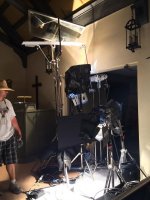
This was a weird looking setup!

lights.jpg

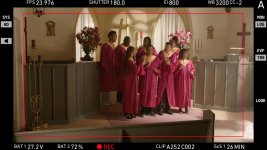
And it was used to light this:

http://www.comedycentral.com.au/key-and-peele/videos/key-peele-415-clips#key-and-peele-415-act-1

gospel.jpg


I was looking to give the chapel a sun-kissed morning or late afternoon vibe, as if sun was pushing steeply through a window and splashing the floor. Two 2K open face (blondes) into bleached muslin on the floor created the overall key, with a gelled M18 making a hard sun rake from the side on the bodies and visible on the floor. I used a 4x4 mirror to make it possible to cut and shape the head (it was just outside the frame, so having the actual head in place would have a) been to close to the wall which was a heat issue and b) the cutters would have had to be extended out into the set). A Source 4 leko with gobo made the pattern for the back wall. A couple of 4x4 flo's added a bit of higher fill. That was the primary lighting for the room, and it was all compacted into a 6x6 piece of real estate as pictured. The only other lights burning were two lekos backlighting the curtains behind the singers, and a 4x2 flo on the left side that was edging the pews (mostly for another setup). It was a cluster*** fitting everything into that hole but we shot most of the piece under that lighting without needing to reset, so it was efficient.
 
Last edited:
Great work! Thanks for the info. For me it's always a hassle getting the lights to fit in the space given, and I use much less than you.

Do you mind that the light stand shadows are showing on the podium, or do you do something in post to hide that? I think most people wouldn't notice. Would you ever add smoke/dust to try and get some light shafts going?
 
Good questions Lowell!

As far as the shadows on the podium, I will often break up swaths of light intended to represent window light with charley bars (there is one on the floor, mostly hidden in that particular angle) anyway, so I like where that one fell. It's actually the crossbar of the 4x4 mirror. You can see c-stand knuckles on the panel just out of frame right--but hey, out of frame is out of frame so I didn't sweat that.

There is atmosphere (smoke) in that shot, it's fairly light. The shaft from the M18 would have taken a lot more smoke to show up and that gets to be a pain in the ass, as wide shots and telephoto shots have very different densities and it's tough to maintain. I went for more of that look in this one: Dad's Hollywood Secret.

Every sketch has it's own vibe, I try to shake up the tree and experiment with different looks each time. Sometimes it's more interesting to go against the expected and stretch out a little bit.
 
By the way, that is obviously a grab from the camera original--has a basic LUT applied but not final color of course. I'll likely do some windowing in color correction, open up the left side a little bit, slow down the bottom right corner etc.
 
Latest:


The director and I watched the rain football scene from "Any Given Sunday" for reference on this one. Other than adding visual interest, the rain helped obscure the fact that the stands were, in fact, completely empty. I used the existing stadium lights in the backlit direction (turned the ones behind camera off) and color balanced our units to match (some flavor of CTB and plus green that I can't remember). Side keyed with two T12's from 15 yards away. I added a series of par cans in pairs in the stands which provided visual interest, some flaring and continued to help hide the empty stands.

The fun part is that the whole thing was cheated in a single direction, in an approximate cone of perhaps 45 degrees. We set the rain towers just out of shot and placed all of the action in that cone. For the play at the beginning I figured that the edit and the handheld footage would be aggressive enough that the directionality of the light wouldn't matter, and in fact the only relight I made all night was when we supposed to be shooting the opposite side of the huddle from the injured character. In that instance, since we were still shooting the same direction and rotated the actors, I turned off the T12's and recreated their effect with a 2K blonde through a diffusion frame from the other direction. I was able to get away with a much smaller unit because I didn't need to cover the width and travel of the original play and the actors weren't moving around. Tragically simple!

Camera-wise, most of it is true handheld with some long lens stuff on our "bobble heads". The cameras wore Sprayoff micro spray deflectors, which are fantastic units that slide into a standard 4x5 matte box (so much less bulky than traditional versions) and were obviously swathed in plastic bags. Not a comfortable night for the cast and crew that had to be pelted with rain for hours on end, but ultimately worth it. Very pleased with how this one came out. I think the sound design is fantastic also.
 
Charles, just wanted to thank you for posting up all this interesting BTS info on your shoots. I've always enjoyed those videos and been impressed with the production quality, so your posting this variety of info is a great read to me - and probably many other peopl as well. Thanks again!!
 
That football one is glorious! Well done.

Someone just showed me 'Gay Wedding Advice' (which was hilarious) but I was particularly struck by your lighting on the boys:

6wAg1pf.jpg


I'd love to hear how you set this one up - it's a beautiful glossy look.
 
Yeah that one--well hmmm. I don't consider that piece to be a personal triumph, to be honest. We shot it on a sort-of-stage, an old building in downtown LA that has a series of ancient standing sets. This living room was on the second floor of the building, so to light through the windows would have required a condor. We do use them in moderation on the show, but I try to keep it to when it is absolutely necessary. I rolled the dice a little and decided not to ask for one for this sketch, which made it a bit of a challenge as a result. Starting from color corrected and ND'd windows (I would guess 85N9), we hung two side by side 4x4 Kino's (lamped with LED tubes) above the window to recreate the sense of backlight. A 5K through a soft top of 4x4 diffusion shot through door from the next room made the sidelight (open on the bottom to add some extra heat of hard light). If anything I prefer the turnaround onto the family, which I think is more natural looking. Basically, I was a little hamstrung trying to balance the two sides of the room. What I'm not too crazy about in the still above is the way the Kinos wrap over the top of the head, which is a false direction based on the height of the windows. It feels a little theatrical and yes, glossy, but that wasn't really by design. If the room had been bigger we could have set the actors further away from the window, which would have helped the Kinos feel more accurate.

That all said, it's one of my favorite sketches this season content-wise, I think it's really funny and full of great comic performances all around.
 
Thanks for the breakdown Charles, very interesting.

The difference between the shots towards the window and the turnaround to the family on the couches is certainly a little pronounced (it's the one thing that stood out to me). Perhaps removing the toplight on the boys would have had them match a little better (by having the boys lit a little more naturally), but I really do prefer the glossier look, it's a little more cinematic and heightened in my opinion (which I suppose is one of the things I love most about the look you've created for the show).

But I may be a little biased by having had to work with near non-existent lighting crews on my last couple of productions (good old indie narrative!) and not having the resources to do anything interesting my lighting, beyond complimenting or recreating a natural look :\ so I feel your pain on being limited by locations!
 
I thought hard about turning off the backlights but there's also a falseness about having characters stand in front of hot windows and not feeling any of that on them. It was a bit of a tossup. I tend to not use backlight unless it's motivated by something in the frame, and even then I go gentle, so this was something of a departure.
 
Could be a dumb question, but how do you guys go about location scouting? As a student filmmaker its crazy trying to get anything shot here in LA, but just curious how that works on a bigger scale when its a company like Comedy Central with permits and everything.
 
I thought hard about turning off the backlights but there's also a falseness about having characters stand in front of hot windows and not feeling any of that on them. It was a bit of a tossup. I tend to not use backlight unless it's motivated by something in the frame, and even then I go gentle, so this was something of a departure.

I have had really good results when I ND windows so that they don't blow out and I can see through them and "back" that window with a kino. I think that can be a really good look. I also agree with your choice to keep the backlight in. I think it really looks great, especially for the gay tutor in that scene so it goes with the story but more to your point, if you indicate a source I think you have to honor that by lighting for it.

Great stuff, again Charles. Thank you so much for sharing it with us. How many shows have so many different looks? Nice with the mirror! Who would have thunk it?
Oh also I love the way you lit that rain. That scene looked fantastic.
 
Last edited:
Back
Top