
Navigation
Install the app
How to install the app on iOS
Follow along with the video below to see how to install our site as a web app on your home screen.
Note: This feature may not be available in some browsers.
More options
You are using an out of date browser. It may not display this or other websites correctly.
You should upgrade or use an alternative browser.
You should upgrade or use an alternative browser.
Just finished another 11 days shooting with the AF101
- Thread starter RieniO
- Start date

My impression is that many who weren't previously familiar with the technical term "aliasing" have come to associate it with the color-fringed moire patterns that plague Canon DSLR videos. I think what they mean by "no aliasing" is the absence of these types of multi-colored artifacts in AF100 footage, and Alan Roberts' report actually confirms that observation.Read the BBC report and you'd think that the image suffers from aliasing -- Listen to the report of every single user who's ever used the AF100 and you'll hear one constant frequent repeated statement -- "no aliasing". Listen to the BBC Scotland evaluation of the AF101 -- they read the Alan Roberts report, they acknowledge it, but then they said "it just doesn't show up in the footage."
Indeed, the AF100 doesn't appear to suffer from aliasing, and I suspect that in some respects it subjectively benefits from it. What I notice in Roberts' 1080p zone plates is not an absence of image detail above the 680 lines he judged to be the camera's "clean" resolution. What I see instead is a well-controlled transition from genuine image details starting at lower resolutions, gradually blending into aliased artifacts whose patterns actually enhance the camera's perceived sharpness at higher resolutions. This suggests that the image sensor's optical low-pass filter (OLPF) has been fine-tuned to transmit just enough hyper-fine image detail beyond 1080 lines to discreetly substitute for the gradual falloff in resolution beyond 680 lines.
The AF100 really impresses me as an ingenuous compromise between high resolution and low cost. It uses an inexpensive OLPF that passes just enough high frequency details to produce aliased artifacts that artificially augment the perceived resolution of the sensor. It then compresses these images with an encoder whose relatively low bitrate tends to smooth out the worst of the artifacts. Improving the quality of any one of these components - the OLPF, sensor resolution, or encoder bitrate - would risk exposing the deficiencies of the other two. They are instead carefully tuned to gracefully conceal each others' flaws.
Hence, a video camera that looks much better than it tests.

Rick Burnett
Section Moderator
Yes it's a great photo cam and it's great to shoot photos with photo cams and video with video cams
I prefer my Nikon D300 for stills, because of its ergonomics, smaller size and lighter weight but as for image quality I think it isn't better than the 7D.
This is why I never sold my D90. I think it shoots better than the 7D, but I like my EOS lenses more than my Nikon lenses. I gave my fiance my D90 and she loves it.

RieniO
Well-known member
Rick, as for objectives, I finally purchased two Zeiss Nikon mount primes and put one on my GH2 and one on my D300 but my D300 doesn't take photos like that, I get some error, I guess I need to change something in the settings, similar to the AF101 "no lens" setting. I was really looking forward to using this combo for shooting stills during these shoots because the Zeiss primes are really impressive hardware. Very heavy and solid, 100% metal. I didn't use a Zeiss prime on the AF101 yet because I for these shoots I heavily relied on the focus distance feedback from the 14mm MFT pancake lens in the LCD screen, but I'm very curious what the image will be like using a Zeiss prime on both the AF101 and the D300.
Rick Burnett
Section Moderator
The Zeiss primes are in fact beautiful lenses, however, my rig is weight sensitive so I didn't persue them. My heaviest lens is my Tokina 11-16mm and I try not to go heavier than that.
RieniO
Well-known member
You have a point here. I've been shooting handheld for years now but last shoot I shot everything from a tripod, well not really a tripod, but from this:
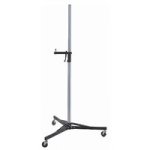
(much easier to work with than tripods but not very steady so it depends on what you need)
For handheld the weight of the Zeiss lens may be an issue but still I think this will be lighter than the D7 rig with Marshall monitor I worked with last year in July in superhot France, that really was hell. The AF101 is really light weight. But we'll see...
Mark Smith
Veteran
I finally had a situation with the AF where Aliasing came up. Last week I had an interview subject sit down in front of the camera wearing a black and white jacket with a very fine hound's tooth pattern . I saw aliasing for the first time with the AF. It wasn't horrible and it didn't go all purple and green like a 5 D would. Actually I think a 5D would have melted its sensor if it saw that jacket. Subject removed jacket evaluating for moire and we moved on. Silly me - I did not roll on the subject with the jacket or grab a still. I'm kicking myself now.

mkfotos.com
Well-known member
Was it on the LCD though, or a live, full 1080p display? Would've been very good to catch footage, just to see how it looked properly displayed.
Rick Burnett
Section Moderator
Was it on the LCD though, or a live, full 1080p display? Would've been very good to catch footage, just to see how it looked properly displayed.
I ask this too because I have notices that the LCD on the AF100 isn't all that great to me. I've not witnessed this yet on the AF100, but on the GH2 we were shooting some tests and the image was aliasing all over the back of the camera, but when we watched the footage, nothing was there. Depending on how their scaling algorithms work for bringing the 1080p resolution down to the LCD resolution, these things can be introduced.
Not saying it wasn't there, but next time, roll some footage!
 Hahahahaa
RieniO
Well-known member
It drives me crazy when someone posts an evaluation after using it for five minutes, because they can't possibly know what they're talking about yet. My experience has been that when someone takes the time to learn it, they turn their opinion (like RieniO in this thread, who really was hammering me hard and in that thread there were the usual allegations of "oh, there's a coverup, you're just trying to hide the truth" and all that typical horsecrap, when ... eventually, if people just take the time to work with it, they'll come to learn what it does and what it doesn't do, and when they tune it to how they like it, you'll see statements like RieniO's in this very thread -- "sorry I was such a pain in the butt, the footage really is actually gorgeous."
I'm one of the guys who work low-budget and for whom the AF100 was the most expensive camera we ever bought. Then it's easy to become sentimental rather than remain rational. I never believed in any conspiracy or cover-up theory though but at the same time I didn't agree with what you wrote about the noise and the flicker, still that's no excuse for being a pain in the ass.
About the 25p flickering, if it's true that this isn't really progressive but still interlaced it may be worth it trying to de-interlace in FCP media manager, and see what happens next. I remember that it still flickered after converting to mp4 for the web but in Episode I have turned off de-interlacing as well because usually all footage I convert is already progressive. I'll play with this tomorrow and let you know.
The difference between 24p and 25p playback is huge but how can I show this to you? Have you tried 25p on your cam, Barry?
very encouraging thread! Its great to see somebody change his mind and openly tell it! I am buying my lenses before I buy the next camera, whichever it will be ( maybe the Af 100 or F3?) but I found a stupendous deal on incredible 60s Zeiss Jena glasses and am completing my set in the next weeks....
Barry_Green
Moderator
Yes, my monitor supports both standards so when this was all going on I put it in 25p mode and looked at it on the monitor and it was absolutely fine. No problems at all. I really think that whatever issue is affecting people is some sort of computer playback issue.The difference between 24p and 25p playback is huge but how can I show this to you? Have you tried 25p on your cam, Barry?
I had a lot of troubles with 25P (and still do). It was not a computer playback issue, at least not monitor. It looked the worst on the Panasonic reference monitor in the editing room. It looked pretty bad on plasma TVs as well. It looked ok on laptops and computer monitors.
Thats why we didn´t notice before the post guys started complaining.
From the start of this thread it thought I now had it sorted, that 24P was fine, and 25P not.
But from what Barry says, he couldn´t see any difference.
I´m starting to wonder if it is something that affects the cameras in PAL land. I have come across a few shooters that reports the same problem here in Norway.
For the record: I do know the rules of pans etc. I have shot a lot on both 35mm and 16mm. I never had this problem with EX cameras or the HVX200
Thats interesting. I will get my camera back next week. I will do some tests then as well. As I stated in another thread, we actually had to switch to interlaced from 25P one week into production as the 25P was unacceptable. We were 2 cameramen with 2 different AF101 cameras.
I would love to come to the bottom of this
I would love to come to the bottom of this
Barry_Green
Moderator
The BBC tested in 25p, and explored this issue in depth and declared that there is no issue and that motion is rendered exactly the way it's supposed to be.
The camera records 25p as 50i, just like every Panasonic has always done. De-interlacing is not a solution, it would just result in throwing away half your resolution.
I put the camera in 25p, watched it on my 25p monitor, and it looked exactly as it should.
The camera records 25p as 50i, just like every Panasonic has always done. De-interlacing is not a solution, it would just result in throwing away half your resolution.
I put the camera in 25p, watched it on my 25p monitor, and it looked exactly as it should.
FlowingCamera
New member
This thread has been re-assuring in nudging my decision to acquire the AF100.
The type of camera work am doing ranges from run and gun ENG style to live concerts, sports, movie shorts etc.. Was originally considering the Sony EX1R but you all are presenting a darn compelling case for the AF100.
My only concern is how manageable (follow focus etc.) is this camera if used on a Glidecam / Stedicam platform which is my particular specialty ?
With the right glass and camera settings could I practically set it and forget it ?
pulpfiction007
Veteran
This thread has been re-assuring in nudging my decision to acquire the AF100.
The type of camera work am doing ranges from run and gun ENG style to live concerts, sports, movie shorts etc.. Was originally considering the Sony EX1R but you all are presenting a darn compelling case for the AF100.
My only concern is how manageable (follow focus etc.) is this camera if used on a Glidecam / Stedicam platform which is my particular specialty ?
With the right glass and camera settings could I practically set it and forget it ?
I don't have the AF100 - but I've used the GH1 quite a bit (same sized sensor) and with the slow kit lens (F4) I've shot stuff just like I would with my HFS 200...basically set and forget.(all daylight though) The problem would come in at faster apertures in lower light and trying to hold focus on a subject in that situation. I do agree with Rienio that it's not the best camera for that type of work compared to smaller sensor cams, because you may have to stop a lens down too much to get deep DOF, or be working like mad keeping focus. It can be done in a pinch, but more controlled scenarios are the playground of a large sensor camera.