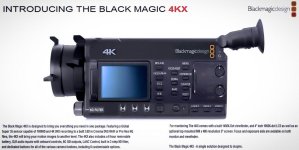
It's shipping! And there's a surprise

Imagine the insides of a BlackMagic camera in the body of a Sony VG900, with XLR inputs, ND filters, etc.

View attachment 82281

1. How much more would it cost them to make it this way? I would be surprised if they had to raise the price more than $500.
2. How many people would say, I can no longer use this camera, I must have the SLR form factor? How many more units would they sell, now that they have opened up its usefulness to more people? Twice as many? 10 times as many?

What Razz said, and Ryan as well.

It's a little short-sighted to assume that it would only cost five-hundred to make such a camera. I think your earlier post was very leveled, but they haven't made a mistake.

We're all a little selfish, we want the "me" camera. Your need for these things (point one and two) would be a self-centered -- used with zero negative connotation here, desire.

My response's also very self-centered: I really don't care about that stuff.

I just want the camera to produce a satisfactory image in most areas. Someone mentioned that people were willing to force the camera, or try it, because the IQ's so good. This tells me that there are more than a few what just aren't satisfied with 8-bit 4:2:0 looks out of the mechanical/functional do-it-alls. At the end of the day, both matter... but an audience doesn't see how easy it was or was not to capture an image ... they just see the image.


( I do realize fiddling can take away time from a shot, etc., just talking about the basic what-it-looks-like.)
 
I am being self-centered. But this particular self happens to want a camera with which he can shoot anything: a wedding, speech, documentary, or feature, depending on the day. So I was thinking such a camera would be of interest to many others here.

There are those that say such a camera is not possible. But in fact many such cameras already exist. For example, the C300, AF100, HMC150... really almost any camera, if you work hard enough.

I guess the camera I'm waiting for is a little more polished. Honestly the only thing keeping me from most cameras is rolling shutter. It's not as big a deal to some, but for me it is a dealbreaker. If, for example, the Sony VG900 had global shutter, I probably would be spending a lot less time scanning the Industry News & Information section.
:)
 
I fully agree with what is said till now.
R&D cost money, and Blackmagic want to keep costs low. Companies are made to make money, so either they save on R&D (e.g using off the shelf sensor and simple design body) and keeping price down or they develop a sensor and even a codec and put the price higher. in any case no one is a saint (even though some companies like to pretend they are), they're just here to earn on our backs.

What would be nice to see from the Blackmagic cameras is more flavours of ProRes, especially would be nice ProRes LT, which is great for Documentary and Run&gun work, as it really save you space without loosing too much image quality, it's also more reasonable to ask then asking for newly designed body.
 
Maybe they will make something like this at some point, lol
View attachment 82410

They give us the arm now we want the leg. Lol...Nice mock up. Interesting to see what NAB brings us this year. The good news is they allow us to enjoy our current equipment for at least a little while, in BM's case almost a year after NAB. I think what would excite me more than blackmagic releasing a new camera would be for them to offer new firmware updates for their existing line. Hell I'd be happy with 60p, 2k/120 fps, maybe a higher native ISO.
 
At those prices, it is nearly cheap enough to not care. It is not like a 30K product dropping to 7K, it is 3K dropping to 2k, not a biggie. Should have your money by then. That's less then 2day dragon rental, and you get to reuse your accessories. Winning.

The footage looks similar to C series cameras in DR, but the colors are very different. Nicer tonality though. To my eye, there is a big difference between 12stops DR and 13.5+. 13.5 seems to be the moment DR is no longer a major concern.

Real life scenes often have dynamic range around 14 stops, and a 13.6 stop camera will not really give you all that great color at either end of the extremes. This camera will often constrict you to clipping something. clipping is never pretty.

Its lack of an OLPF makes actors look less attractive (in every shot, just some more than others) as every wrinkle and pore looks more pronounced. Diffusion filtering does not really solve this, and post absolutely does not in an artifact-free manner.

It is only recording 4:2:2 - which makes secondaries much harder to pull cleanly in grading.

SO….

Although this is an amazing student/beginner camera for the price I would have drooled over as a student, and rightfully so, it is foolish to think it replaces an Alexa or an Epic for production with any serious budget, or one where the finer points of image quality are important. It is often a good investment in one's reel and client relations to rent a better camera body for the day.

A better camera will also take less time to light, as something like a Dragon is very forgiving and offers immense latitude in post.
 
Maybe $500 in parts after all is said and done, but you're leaving out one very important factor. R&D.

Actually I was including R&D. XLR inputs, and their attendant circuitry, are probably $50 or less, in bulk. A longitudinal body, instead of a wide one, costs practically $0 more in parts. Firefox is talking $25 cell phones, consider all the parts in one of those.

For some reason, people on this forum argue against the products that would benefit them and are certainly possible. They usually fire back that the technology isn't there or that it can't be done at that price. But in my multi-decade experience, it's very often that companies are just dumb. Or greedy. Did Canon wait until the end of 2011 to launch the C300 because until then the technology just wasn't there?

Corporations are bastions of non-progress. I know because I work at one, a large one, with oodles of beaurocratic red tape and tons of demotivation to do anything that offers better bang for the buck.
 
Last edited:
Actually I was including R&D. XLR inputs, and their attendant circuitry, are probably $50 or less, in bulk. A longitudinal body, instead of a wide one, costs practically $0 more in parts. Firefox is talking $25 cell phones, consider all the parts in one of those.

For some reason, people on this forum argue against the products that would benefit them and are certainly possible. They usually fire back that the technology isn't there or that it can't be done at that price. But in my multi-decade experience, it's very often that companies are just dumb. Or greedy. Did Canon wait until the end of 2011 to launch the C300 because until then the technology just wasn't there?

Corporations are bastions of non-progress. I know because I work at one, a large one, with oodles of beaurocratic red tape and tons of demotivation to do anything that offers better bang for the buck.

Greed doesn't exist in camera companies. Their job is to make as much money legally as possible for their stock holders.

Canon is a publicly traded company:

http://www.nasdaq.com/symbol/caj

If they made less money than they could, because they were just wonderful people and wanted to give cameras away to awesome people like you, they would be stealing money from the stock holders. What you call "greed" is Canon not being a company that steals from it's stock holders, like retired grandmothers with 401k investments. Wouldn't Canon be "greedy" if they stole from their stock holders, the people that risked money investing in the company?

A different argument would be if Canon made a cheaper camera with more features, they'd sell more cameras, so they'd make MORE money. That would be a sound business decision.

Companies base their decisions on making money for the stock holders, not "greed".
 
Actually I was including R&D. XLR inputs, and their attendant circuitry, are probably $50 or less, in bulk. A longitudinal body, instead of a wide one, costs practically $0 more in parts. Firefox is talking $25 cell phones, consider all the parts in one of those.

For some reason, people on this forum argue against the products that would benefit them and are certainly possible. They usually fire back that the technology isn't there or that it can't be done at that price. But in my multi-decade experience, it's very often that companies are just dumb. Or greedy. Did Canon wait until the end of 2011 to launch the C300 because until then the technology just wasn't there?

Corporations are bastions of non-progress. I know because I work at one, a large one, with oodles of beaurocratic red tape and tons of demotivation to do anything that offers better bang for the buck.

Tell me how all the cameras not made by corporations are doing?
 
Greed doesn't exist in camera companies. Their job is to make as much money legally as possible for their stock holders.

Canon is a publicly traded company:

http://www.nasdaq.com/symbol/caj

If they made less money than they could, because they were just wonderful people and wanted to give cameras away to awesome people like you, they would be stealing money from the stock holders. What you call "greed" is Canon not being a company that steals from it's stock holders, like retired grandmothers with 401k investments. Wouldn't Canon be "greedy" if they stole from their stock holders, the people that risked money investing in the company?

A different argument would be if Canon made a cheaper camera with more features, they'd sell more cameras, so they'd make MORE money. That would be a sound business decision.

Companies base their decisions on making money for the stock holders, not "greed".

Canon sells their camcorders at a significant markup, relative to how good the footage they can output is compared to the competition, because they can get away with it. For now, anyway. I think that's the 'greed' people are talking about.
 
I think some here don't appreciate how much "black magic" (R&D) it takes to implement audio meters. Oh...I'm sure it's coming. Maybe next cam. Kind of reminds me of DSLR cams omitting headphones for so long...although there you could posit they were protecting videocam turf etc. What is BM protecting?
 
Last edited:
Canon sells their camcorders at a significant markup, relative to how good the footage they can output is compared to the competition, because they can get away with it. For now, anyway. I think that's the 'greed' people are talking about.

Why is that "greed"? Every company sells their product to make as much money as they can from that product legally. You can't give money away. That would be stealing from your stockholders.

Canon can "get away with it" because they are competitive in the market place. If someone can produce what Canon does for less money with more features, then they are welcome to do that and they can take market share away from Canon.
 
To me, it's just a matter of priorities. BM could have brought a longitudinal body in 2014, or the 4K camera, but not both. Not with their limited resources.
They decided to go with 4K. I probably would have gone the other way (a good body is something you'll reuse in future designs, for years), but I'm not running a camera company. I also thought that the BMC-m43 would sell a lot more than the BMC-EF, but sales numbers say I was wrong. My needs vs most people's needs.
 
Yes. I think m4/3rds is kind of a financial trap. The user base of Canon EF lenses is huge and can not be ignored when it comes to a camera purchase that allows one to "use what you already own".

As far as body design and XLR inputs and preamps, I am scatching my head. The camera is already considered a low entry price. Would a "normal" camera design really cost that much more to prohibit hitting their targets? Maybe they are saving a complete model for the future to keep the dream alive.
 
From the looks of it, they originally went for the simplest PCB they could think of. It's the same thing I would do: start simple.
Redesigning that and breaking it into several boards with flex connectors is not a small task.
 
From the looks of it, they originally went for the simplest PCB they could think of. It's the same thing I would do: start simple.
Redesigning that and breaking it into several boards with flex connectors is not a small task.


I think that was wise as well to hit their price point....I'm wondering if they couldn't do a better design around a simple board though.
 
Back
Top