Is this window clipping?

Viscount Omega

Carbonite Member
Here are 2 stills from "The Shining". I've heard this window is probably lit artificially with an HMI but that's beside the point. Can you tell if it's clipping? If it is, does it bother you?
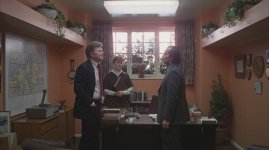

Shining Window 1.jpg


Shining Window 2.jpg

My histogram in Sony Vegas says thay are.

Some of my windows look like this and my histogram says they're clipped but I'm using digital, not film, of course. If my windows are clipped but I render to 16-235 video levels am I now "broadcast safe"? Does someone up the chain just decide later, "that looks too clipped, I can't broadcast it"? What is the standard?

Thank you.
 
Yes, I think it's fully clipped. Which is much more common than we gearheads tend to think.

I recently watched all the Mad Max series. In the Thunder Dome one there's a clip when they move out of Tina Turner's "office" and see the city from above. There's a strong iris ramp in that shot. Before the iris ramp starts, the outside is clipped. And that's kind of a "hero shot".

Some thoughts about this, though:
* If you get clipping in camera, you are stuck with that, no way to unclip in post.
* I often clip stuff in post, by applying a look with lots of digital diffussion. Usually it doesn't look bad, and won't bother a regular audience.
* Film clips in a nicer way than most digital cameras. With some cameras, or when you clip in post, you can get close to that.
 
I clicked through my Kubrick collection movie files and quickly found a dozen more examples containing very overexposed windows, lamps and bare light bulbs. I never noticed it before I started learning more about photography. As a director, I think if the viewer is distracted by the clipping I have failed to keep them engaged. What worries me is if I put a lot of time and effort into a project and it contains a fair amount of highlight clipping, someone in charge of programming is going to reject it based on that alone.

I can hear you saying: "why not just expose correctly?" 1) I want to use all practical lights as much as possible because it's faster and leaner 2) slog-2 is noisier and skin tones look terrible sometimes if exposure is adjusted for isolated highlights 3) I think I can get away with overexposed stuff by leaving the highlights up and blending the destroyed portions in with the whites.
 
Lots of Dp's blow out windows as a choice. It's nothing new or unusual really. I think we tend to see it less in the digital world due to poor highlight roll off. The Sony F35 and Alexa both are able to pull it off nicely without harsh clipping.
 
As for DSLRs and other sub-$4K cameras, the NX1 is the camera with the best highlight rolloff AFAIK. It makes it work as if it had better DR than it actually has, because you if something clips it's not such a big issue.
 
the NX1 is the camera with the best highlight rolloff AFAIK.

I concur. It blooms highlights in a creamy style unlike all the others. I saw it from the very first samples of someone walking on the street with the camera.

If highlight roll-off is a big concern nx1 is the low-budget solution, and remember with careful grading, you can actually change highlight roll-off from something hideous to very good. Play with the upper part and experiment.
 
We do spend too much time looking at still frames. Watch some older classics and marvel in the lens aberrations, chromatic aberration, halation, flare, distortion, softness and no one cared. Exposure variances from shot to shot, entire lighting setups change, cameras in windows, shadows, missed focus (Kramer vs Kramer has some classics of those) and so on. Different times, when people didn't get to check on set, or stare endlessly in post and obsess.

The fact that film desaturates heavily as it goes over exposed makes for a much nicer clip. These sort of things can be mimic'd with a decent film emulation LUT.

But pretty much everyone on this forum, pixel peeps and obsesses over these things, myself included!

Back then people weren't obsessed with film look either...

cheers
Paul
 
Now when we have the ability to save highlights thanks to great DR in camera it's still not the best option. Blown windows and lights can be a better choice. The dilemma these days is we have to good cameras in our hands.
 
And don't forget that certain things LOOK clipped to us in real life.

Really bright windows in a dimly lit room. Bright lights at a stadium or streetlights at night when our eyes are adjusted for the dark. Many more...

That's why clipped windows and light fixtures are rarely noticed by us when we watch a film - it's a normal look to our eyes.


That's true. Going higher than 13-14 stops of DR in one image, it starts to look cheap, unrealistic. Just look at HDR photography (bracketing, so 20+ stops), I hate it, just like I hate HFR and 3D.

DR has a sweet spot going for a filmic look (at the viewers end, at aquisition it's ok to have 84 stops of course, just don't keep it if you want a filmic image)
 
Last night, I was watching - accidentally, during the half-time of a soccer match - some film noir. In a scene, a kidnapper and his accomplice walk the subject of their crime through a darkly lit room with only street lights slashing through it ... and two thirds of the individual frames were totally crushed. And that's how film noir and horror flicks were and still are.

As to Kubrick and Alcott - the top shot is definitely overexposed but it can also be viewed as a "come to G-d ... here's your fate" moment for Jack. The lower shot is not really overexposed and, given the expertise of the people involved, unlikely to be incidental either. Most of the film was shot on the set, so they could given it as much light as they felt to be appropriate.
 
Back
Top