Is this IR pollution?

xbourque

Well-known member
I'm starting to suspect that the built-in IR filter in the 7D lets a little too much IR pass through.

For example, see the attached shot of a traffic light. Lots of magenta and yellow in there (suggesting IR pollution in the blue and green channels). I certify that the light 100% pure red in real life. I think they are actual red LEDs in there.

Anybody tried to put a hot mirror on the 7D to see what happens?

Here's some info on the topic:
http://provideocoalition.com/index.php/aadams/story/red_hot_mirror_shoot_out/

--X
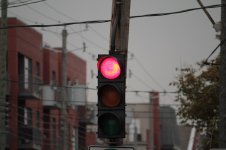
IMG_4378_small.jpg
 
That looks like clipped colour channels due to overexposure of that part of the 'scene'

If you want to check for IR pullution film someone in a dark business suit - does it go purple ?

S
 
I can show you what extreme IR pollution looks like, if you want. I have a Sony HDR-SR11 that had its IR filter removed (so that it can do IR videography). I can post a grab, if you want.

What you posted doesn't look that bad to me. Red LEDs seem like an unlikely source of significant infrared radiation. IR pollution can only be visible if there's a lot of IR radiation. The main source of IR outdoors during the day is the sun. Clouds block solar IR, and that shot looks like it was taken during a very overcast day.

The RED One has a notoriously weak IR filter. Yet the footage from it looks fine in most cases; seemingly the majority of users neglect to use a hot mirror. IR pollution only becomes an issue on it when a lot of ND is used.
 
Thanks for the replies.

Since LEDs do not become physically hot, one would think that they do not emit a lot of IR. Then again, TV remotes use LEDs to emit IR.

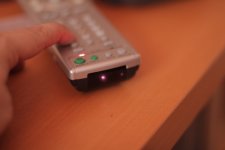
Proof that at least some IR creeps through...

IMG_6021_small.jpg

The IR LED is 100% invisible to the naked eye. Suspiciously, the remote IR LED is the same magenta hue as my problem traffic sign.

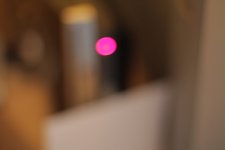
See this out of focus shot of my PS3 in standby mode. The red LED is clearly magenta. You can tell the WB is bit yellow (i.e. not blue enough) from the sheet of white paper... so I'm actually decreasing the chance of the blue channel being polluted.

IMG_6015_small.jpg

I do have a grey jacket that appears kind of magenta-ish in pictures when in real life its blue-ish even when WB is done correctly.

I also started suspecting something was odd when using cheap Cokin ND filters to do long exposures for timelapse. Even after doing a manual white balance to compensate the red tint of the filters, some colors were really wacky. White paper was white, my black couch was black, but my grey jacket was burgundy.

I just got a fader ND today in the mail... I'll experiment with that a little more. At first glance it seems much better than the Cokins at blocking IR as well as visible light.

Anyways, anyone with access to a hot mirror want to try shooting a red LED to see what happens?

--X
 
So the evidence is clear. I wonder why Canon put such a weak IR filter in the 7D while the 5D Mark II got a really strong one.
 
So the evidence is clear. I wonder why Canon put such a weak IR filter in the 7D while the 5D Mark II got a really strong one.
I can confirm that the GH1, 7D, and HMC40 all see the infrared from remote controls.

As to why it's there, the only guess I can make is that cutting off that end of the spectrum would lower overall sensitivity. Sony made a statement about how letting near-IR pass through on their EX1 was a "feature", not a bug.

Then they promptly went and fixed it on the EX1R... :)
 
Back
Top