Is this CMOS rolling shutter -- and the reason to buy the HMC150?

I am in the middle of gathering as much info as I can on new camcorders so that I can make a recommendation to my boss. My number one choice right now is the HMC150, and it and the second on my list, the JVC HM100, are the only CCD cameras on my list. One good argument for the HMC150 is that all of the CMOS cameras have the "rolling shutter" issues. I would like to show an example of this so they can judge just how bad it can be. The image below is a screen grab from a video a co-worker took with a Canon DSLR. I don't remember if it was a 7D or a 60D, but either way it's CMOS. See the rear spare tire -- in real life it is straight up and down. The skew on the video is crazy! Not acceptable in my opinion. Can you please tell me if in fact this is because it was shot with a CMOS camera? (I'll be one step close to a new HMC150 if it is.)

Oh, one other thing ... if I can talk the boss into spending a bit more and getting the AC130, would we get this skew with its 3CMOS sensor?

Thank you, oh wise ones!
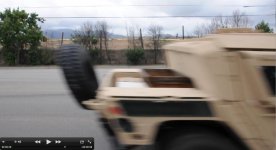
CMOS_rolling_shutter.jpg
 
Yes, that is moire/panning mud from the rolling shutter on a CMOS sensor. Some cameras it's worse than others. General rule of thumb is that you should avoid sharp pans and drive-alongs, camera flashes, lasers and ceiling fans or propellers when shooting with a CMOS camera. Avoid those things and these cameras are beautiful.

If you're going to talk the boss into spending more dough than hmc150 on a CCD camera, I'd recommend looking into a JVC hm700. Shoot directly onto ProRes files on SDHC cards? Sweet. And I believe the sensor is the same size, plus interchangeable lenses, great ergonomic professional ENG design. Of course, you're talking a couple thousand dollars more dough and for a more moderate pricetag you could buy an AMAZING CMOS camera like the FS100 or AF100, but if panning mud is an issue, well then it's an issue.

What are you planning to shoot?
 
The ac130 has a much faster rolling shutter rate than a DSLR. You may still see some lean with it, but probably only about 1/3 as much (or so) as on the DSLR.

Of course a CCD camera would show no lean whatsoever.
 
Thanks, Joe and Barry. I will definitely look into the cameras you suggested, although I'll try not to get my hopes up, as budgets are being tightened. Sometimes I shoot things like drag races and ride-along in off-road vehicles, so that's why I'm afraid of CMOS cameras. Too bad the HMC150's "upgrade" -- the AC130 -- isn't perfect like I first thought it was going to be. 23x zoom?!! Awesome! Ohhhh, hunting autofocus because of it. D'oh!

Thanks again. You've given me some good info to think about when I get back into the office in the morning...
 
It just sucks that Panasonic seems to be have no further interest in CCD's. Once the 150 is discontinued, that's about it.

I shoot a lot of weddings, so I need a CCD.

Given that Panasonic was one of the last to offer a CCD in this price range/market, I think it had less to do with interest as economics. People want full 1920x1080 chips, and you can't get that with 1/3" CCD's. And for most people, the rolling shutter is not much of an issue.
 
Yes, that is moire/panning mud from the rolling shutter on a CMOS sensor.

To be specific, it's not moire - you can have moire in a static shot. It's sensor skew or jello to use a few common descriptions.

Moire is the psychedelic look you get from patterns (bricks, shingles, fabric patterns, etc) that comes from line skipping and other "DSLR shoehorned into the video world" issues.

Ah yes. fair enough.
 
You just have to plan for the rolling shutter and watch for whip pans & whatnot. I use an HMC150 for DSLR shoots where the skew will hurt (or if I'm going to key a shot).

I shot a music video where I was tracking on a girl's face, spinning around her, etc; there are lamp posts in the BG that look like octopus arms! Nobody notices it, since you're focused on her face. There are times only you will see it.

When I've done event videos with a DSLR (or even the 150) I just make a "flash" clip, a frame or two of white that fades to transparent and line it up with the camera flashes, paste as needed. You can do it with a solid in any NLE. You get a more dramatic "pop" - it also makes a cool transition to a different clip or to a still.
 
I would like to point out that CMOS alone should not eliminate your looking at other alternatives....DSLR CMOS....yep, it's bad when trying to pan fast, but even on my consumer Canon HFS 200 CMOS, jello is not something I ever see. I'm sure one could try and the effect would happen, but it is simply something I never think about while shooting the way I would on a DSLR. I'll bet the AC130/160, XF100 and other CMOS cams are very stable as well VS the DSLR's CMOS
 
To put what other users have said into a concise statement.....


  • Jello/skew is very visible when shooting DSLR video, along with other CMOS artifacts like moire (moire primarily coming from the "shoehorned" image manipulation for video capture, not necessarily a CMOS issue at all)
  • Jello/skew and moire effects on CMOS are not nearly as noticeable when using professional video cameras (instead of DSLR)
  • Rolling shutter issues (such as with flashes firing during an event, for example) are barely noticeable on CMOS video camcorders, with the more expensive camcorders handling this issue much better than cheaper models.
  • CCD doesn't have these issues, but CCDs aren't quite as sharp on 1/3" chips as their CMOS counterparts
  • CCDs are more expensive/difficult to manufacture at a comparable size to their CMOS counterparts and are thus being phased out by most manufacturers.
 
Wow, this is great. Thanks for all the input, everyone. And that was a great summary too, scapsinger.

Side note ... I've read all the warnings against "whip pans" but that's not my big worry since I am in control of how fast I pan (and I know not to pan too fast), but I can't control my subject matter -- which oftentimes is vehicles driving by really fast. (The shot in my example image was handheld, but I imagine that if the camera was stationary on a tripod the vehicle would still be skewed, right?)

Well today is the day I'm suppose to present my camera recommendations to my boss. I think I will give a few options based on price range, with the "high end" package being one HMC150 and one AC130. That way I'll have an A camera and a B camera, and which one is which would depend upon what I'm shooting. Best of both worlds! I doubt he'll go for it, but I'll try to make a strong case for it.

Thanks again for the replies.
 
I think if you're going with 2 cameras and you're buying them TODAY then you probably get a good combo out of the HMC150 and an AC130 (although the street price on an AC160 is not much more, and you gain some versatility that may be worthwhile to you).

Good luck!
 
Thanks scapsinger. I'm glad you like my "dream package." I thought those two cameras together would be ideal. I kinda ruled out the AC160 because it's $980 more (B&H prices anyway), and the things it adds are things I either don't need or could get by without (HD SDI is beyond my skill set, PAL/NTSC isn't an issue, having Dolby instead of Linear PCM I don't think is an issue with my FCP 6.0.5, and VFR would be cool but I think I can do decent slo-mo with doing the 60fps-to-30fps conversion thing).

I have a fear that my boss will want to go with the "bottom end" of my suggestions, which is two Panasonic TM900's (since they're relatively cheap at $700 each). While those would still be better than my standard def Sony VX2000 I've been using for years, I'm really going to push for my dream package. (And that's where my original "rolling shutter/skew" issue will come into play.)

Boy, this is a great community here! (Maybe some day I'll be able to post an answer to something instead of just asking questions ... some day...)
 
Last edited:
I haven't used a TM900, so I don't know how good or bad the skew is on it. It's a lower-cost consumer camcorder so I would expect it to display more jello, but that's just speculation.
 
More jello with snack time -- good! More jello with your camera -- bad! Thanks for more ammo to use in my argument for a better camera, Barry.
 
The advantage of two identical cameras is that the footage will be easier to match when editing. So try to look on the bright side if your boss insists on two identical TM900's!

The speed of the rolling shutter on video cameras is generally better than DSLRs. As the read/reset speed of a CMOS shutter is relatively easy to measure, it is surprising that no one has compiled a table of measurements for different cameras. That would be a useful resource.
 
That's a good point about two TM900's, ejoison. I was thinking two TM900's would be okay, or one TM900 and one HMC150 would be even better -- but -- I'm running FCP 6, and there are apparently issues with the TM900's 1080p60 not being supported. (And it's not even supported on FCP 7 or FCP X.)

I got some extra time to figure this out since my boss left early yesterday and I didn't have to give him my list of recommendations, but I'm not sure what to tell him today. Two HMC150's is totally awesome in my book (or HMC150 + AC130), but I can't have my "budget" recommendation include a camera (TM900) that I'm not sure will work with my software.
 
Back
Top