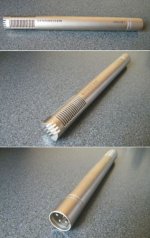
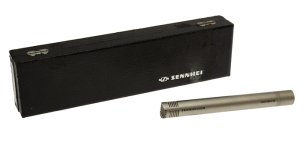
Indoor shoot. Sennheiser 416 vs Oktava Mk 012 ?? Also MKH408? Rare?

derbrocks09

Well-known member
So I have an indoor shoot coming up and to my ears the Sennheiser 416 sounds better than the Oktava hyper.

Everything I know about sound Ive learned here or from Barry Green's excelent DVD. The Oktava's are more mid range in terms of price vs the higher end Senn 416 obviously but from what understand in general the hyper Oktava is usually the better choice indoors

Can anyone clarify for me why shotguns aren't the best for indoor locations. Also please weigh in. Which would you use? To my ears the 416 sounds better. Sould I maybe use both?


Also, does anyone know anything about the Sennhieser MKH 408? It seems to be rare as very little showed up on my Google search. I just bought a used one from Adorama for what seemed like a bargain. Could it possibly fit the bill better than the Oktava for this shoot?

Thanks in advance for the help everyone!

:)
 
I have never heard of an MKH 408 - could it be an MKH 406 and you have mistaken the 6 for an 8?

If so, it's an excellent cardioid mic. - but make sure you power it correctly, there were T-powered as well as phantom powered versions available.
 
Nope. It's a MKH 408 for sure. In fact it is even a P48 model. Looks like a really short 416 in Nickle. I'm starting to think it may be a very rare mic, perhaps even a collector item? Almost nothing comes back when I google it. Was hoping someone knew something about it.

Anyone?
 
Nope. It's a MKH 408 for sure. In fact it is even a P48 model. Looks like a really short 416 in Nickle. I'm starting to think it may be a very rare mic, perhaps even a collector item? Almost nothing comes back when I google it. Was hoping someone knew something about it.

Anyone?

Can you post a picture of it?

I was wondering if it was an MKH 435 re-numbered for the American market??? Sennheiser did this with some microphones which were only available in the USA.

This is the MKH 435 - it's actually a cardioid mic., even though it looks like a very short gun:-

$(KGrHqR,!hQE1fCtgBlSBNgVfh0f3!~~0_12.JPG
 
That's a cheap fake from China, made to look used. They make fake Ferraris in China, a mic is nothing.


j/k - but it is true that a lot of "brand" stuff on ebay is fake stuff from China.
 
lol yeah but I bought it from Adorama so I'm sure its legit

It looks a lot like a 406 so perhaps its simply the upgrade to the 406 that they only made briefly

Interesting that almost nothing came up on Google though
 
yeah thats the same one

Was hoping someone here could tell me more but yeah, I might have to email them.

What about the 416 vs the Oktava question? Anyone?
 
yeah thats the same one

Was hoping someone here could tell me more but yeah, I might have to email them.

What about the 416 vs the Oktava question? Anyone?

First a definition or two and some physics ... direct sound is that which comes straight from the sound source to strike the mic; reflected sound is that which comes from the same source but bounces off a surface or two such as a wall or a ceiling before hitting the mic. The way interference tube mics work, in the case of direct sound, is that sound arriving from along the mic's axis and entering from the front mixes with the same sound as it sweeps along the side of the tube and enters through the side ports - both waves are in phase and pass down inside the tube to the capsule unimpeded. But consider a sound wave arriving directly from the side ... it sweeps over the tube and enters through the side ports. But when it gets to the front of the tube it has to change direction to enter and this introduces a phase inversion. When the in-phase wave coming through the ports mixes with the inverted-phase wave coming through the end, they tend to cancel each other out. Hence sounds arriving along axis are unchanged, sounds arriving from the sides are suppressed and you have a directional mic. But when sound reflects on the way to the mic, the reflection flips the phase with respect to the original. Plus the reflection's path from the source to the mic is longer than that of the portion of the wave that travels directly from the source to the mic. This causes an additional phase difference due to the different path lengths. When you mix those waves in the interference tube all sorts of strange things go on. Direct sound entering the front of the mic mixes with numerous differently phase shifted copies of itself from the reflections entering through the side ports while direct sound coming from the side mixes with an untidy combination of phase shifted copies of itself coming in through the front, with the result being some frequencies are reinforced and others cancel willy-nilly. Directivity is reduced and you have a pronounced comb filtering effect introduced. To my ears the typical result is the sound takes on a metallic/ringing/hollow quality sounding as if the scene was shot in a metal culvert running under a highway or in an old, empty steel Quonset-hut building.

Typical interiors - homes, offices, wedding halls, etc - that have not been subject to acoustic conditioning generally have a lot of hard surfaces that reflect sound well. But the distinction is really not indoors or out. Some interiors are quite free of short term reflections - a sound stage or theatre for example. And conversly some exteriors can be highly reflective - consider a paved playground a few feet away from a brick school building. Short 'guns like the 416 are less than optimum in environments where there is a high proportion of reflected sound to the direct sound hitting the mic. Hypers, like the Oktava, do not use the same interference tube principle as do 'guns to achieve their directivity and so are better behaved in the presence of relatively high levels of reflected to direct sound. So it's not that the 416 sounds better than the Oktava or vice versa, it's a matter of which mic is going to behave better in the specific environment where you're going to be shooting. And you can only tell for sure if you do a scouting trip and test each one in the location where you're going to be working.
 
Last edited:
Steve.

Thank you so much for explaining it! Everything makes sense now.

So the bottom line is that it depends entirely on the specific location and while in general, the hypers are better indoors, it all depends on the reflectiveness of the room. That also explains why I prefered the 416 in the room I tested it in (my carpeted bedroom with a fabric black cover over the window).

Thanks again Steve!
 
Back
Top