In need of Sony cameras model comparison information, ramblings follow....

Grant Peacock

Active member
I had mentioned recently that my team was looking for replacements for our relatively heavy and power-hungry old-school ENG cameras. In doing research, and learning as I go, I wish for, but cannot find any information that lists Sony camera models within a line-up, and how they compare. This would be so helpful. Most of the cameras now available in the used market are ones that I will never be able to see ahead of buying.

As an example - the Sony PXW camcorder line. There's an X70, Z90, Z90V, Z100, Z150, Z190, X200, Z200, Z280.. and probably a few more. After choosing the basic form factor that we can go with, then I would really appreciate seeing a tabulated feature set for all of these in one place. Examples of must-haves for us are : retention of interlaced format, and simultaneous powering options - battery/AC (I have learned that at least one of these models precludes that). I am getting increasingly interested in our conversion to a relatively tiny camera, with low power requirements, and subsequent lightening of the load with reduced tripods, etc. Some of the cameras look as though they weigh less than our current tripod PLATE.

Ramblings : My experience has been that all the camera manufacturers go quiet to some extent, once a model is no longer in their current list of new sales items. With the sort of work we are doing, carefully selected used gear is a fine choice. If you have any leads on this sort of high level, collated information, please share!

One other thing - it would be of interest to see how the model prefix designations are arrived at. I'm thinking here of PMW vs PXW, etc. Sometimes there's a -X in the pre-digit section of the model label, and sometimes a -Z. The ground has shifted under us in so many ways over the past few decades. Those of us that had a camera on our shoulder & on tripod as far back as the early 90's remember that there were few models to choose from, and subsequent models tended to have very incremental changes in features, with few or no updates in layout (form-factor, switches etc*). These rigs were eminently serviceable - typically, a fault was traced to an individual board, which was removed and replaced with a refurb replacement. Compare with now! If these new, compact models, no moving parts, ever cross an engineer's bench, I am betting it's rarely. Ditto for 'the business end' of the camera - the lens .... can a lens engineer even service these units?

Grant.

* Who remembers Sony BVW-200, 300, 300A, 400, 400A, 600, 600WS (learn to shoot on one, and you're good to go ..)
 
Would this page suit some of your needs? https://pro.sony/ue_US/products/handheld-camcorders

It's far from perfect, and doesn't allow for comparisons, but if you click on each camera and go to "Specifications" you can generally find out quite a bit of info.

As an alternative, I often use bhphotovideo.com as a quick way to find camera and lens specs.
 
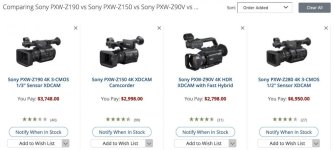
You can also compare up to 4 cameras on B&H which shows a list of all of the specs...a useful feature pending everything is correct and the camera is available to be compared.

B&H Comparison Tool.jpg
 
Thanks both! Yes, I should have thought of this method myself. On the caveat about accuracy - I have found that a LOT of the posted information is wrong. It looks like data from one set of specs is copied into the listing of a similar piece of equipment. But it is a good starting point for sure.
 
The info for newer cameras is much more accurate, especially more relevant ones like cinema cams and mirrorless systems.

Data input 10, 20+ years ago was archaic compared to the way information is transferred and presented to us now. (One thing I love about B&H is they still archive products - maybe not everything - from a long time ago.)
 
As an example - the Sony PXW camcorder line. There's an X70, Z90, Z90V, Z100, Z150, Z190, X200, Z200, Z280.. and probably a few more. A

I understand the overall point you are making, and I don't necessarily disagree that the manufacturers should do exactly what you describe, but I would say you're over dramatizing the situation. It should only take someone a few minutes via the process of elimination to narrow down a list of the available cameras to just one or two models that actually need your serious consideration.

Tell me your budget, tell me what you mostly shoot, give me a list your top 10 "must have" features in order of importance, plus a list of 5 things you don't care about at all, and I will tell you exactly which Sony camera is best suited for YOUR needs. I'm never wrong. :)
 
Last edited:
Functional af
useful fov
fat enough colour depth
three rings
chip large enough to throw some dof
its only gonna be bettered by a 2/3 cam and 4.5 zoom.
canon just got it right - i don't know if that was skill or luck - luck probably
 
Functional af
useful fov
fat enough colour depth
three rings
chip large enough to throw some dof
its only gonna be bettered by a 2/3 cam and 4.5 zoom.
canon just got it right - i don't know if that was skill or luck - luck probably

Thanks for the answer. A couple more questions, if you don't mind.

How do you think the XF605 compares to the XF705?

How much experience do you have shooting with the Sony Z280?
 
I think the 605 is smaller and neater better af than the 705 - the 605 crosses a line that the 795 does not

i think the 280 has three small chips deep dof and narrow fov (like the ex1 i own) and however the af and codec have moved since the ex1 that the narrow “29mm?” Fov is a continued frustration for shooting broadcast human based docs

So yes i have certain biases that swing me heavily towards “25mm” or 4.5mm 2/3 start point. But i think the ability to shoot that eatablisher is well known in the doc industry not just a personal foible.
 
The MM logic of course is a lot “feel” but i bet a 705 + clothes toothbrush and laptop wont go in a carry on thinktank where a 605 will
the 605 - just feels like it crosses many of “my” line

we have z90 (good grab bag cam) ex1 fs7 c200 in the house and a heap of dslrs - the dslrs and 24-200 lenses eat chunks frim camcorders in many siuations. Im currently working with the arri lf and a lens set that starts at 20
 
If size is a really important consideration, then yes, the XF605 beats the XF705 and Z280. But for me, those two cameras are just about the right size and going smaller is not needed. I've never touched a XF605 so I can't really say anything else about it except for some things I can infer from having spent a few days with an XF705 last month. On paper, the two Canons are quite similar with what appears to be the same lens, imager, etc. So I think my opinion of the XF705 would mostly carry over to the XF605.

I found the picture quality of the XF705 and Z280 to me surprisingly similar outdoors in daytime. It was difficult to tell them apart if I didn't know which one I was looking at. However, the Z280 is about 1-2 stops better in lowlight with the exact same exposure settings. And since the Z280 can go to f1/.9, the actual difference between the two cameras was closer to 3 stops in 4K and even more in HD. That is a huge difference for documentaries, news, reality TV, etc.

If you think the 1" sensor of the Canons give them some kind of DoF advantage over the three 1/2" sensors of the Z280, you're mistaken. The problem with the Canons is that they are hobbled with a f/2.8-f/4.5 lens. So, for example, if you're going to shoot a typical interview and zoom in to a medium or long focal length, the Canon lens will ramp down to as much as f/4.5 -- thus destroying any advantage that the 1" sensor may have provided. In my testing, DoF on the Canon and Sony looked almost identical at most focal lengths when both cameras were running at the max. aperture. As we know from S35 and FF cameras, having a bigger sensor is of no advantage if you don't also use a nice fast lens. The same thing applies here.

Dealing with an exposure that ramps is bad enough, but the Canon is hobbled even further by not having variable electronic ND. With the Z280 I can shoot wide-open any time I want and then dial in just the right amount of ND to make the exposure correct. The Canon has old fashioned ND fitlers where one is going to be too much, and the next won't be enough. So a lot of times you won't even be able to shoot wide open for minimum DoF. For example, you might want to shoot at f/4.5 but you have to dial down to f/5.6 to make the exposure work. While the Z280 could easily shoot the same scene at f/1.9. If you ever have the opportunity to do some side-by-side testing, you'll see that your assumptions about the Canon's DoF advantage just don't hold up.

I did appreciate the wider focal length of the 15x Canon lens, but once again, the difference was not as big as you imply if you look at side-by-side shots. I'd have to be shooting in some pretty tight quarters for that litte wider FoV to make much difference to me. Personally, I much prefer the better telephoto capability of the 17x lens on the Z280 for sports, wildlife, news, documentaies, etc. I wouldn't expect you to agree because I know have different shooting styles. To each his own.

AF performance was about the same on both and I couldn't see any advantages for one vs. the other. But the MF focus ring on the Canon is a joke. Trying to follow focus manually on a moving target was nearly impossible due to the very short focus throw and the really touchy fly-by-wire performance. Awful. When you consider both the camera's really bad peaking performance and the crappy MF lens control, I'd say that the Canon is built with AF shooters in mind.

I preferred just about every other facet of the Z280. Much better zebras. Superior edge-enhance peaking. Better and more codec choices. Two MI-Shoes for direct audio input from wireless receivers and powering lights. Timecode IN and OUT. Last Clip Delete. Duration counter. More control over clip naming. Clip name display in VF. User Box. Proxy files. Higher resolution VF and LCD panel. etc.

I could go on and on, but there's no way that I would agree either of the Canon's are better than the Z280. I've put the XF705 and Z280 side-by-side, have you? Granted, my assumptions about the XF605 might be wrong, but whenever the specifications and operation instructions are identical for both models I think there is a pretty good chance they would be nearly the same as the XF705.
 
Last edited:
AF performance was about the same on both and I couldn't see any advantages for one vs. the other. But the MF focus ring on the Canon is a joke. Trying to follow focus manually on a moving target was nearly impossible due to the very short focus throw and the really touchy fly-by-wire performance. I think there is a pretty good chance they would be nearly the same as the XF705.

Doug, I did take a serious look at the Z280 when shopping for a camcorder. For me the total price of the the camera, batteries, media, and media player came out to be around $10K USD, which was beyond my budget. I bought a Panasonic CX350 when it came out. The CX350 was reliable, however I found the camera's autofocus, lens quality, and color science not to my liking. Six months ago I sold the CX350 and bought a XF605. I find if I shoot interviews with the subject about 10' feet away and adjust camera exposure for f4.8 I can get a shallow enough dof and not have to worry about lens ramping. There is an interesting note in the XF605's owners manual regarding auto focus. At the bottom of page77 it states "• Autofocus may not work well on the following subjects or in the following cases. In such case, focus manually.....When the gamma curve component of the [Gamma/Color Space] setting in the custom picture file (A 123)
is set to an option other than [BT.709 Normal] or [BT.709 Standard]". I usually set the camera for WDR BT.709 when shooting interviews. https://gdlp01.c-wss.com/gds/3/0300042793/02/xf605-im2-en.pdf. Does the Z280 have the same type of caveat? By the way, my first camcorder was a Sony PD-150 which I remember fondly.
 
Canon says that for all of their cameras (or many) supposedly because of the lack of contrast in other options.
 
I find if I shoot interviews with the subject about 10' feet away and adjust camera exposure for f4.8 I can get a shallow enough dof and not have to worry about lens ramping.

My point wasn't that you couldn't shoot a decent looking interview with the XF705, XF605, or Z280 despite them all having small sensors. I've done it plenty of times myself. My point was that if someone thinks there is a shallow DoF advantage to a 1" sensor at f/4.8 vs. a 1/2" camera at f/1.9 they are delusional.

Does the Z280 have the same type of caveat? By the way, my first camcorder was a Sony PD-150 which I remember fondly.

No, Sony doesn't make any such warnings in the manual and I have not experienced any AF problems during shooting with LOG. However, with that said, I don't use AF or S-LOG very often on my Z280 so I cant say i have a lot of experience with that combo. However, with that said, I do use AF and S-LOG together on my FX6 and there is absolutely no performance difference on that camera.
 
It seems like that caveat would make it real tough to shoot LOG with either of the Canon cameras -- they admit AF won't be any good, and I can attest from personal experience that manual focus on the XF705 (and I assume on the XF605 since it appears to have the same lens) is a terrible experience. Crappy peaking, short throw on the focus rings, and super touchy response due to focus by wire. By contrast, the Z280 is real easy to focus manually -- or use AF if you prefer. Either way is good.
 
FWIW, I went from the XF400 --> FX6 and (for me) the killer feature for the sony's is the eVND. It changes the way you shoot and just works. Set you Aperture and Shutter Angle for the desired look, and let the eVND control the exposure. I would not go back to ND wheels or filters.
 
Back
Top