Ikonoskop back in business under new management

Well, interesting conversations all around, but the bottom line is, Ikonoskop is no longer manufacturing cameras.

They will still offer tech support for current owners, when and if they have a new website up. I don't know how long they can keep that up without a good income stream. As far as parts, we can assume there will be no more spares produced.
They might design a new camera, if they feel there is a market for one. But as for now, I wouldn't bet on it.

I wonder what the used market will be for these cameras, especially with a proprietary media card that is no longer produced. Or any spare parts. Or, possibly, no tech support.

The company that purchased Ikonoskop will be servicing the cameras for the foreseeable future, they are also going to be supplying spare parts as well as memory cards. The first batch of cards is coming out soon. The guys that run www.rawcinemashop.be are Ikonoskop fanatics and I think they will stay focused on the cameras since there is a healthy rental market for them in Europe.

I can't imagine selling mine since I'm just starting to really dial in how to use the camera properly after a year of ownership. I've actually thought of pairing it with a 1DC for static 4k wides downscaled to HD for a doc i'm doing in West Africa but for people and faces there's nothing else I'd use.
 
The only real practical difference that most people will notice between CCD and CMOS is that CMOS tends to come with some degree of rolling shutter. How severe depends on the camera - from appalling on some mobile phone video to "rarely a problem" on such as Red. And yes, Red and Alexa are CMOS, as are the F5/55.

And as the F55 proves, CMOS does not necessarily mean rolling shutter at all.

Aliasing and moire have absolutely nothing to do with whether the chip is based on CCD or CMOS technology. They are solely functions of how the physical layout of the photosites relates to fine detail in the image - the technology of how the photosite converts light to electric charge (CCD or CMOS) is irrelevant.

Yes, an OLPF will cut out the too fine detail, and hence the aliasing, but the cut off is not abrupt. Consequently, designers have to make a trade off between aliasing and excessive softening in choosing the cut off of the OLPF. Hence, a good OLPF is only part of the answer. The chip needs to be designed with oversampling as well - so that the the OLPF can do it's work on frequencies that are out of band. Hence the reason why such as the Alexa has far more than 1920x1080 photosites for a 1080p output.

Start with a 1920x1080 chip and no matter how good the OLPF, there must inevitably be a compromise between aliasing and softening. CMOS/CCD considerations are irrelevant in this respect.

Aliasing and moire occur at the detail frequency that the camera can't resolve. When it occurs it pollutes detail at much lower frequencies, so in effect you actually get less clean resolution than you would with a properly matched OLPF. At the maximum clean resolution, the camera with OLPF will show the detail with smooth edges, without the OLPF you get aliased edges that give a superficial impression of extra detail, but it isn't real.

We are talking about low end cameras here. DSLR's either don't have OLPF's or they aren't matched well for their video resolution and they have other scaling issues that make the problem worse. The BMC's have no OLPF.

With an OLPF the only aliasing that occurs happens with detail that is beyond the maximum resolution of the format. For HD or 2K footage that occurs at about 1.6-1.7k horizontal resolution. If the camera is filtered to produce maximum detail below that level there will be no aliasing or moire in the image.

For my intended use such artifacts are unacceptable. I want a smooth organic film like well resolved image. Not false detail and artifacts. Compression artifacts aren't acceptable either. So any form of compressed video codec camera is out. The finished work may not even be encoded to conventional video formats.

A Scarlet or Epic would be great, but obviously not affordable for most as a hobby cam. The top end cameras, Red, Alexa, and Sony all have properly matched low pass filters.

At sub $5k price ranges for a camera body, every camera comes with a host of compromises. Which compromises you choose depends on what you need vs what you can afford to pay.

From actually working with raw footage, the Ikonoskop and the Digital Bolex are the cameras that can produce the texture and color qualities I want in the finished image that are reasonably within reach.

Ikonskop frame sample:
10326971344_5416e978db_b.jpg


Bolex frame samples:

9673328247_c3ac5d4759_b.jpg


A frame from Philip Bloom's samples:

11646360903_f74d744449_b.jpg
 
Last edited:
I would like to see Ikonoskop vs DigiBolex shootout side by side. It would be very interesting. And maybe with BMPCC and SI-2K too :)
 
Last edited:
I would like to see Ikonoskop vs DigiBolex shootout side by side. It would be very interesting. And maybe with BMPCC and SI-2K too :)
Here you go:
https://vimeo.com/82535105
It's obvious D16 is inferior in low light. Other thing nobody is talking about with CCD's is vertical light streak, which is frequently hard to control. I don't see any difference between the colors on D-16 and Pocket, however I see a huge amount of noise even on ASA400 on D-16 footage in comparison. And it looks nothing like film grain, but just plain old CCD noise.
 
Aliasing and moire occur at the detail frequency that the camera can't resolve. When it occurs it pollutes detail at much lower frequencies, so in effect you actually get less clean resolution than ........
I don't disagree with any of that - but it could be as easily true of a CCD sensor as CMOS. I was replying to your quote: "........suffer from the same low end CMOS artifacts as other cheap cameras, shooting raw or prores. The worst of these IMO is aliasing and moire which ......"
With an OLPF the only aliasing that occurs happens with detail that is beyond the maximum resolution of the format. For HD or 2K footage that occurs at about 1.6-1.7k horizontal resolution. If the camera is filtered to produce maximum detail below that level there will be no aliasing or moire in the image.
Sensor aliasing is nothing to do with *format* resolution, everything to do with fundamental *sensor* resolution. It's down to when the fineness of the detail becomes finer than the spacing between photosites. Your comment about needing to filter detail finer than 1.6-1.7k to minimise aliasing is only true for the 1920x1080 Bayer sensor that such as this and the Digital Bolex use. Use a higher resolution sensor (as the Alexa, F3 etc) and unwanted detail can be suppressed by a suitable OLPF without also suppressing detail that falls within the format resolution capabilities.
For my intended use such artifacts are unacceptable. I want a smooth organic film like well resolved image. Not false detail and artifacts.
That's fair enough - but design a camera around a 1920x1080 sensor, and it has to be accepted that any OLPF that will suppress aliased detail to the extent you wish (virtually nil at 1920 horizontal res) must also suppress detail that would normally be considered wanted in a 1080 system camera. If you're happy to accept that "a smooth organic film like well resolved image" will be roughly equivalent to not much better than 720p standard - fine, a 1920x1080 sensor with suitable OLPF is OK, especially given all the facts about giving RAW etc.

Even expensive OLPFs don't cut off that finely. To get what you want means little res at 1920 horizontally - the 1.6-1.7k you talk off will be round about the 50% mtf point. But that means it'll be not until around 1300-1400 horizontally you're getting back up to high mtf percentages, which is why I say "roughly equivalent to not much better than 720p standard".

And all this leaves aside colour aliasing, due to the Bayer patterning. For red and blue, you're effectively looking at photosite matrices of 960x540 for each - and that's what will determine the chroma alias responses.

The comment above about "......fundamental *sensor* resolution. It's down to when the fineness of the detail becomes finer than the spacing between photosites." does need a little qualification. It's true when the sensor is read in the best way possible - but not when it's done in a simplified manner, as with nearly all DSLRs etc. In that case, the photosites get grouped, and the sentence above should read "It's down to when the fineness of the detail becomes finer than the spacing between grouped photosites."
 
Here you go:
https://vimeo.com/82535105
It's obvious D16 is inferior in low light. Other thing nobody is talking about with CCD's is vertical light streak, which is frequently hard to control. I don't see any difference between the colors on D-16 and Pocket, however I see a huge amount of noise even on ASA400 on D-16 footage in comparison. And it looks nothing like film grain, but just plain old CCD noise.

D16 has the same effective sensitivity as film stocks in the 100-500 ISO range. It is not, nor is it intended to be a low light camera. But you guys are looking at vimeo videos not the raw data in an image processor. Less than 10% of the original raw data for the 1GB 1080p download. BMD film log is not a good starting point for grading D16 raw footage as it sacrifices too much data in the deep shadow areas (compression).
Vertical streaking is not an issue with interline CCD's like the Sony's and Kodak's anywhere near normal exposures. It takes 300x exposure above white clip for vertical streaking to show on the Kodak.
The D16 is superior to my eye in color saturation and fine color discrimination. It is better at producing accurate saturated warm colors, deep reds, yellows, browns. It is completely free of aliasing artifacts and chroma moire. These begin to occur on cameras without OLPF at detail frequencies equal to twice the diagonal dimension of a single pixel. The pocket cam is ugly in this respect, especially on a large projection screen.
Chroma aliasing is not an issue with high quality debayer processing.
 
Last edited:
I don't disagree with any of that - but it could be as easily true of a CCD sensor as CMOS. I was replying to your quote: "........suffer from the same low end CMOS artifacts as other cheap cameras, shooting raw or prores. The worst of these IMO is aliasing and moire which ......"

Sensor aliasing is nothing to do with *format* resolution, everything to do with fundamental *sensor* resolution. It's down to when the fineness of the detail becomes finer than the spacing between photosites. Your comment about needing to filter detail finer than 1.6-1.7k to minimise aliasing is only true for the 1920x1080 Bayer sensor that such as this and the Digital Bolex use. Use a higher resolution sensor (as the Alexa, F3 etc) and unwanted detail can be suppressed by a suitable OLPF without also suppressing detail that falls within the format resolution capabilities.

That's fair enough - but design a camera around a 1920x1080 sensor, and it has to be accepted that any OLPF that will suppress aliased detail to the extent you wish (virtually nil at 1920 horizontal res) must also suppress detail that would normally be considered wanted in a 1080 system camera. If you're happy to accept that "a smooth organic film like well resolved image" will be roughly equivalent to not much better than 720p standard - fine, a 1920x1080 sensor with suitable OLPF is OK, especially given all the facts about giving RAW etc.

Even expensive OLPFs don't cut off that finely. To get what you want means little res at 1920 horizontally - the 1.6-1.7k you talk off will be round about the 50% mtf point. But that means it'll be not until around 1300-1400 horizontally you're getting back up to high mtf percentages, which is why I say "roughly equivalent to not much better than 720p standard".

And all this leaves aside colour aliasing, due to the Bayer patterning. For red and blue, you're effectively looking at photosite matrices of 960x540 for each - and that's what will determine the chroma alias responses.

The comment above about "......fundamental *sensor* resolution. It's down to when the fineness of the detail becomes finer than the spacing between photosites." does need a little qualification. It's true when the sensor is read in the best way possible - but not when it's done in a simplified manner, as with nearly all DSLRs etc. In that case, the photosites get grouped, and the sentence above should read "It's down to when the fineness of the detail becomes finer than the spacing between grouped photosites."

Nyquist theory basically says that to resolve a particular resolution fully requires 2:1 sample. I've seen an MTF chart on the Alexa, which does have a very nice OLPF, and it hits 10% MTF at 1.6k with oversampling. We aren't seeing what we think we see with resolution in HD. HD video is a square pixel format and it will alias with excess detail above 1.6k regardless of the source or how it is oversampled. If the camera doesn't the display will, even with 3-chip 1080p cameras. TV's alias, projectors alias.
These days color aliasing with Bayer sensors is the sign of a low grade debayer algorithm. It has effectively been eliminated with better debayer processors. Chroma moire from spatial frequency detail only occurs with cameras that don't have a well matched OLPF. No pixel defined format can fully resolve to its pixel resolution, it is physically impossible. Bayer video cameras show chroma aliasing due to inferior debayer algorithms used internally to meet real time processing requirements. The best debayer algorithms require 200 times or more the processing power of the simpler ones. With current state of the art these will not run real time on most computer systems even with high speed GPU processing. You have to get to Alexa price range cameras to see something close in a camera. Low end cameras still use pretty primitive algorithms by comparison.
 
Nyquist theory basically says that to resolve a particular resolution fully requires 2:1 sample.
Nyquists theory states that in this context you require AT LEAST two samples to resolve a *line pair*, ideally more.

But for video, it's more usual to not talk in terms of line pairs, but rather lines, and in particular "lines per picture height" or lpph. Hence, if a camera will resolve 800 line pairs, horizontally, it's the same as 1600 lines, or 1600*9/16 (=900) lpph. Lpph is a way of normalising figures such that the same basic resolution gives the same figure regardless of whether we are talking about horizontal or vertical resolution.

Consequently, if you are referring to figures like 1.6k horizontally, you are implying lines of resolution - not line pairs - and in that case the required number of samples is (at least) 1:1. It would only be 2:1 if you were referring to line pairs.
I've seen an MTF chart on the Alexa, which does have a very nice OLPF, and it hits 10% MTF at 1.6k with oversampling. We aren't seeing what we think we see with resolution in HD. HD video is a square pixel format and it will alias with excess detail above 1.6k regardless of the source or how it is oversampled.
I'm assuming by 1.6k you are referring to lines of resolution horizontally? Which from above translates to 900lpph assuming a 16:9 system. The best link I know of to charts shot with the Alexa, F3 and Red is at Adam Wilts site: http://provideocoalition.com/awilt/story/ag-af100_and_pmw-f3_on_the_charts/P2 And it's pretty obvious that all three of them are easily resolving past 900lpph at more than 10% mtf, probably past the 1000lpph mark.

It's also clear that different manufacturers have gone for different trade offs between sharpness and aliasing, especially coloured aliasing, and that's highly likely to be down to how aggressive the OLPf is. The F3 have permitted a level a colour aliasing to keep up the resolution, the Alexa is somewhat less sharp - but virtually totally eliminates the colour aliasing. But all three of the cameras have an oversampled Bayer sensor (more than 1920x1080) which can only help. The coloured aliasing on the F3 is centred somewhere around the 1300lpph mark because that's the vertical photosite count of the sensor. Any camera with a 1920x1080 sensor will have it around 1080lpph. The only way to eliminate it will be with a sufficiently fierce OLPF - but that will necessarily drop the real resolution to somewhere around 700-800lpph. (Equivalent to about 1250-1400 horizontal lines.)
These days color aliasing with Bayer sensors is the sign of a low grade debayer algorithm. It has effectively been eliminated with better debayer processors.
That is simply not true. On the chart above, we've seen the chroma aliasing for the F3 is largely around the 1300lpph mark, close to the row/column spacing dimensions. That's not a coincidence. What is happening is that the white lines are tending to line up with rows/columns which are R,G,R,G,R etc and the black lines B,G,B,G,B etc (or vice versa). Consequently, as far as the chip is concerned, it may as well be illuminated with red+green (yellow) light, or blue+green (cyan) in the vice versa case. No deBayering algorithm is capable of dealing with that, no matter how sophisticated.

The only answer is to use an OLPF to filter such detail out - but then you need to oversample to retain system detail up to 1000-1050lpph. Use a 1920x1080 chip and that's not possible. You can't have your cake and eat it. Sorry, I know you like the Digital Bolex, but there's no getting away from the laws of physics. That's not to rubbish it, or the Ikonoskop, and I'm fully aware of price implications and comparisons, that 700-800lpph may well be good enough for many uses, the benefits of RAW etc - but it's just plain wrong to make out it will perform up to 1080 system spec with no chroma aliasing. Such a chip can't.
 
I'm not saying a 1080p Bayer chip will perform like an oversampled higher resolution chip. But it will come closer than you might think. TV systems measure vertical resolution in TV lines, which counts a line pair as two lines rather than counting pairs as by the lpph method. Maximum lpph for 1080p regardless of source is 540, but this will show aliasing on diagonals, again regardless of source. The effective upper limit of vertical resolution for smooth non aliased reproduction with 1080P is about 800 TV lines give or take.

But debayer algorithms do make a significant difference in chroma aliasing if you have the processing power and/or time to implement the better ones. We are talking seconds per frame rather than frames per second. Not practical for real time video cameras, but usable for DNG raw cameras if you don't mind the wait.

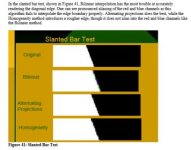
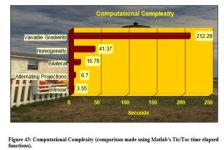
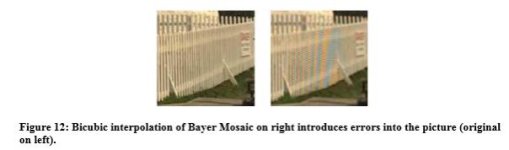
slanted bar test.jpgHomogeneity vs AP.jpgComplexity.jpg
 

Attachments

  • Bicubic demosaic.jpg
    Bicubic demosaic.jpg
    12.6 KB · Views: 0
Last edited:
TV systems measure vertical resolution in TV lines, which counts a line pair as two lines rather than counting pairs as by the lpph method.
No, not true. "Lpph" does NOT count in pairs. It stands for "lines per picture height, *NOT* "line pairs per picture height".

As I said above "Lpph is a way of normalising figures such that the same basic resolution gives the same figure regardless of whether we are talking about horizontal or vertical resolution. Vertical resolution will automatically read in lpph - horizontally, you need to divide resolution by the aspect ratio to get the lpph figure. (So multiply by 9/16 in the case of widescreen TV)

Maximum lpph for 1080p regardless of source is 540, but this will show aliasing on diagonals, again regardless of source. The effective upper limit of vertical resolution for smooth non aliased reproduction with 1080P is about 800 TV lines give or take.
Bearing in mind the above, the max lpph figure is 1080, not 540. Yes, it's true that any practical system will never reach that figure (Nyquists theory states that you require AT LEAST two samples to resolve a line pair) - but around 1000lpph is perfectly possible. Not just possible, but happens, and the link posted earlier proves it. Both for oversampled Bayer sensors, and 3x1920x1080 designs - at the bottom of the page a chart clearly shows an EX1 resolving real detail past 1000lpph.

I think you may be confusing the facts for interlace and progressive. It's quite true that for 1080i, the vertical resolution is nowhere near 1080, and 800 lpph is a reasonable figure. (Practically, it depends on compromising sharpness with interline twitter, so any exact figure is impossible.) But for progressive that's not the case, and resolutions of 1000+lpph are quite achievable.) If you still don't believe that, try Alan Roberts tests on the EX1 for the BBC - https://tech.ebu.ch/docs/other/WHP034-ADD30_rev2_Sony_PMW-EX1_and_EX3.pdf .

Yes, some deBayering algorithms are better than others, but even the best cannot dredge up something that is not there to start with. They can only do the best with what they have. And since for a 1920x1080 sensor, the red, blue dimensions are 960x540, that sets an upper limit to how good chroma performance can be.

The Alexa results can give us a pretty good idea of what performance we may expect from a 1920x1080 Bayer sensored camera with an OLPF to fully cut out undesired aliasing. (As the Alexa seems to just manage about 1000lpph from a 2880x1620 sensor.) It's basically needing 1.5x the photosites for a given clean resolution (approx. 1000 needs 1620). Use that for a 1920x1080 camera and if you want to exclude any aliasing, don't expect more than 1080/1.5 lpph. In other words, it'll give very good 720.
 
Back
Top