I think this is an important issue...

I really have tried getting into higher frame-rate movies, falsely believing that it is something that I could get used to and that when I did it would be better, but it just feels off and I really don't believe that it is because I am used to "24p" content. I was born in 1985, so I have grown up with a variety of different content, from film, video games, TV, VHS, MiniDV, HD, etc.

I honestly believe that 24fps better emulates the way that human vision operates than higher frame content. Yes, we can perceive content faster than 24fps, but I believe that the subjective way our brain chooses what to focus on is most closely emulated by 24fps and the inherent motion blur of the format.

Video games & Virtual reality etc might work better in higher frame-rates as they are more geared to trying to emulate reality than movies, with the goal of ultimately crossing the "window to the world" threshold. But most movies don't really strive to be a "window to the world", but to create an alternate world.

Movies will stay in 24fps, and it isn't because of cost or technical reasons, but because it just looks & feels better. It's the same reason that people still chose to paint in a world where cameras exist... sometimes being closer to reality doesn't automatically bring more meaning to a work of art.
 
I wonder, how many people actually watch movies at a display that is set for 24p at home?

Whenever possible I watch all 24p (or mostly 23.976p) sources at the original framerate but it does take some effort to set that up, some effort I suspect most people will not take.
 
Until the smooth mode TVs werent all displays set for 24p? Sure pulldown may be used but it always LOOKED right. Except in those rare cases where you a bad transfer and it looks off.
 
I wonder, how many people actually watch movies at a display that is set for 24p at home?

Whenever possible I watch all 24p (or mostly 23.976p) sources at the original framerate but it does take some effort to set that up, some effort I suspect most people will not take.
Whether they are aware of it or not, most people have been watching 24p / 23.976p content at home for years via pull-down at 60i. This isn't just movies, but almost every dramatic TV show and even most big-budget commercials & music videos are finished at 24p / 23.976p.

It is only recently with the advent of the motion interpolating TVs that this is changing, though most consumers are yet again unaware of the differences without seeing things side-by-side. I was watching a movie with someone the other night who had their TV setup in almost every way that was painful to my eyes (vivid color, motion-smoothing, dynamic contrast, etc). and they just hadn't bothered changing any of the settings out of the box.

That said I know that people can tell the difference even if they aren't aware of why. 10 years ago at a short film festival at my college my dad asked me why only mine and one other student film looked like "movies" while every other film looked like home-video, and it was because only the 2 of us had chosen to shoot our films on our own DVX100As, while the rest of the students had simply used whatever 60i Sony camera the school had in stock.
 
Whether they are aware of it or not, most people have been watching 24p / 23.976p content at home for years via pull-down at 60i. This isn't just movies, but almost every dramatic TV show and even most big-budget commercials & music videos are finished at 24p / 23.976p.
That's not watching 24p.

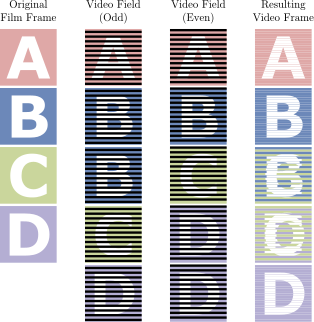
And that's a bit of my gripe here, so it is an issue to have intermediate frames but it is apparently not an issue to "cut up" frames and map them onto 60i?

314px-32pulldown.svg.png
 
That's not watching 24p.

And that's a bit of my gripe here, so it is an issue to have intermediate frames but it is apparently not an issue to "cut up" frames and map them onto 60i?

314px-32pulldown.svg.png
There is a dramatic difference between watching 3:2 pull-down and watching motion interpolation. They aren't even remotely comparable in practice.

One retains the motion characteristics of 24p, while the other changes them.
 
There is a dramatic difference between watching 3:2 pull-down and watching motion interpolation. They aren't even remotely comparable in practice.

One retains the motion characteristics of 24p, while the other changes them.
I totally disagree, I think they are they are both just as bad.

Also try to see a good pan with a 3:2 telecine.

I think it is having a double standard to complain about frame interpolation while at the same time saying that 3:2 telecine is allright.
 
I wonder, how many people actually watch movies at a display that is set for 24p at home?

Whenever possible I watch all 24p (or mostly 23.976p) sources at the original framerate but it does take some effort to set that up, some effort I suspect most people will not take.

They all watch it as 24p in the theater and I rarely ever hear anybody complain about it. This is a made up issue by a very tiny niche of the video/film making community which is also a tiny niche. Most consumers never asked for this feature and manufacturers just started forcing it on consumers so they could sell more TV's.

Of course 3:2 pulldown is still 24p. It isn't 60i and the cadence of 24p is still there. 3:2 was just the way to package up the frames to mathematically fit into a 60i signal. The cadence is still 24p with a bit of duplication thrown in to force it to fit. Most consumers since the 70's have been used to seeing movies on beta and VHS with pulldown and it too has been a norm and very few ever actually complained about it. The only thing I ever heard people complain about was letter boxing because the idiots thought the movie was cut off.
 
I totally disagree, I think they are they are both just as bad.

Also try to see a good pan with a 3:2 telecine.

I think it is having a double standard to complain about frame interpolation while at the same time saying that 3:2 telecine is allright.


3:2 is a duplication of frames to fill in the gaps. Nothing new is created. Motion smoothing creates fake in between frames in the same exact way that optical flow slow motion does.
 
I totally disagree, I think they are they are both just as bad.

Also try to see a good pan with a 3:2 telecine.

I think it is having a double standard to complain about frame interpolation while at the same time saying that 3:2 telecine is allright.
Frame interpolation specifically add frames that were never filmed and changes the way the content looks and moves, while 3:2 pull-down is merely an imperfect way to view the same content... it looks and moves the same but at a slight loss of image quality.
 
Most consumers since the 70's have been used to seeing movies on beta and VHS with pulldown and it too has been a norm and very few ever actually complained about it.
Tape and DVDs where telecined if you were lucky, many were simply converted to 60i using frame blending. But even the telecined versions had problems, sometimes the fields did not even match up spatially to form a frame and cadences were interrupted frequently. Or even worse 24p sources that turned out doubly interlaced causing artifacts that are practically impossible to remove. Those problems existed even when DVDs became mature. Only after most DVDs were encoded with soft telecine problems went away.

The argument that 'consumers cannot see it so it is not important' is not something I am willing to agree with.

24p is part of the HD Broadcast standard and, assuming they do not use it, I don't know, I don't have TV, is yet another example of the inflexibility of US broadcasting (Europe does not have these problems, in the 50i world you simply render 24p at 25p and then faux interlace it) compared to for instance Japanese broadcasting.

But I guess I am alone in seeing an issue with 3:2 telecined material.
 
Last edited:
But I guess I am alone in seeing an issue with 3:2 telecined material.
Nobody is saying that 3:2 pulldown was ever a perfect representation of the original 24fps source material. Obviously like any conversion process, it resulted in a compromised version of the original material. However, when the pulldown is applied properly and it is viewed on an older interlaced TV (not a computer screen), I would not hesitate to say that 99.999% of people would NOT be able to tell the difference, even when viewing a 3:2 pulldown side-by-side with a true 23.976p image.

The point is that 3:2 pulldown is not even remotely comparable to motion smoothing / interpolation, which creates a distinct visual difference from the original material.
 
Even if you were able to get the playback timing perfectly worked out you’d still be missing the flicker, gate weave, stutter, and dust and scratches which are also essential film attributes, film being, after all, a physical thing. And if you were able to able to faithfully reproduce all of that you still wouldn’t have a real film experience just sitting in your living room and watching, because film was also a social experience. Film is historically experienced in a dark room, a dream shared with strangers whose names you’ll most likely never know and who you’ll never see again. The only way you’ll really be able to experience all that is to go to a traditional cinema. One that still has a projector and a projectionist.
 
I'm with the camp that says the difference between watching "real 24p" vs pulled down is negligible. When you watched Buffy on TV back in the late 90s or whatever it looked fine. Any sitcom shot on film looked fine. Commercials on film look fine. They look right, they look correct, nothing weird off about the motion/strobe. There are occasional examples of shows where it does NOT look right...I would swear it's generally shows like Republic of Doyle that (I assume) are shot/finished in PAL.
 
Is that actually true?

My understanding is that 24fps was chosen as the minimum rate to enable a minimal quality soundtrack on the celluloid, film after all was and is expensive.

The reason that it was chosen because it gave a "magic" look seems more like myth making than history to me.

It may not be the reason it was chosen (no one really knows for sure), but it's the reason it was kept. It could have been changed decades ago, and god knows Douglas Trumbull has been relentless in trying to prove people want it to, but it sticks because it's what people prefer. Fiction feels better when it doesn't look live.
 
I'm with the camp that says the difference between watching "real 24p" vs pulled down is negligible.

It is. I can tell the difference between 24 fps and 25 fps, but I can't see the difference between straight 24 fps and 24 frames in 2:3 pulldown in a 60 fps stream.
 
Back
Top