
Navigation
Install the app
How to install the app on iOS
Follow along with the video below to see how to install our site as a web app on your home screen.
Note: This feature may not be available in some browsers.
More options
You are using an out of date browser. It may not display this or other websites correctly.
You should upgrade or use an alternative browser.
You should upgrade or use an alternative browser.
I need a cheap wide angle lens. Recommendations?
- Thread starter daktulus
- Start date

David W. Jones
Veteran
My go to wide would be the Tokina 11-16mm
vision_filmz
Carbonite Member
I need a wide angle lens that is wider than my 18-55mm zoom lens.
As far as I know the Canon wide angle lenses are pricey, is there a cheap one from a different manufacturer?
Any recommendations?
Sry, this should be in the glass section ... thx anyway.
Tokina 11-16mm cost $500-$700 (used-new)
Your other option is the Rokinon 14mm which people say is pretty good
http://www.amazon.com/Rokinon-FE14M-C-Ultra-Canon-Black/dp/B003VSGQPG
Other than that these Dslr Canon cameras weak point is shooting extreme wides, so be careful.

ROCKMORE
Veteran
I need a wide angle lens that is wider than my 18-55mm zoom lens.
As far as I know the Canon wide angle lenses are pricey, is there a cheap one from a different manufacturer?
Any recommendations?
Sry, this should be in the glass section ... thx anyway.
The Tokina 11-16 is good but does distort round objects such as human heads to the outsides of the frame. Still a great lens.
I believe the 14mm Bower is a fisheye so it has other distortion characteristics to factor in and has no auto focus.
The 10-22 Canon is great but variable aperture and expensive.
What I'm getting at is all these lenses have vastly different distortion from one and other and they will all set you back plus or minus 500 bucks.
Another cheaper choice in the mean time is a wide adapter on the front of your canon 18-55 to experiment with until you have more cash and know which ultra wide lens will suit your style of shooting and subject. I have a Century Precession x.6 wide adapter I used on the Canon 18-55 and now on the Tamron 17-50 2.8 non vc. It does distort straight lines, but with organic shapes like heads they tend to look more normal than the Tokina, and I still have about an 12 mm field of view. Wide adapters do get soft on the edges but for the price a good learning experience.
The best money saving technique is take your Canon to a camera shop that will let you test everything in the store then take the camera card home and judge the results for yourself. 9 times out of 10 the results will be different than what you imagined.
http://www.ebay.com/sch/i.html?_nkw...adapter&_osacat=0&_trksid=p3286.c0.m270.l1313
Last edited:

Samuel H
Major Contributor
I'd say the tokina has as little distortion as such a wide angle lens can have - the samyang 14mm is not a fisheye, but it does have a lot more distortion than the tokina - also, the 14mm works on fullframe, but with quite nasty mustache distortion - apart from this, that 14mm is a very nice lens, sharp and cheap - photozone has nice distortion tests for all these lenses http://www.photozone.de/canon_eos_ff/532-samyang14f28eosff?start=1 - http://www.photozone.de/canon-eos/533-samyang14f28eosapsc?start=1 - http://www.photozone.de/canon-eos/666-tokina1116f28eos?start=1

Ted Ramasola
Veteran
11-16mm f2.8 Tokina
The Tokina 11-16 is good but does distort round objects such as human heads to the outsides of the frame. Still a great lens.
Tokina has very little distortion. Straight lines stay straight.
Every wideangle will "distort" stuff on the edges though, that's just completely normal. Don't put your face completely in front of the lens.
ROCKMORE
Veteran
Tokina has very little distortion. Straight lines stay straight.
Every wideangle will "distort" stuff on the edges though, that's just completely normal. Don't put your face completely in front of the lens.
They all distort differently. If you plan to shoot Architecture, by all means use a Tokina 11-16 or a canon 10-22 but if you plan to shoot people close up in a wide shot they will have alien shaped heads. That's why I recommend going to a camera shop and shooting your own tests to see for yourself what the result will be before spending the cash and then being surprised.
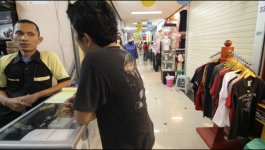
This is a test I shot in a store and shows severe distortion on round objects like human heads from the center of the screen to the edges.
It's wise to understand what will happen with your lens distortion to avoid unwanted problems before they become problems.
Test and learn.
Attachments


Last edited:
Samuel H
Major Contributor
if the second pic is not a crop from the center, but a corner crop with a different lens, this is very interesting: I guess the first crop if from the left side of the pic; it could look better if you move the left edge inwards (both vertically and horizontally), i.e. if the lens had some barrel distortion, instead of being so perfectly rectilinear - or maybe I'm overthinking this - anybody with a tokina and a samyang willing to run this side-to-side test?
ROCKMORE
Veteran
Can you show the entire still instead of a cropped/blow-up portion of the frame?
Here are the full shots, This test showed me the Tokina won't be the best solution for everything. The straight lines look relatively normal, but to correct them comes with a compromise in other objects. Humans are the most obvious to spot unusual distortion.
(With the Tokina at 16mm, the distortion is much less however.)
Attachments

Last edited:
ROCKMORE
Veteran
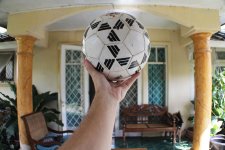
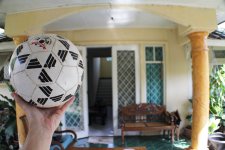
Here is another test with the Century x.6 wide on the Canon 18-55 which produces about a 12mm view. I placed the ball in a similar position to my store salesman head shot to see if there was any difference. The salesman became about 2 times wider at the side of the frame as he was in the center. The ball is also way closer to the lens than the head was and still looks normal.
Sometimes wide lenses are used to exaggerate distortion for effect and other times necessary to hide unwanted distortion.
In this test the pillars are very bent, but the ball is left unaffected by comparison from center to edge of the frame. In the case of shooting organic shapes like people in an organic setting such as nature this type of wide view may be a better choice.
I need ultra wide lenses in many cases to shoot closed spaces like public bus interiors where people are the main subject and fill the frame from center to edge. In that case the Toking would be distracting.
It's better to know what will happen from experience before your shoot. Testing lenses for yourself in camera stores is free and the best way to learn about lenses before buying them.
Attachments
Last edited:
Samuel H
Major Contributor
so there you have it: distortion is bad for architecture, but it can be great for shooting people - if you're on APS-C, that leaves the samyang 14mm as a near-perfect option (its only downside was distortion, sharpness and price were already great selling points) - does anybody have both lenses? can you run a test similar to this one?
ROCKMORE
Veteran
so there you have it: distortion is bad for architecture, but it can be great for shooting people
It depends. The Tokina 11-16 looks correct with straight lines like buildings and anything without objects that would look smashed up. This would also go for the Canon 10-22 which has little barrel distortion.
The Samyang has a lot of barrel distortion so it will most likely leave round objects intact, but kill straight lines.
A wide angle adapter can be a good low cost experiment to have in the bag.
At any rate go to your camera shop and test everything they've got for free, put the images on you computer and then decide where to put the cash.
Pick your poison
The problem is that the Tokina is being used way too close to the subject, and the Century seems pointless because what's the point of shooting a close up with a wide angle? I would take the Tokina and shoot properly with a wide than the Century adapter and make everything else look all wonky in the background any day.
Samuel H
Major Contributor
well, I've learned something very useful in this thread: the regular way of measuring distortion (those photozone charts) is not appropriate for every situation, there are times where you actually prefer a lens with "less distortion", precisely because it will distort your subject less (conclusion pending first hand or side-to-side confirmation)

cpc
Well-known member
The story with distortion is actually even more convoluted.
The same lens at different subject distances can manifest not only different amounts of distortion, but also different distortion types.
The Zeiss Distagon 21 is a well known example. It has moderate barrel distortion up close, and this turns into slight (but noticeable) moustache distortion going in the distance.
Figure distortion from wide angles is purely geometric. For the same angular section of the FOV outer portions of the FOV get mapped to a larger frame area. This leads to stretched figures. Barrel distrotion has a side effect of decreasing the border stretch effect by giving more frame space to the center and pressing borders outwards. But this can reverse the situation and lead to the opposite size problem (think fisheye, but toned down).
You can see on the ball pictures how the ball in the first picture is almost as big as the ball in the second even though the first is further away from the camera. In single head images this is not much of an issue, but in pictures with more people this may be noticeable. It is best to simply avoid shooting people with lenses that wide and use a lens with more uniform rendering across the frame.
Barrel distortion is apparently much stronger in lenses that are designed for camera systems with mirrors -- rangefinder wide-angle lenses are *almost* free of it (but are useless on SLRs):
http://www.rangefinderforum.com/forums/archive/index.php/t-110507.html
Rangefinders don't have mirrors for the lens to bump into, so the wide lenses can sink much deeper into the camera body, which allows them to be designed more simply and with less distortion.
The need to work around this, from what I understand, is also one of the reason SLR wide-angles tend to be as expensive as they are, typing relatively.
cpc
Well-known member
Barrel distortion is apparently much stronger in lenses that are designed for camera systems with mirrors -- rangefinder wide-angle lenses are *almost* free of it (but are useless on SLRs):
http://www.rangefinderforum.com/forums/archive/index.php/t-110507.html
Rangefinders don't have mirrors for the lens to bump into, so the wide lenses can sink much deeper into the camera body, which allows them to be designed more simply and with less distortion.
The need to work around this, from what I understand, is also one of the reason SLR wide-angles tend to be as expensive as they are, typing relatively.
Technically speaking it is the distance from flange to sensor/film that is the limiting factor. It's not that the simple design would bump into the mirror, but rather a simple symmetrical design for large flange focal distances is not really an option. And the side effect of stuffing mirrors in the camera bodies is the need for longer flange focal distances. When the focal length of the lens is similar to the FFD it can be designed as a (near) symmetrical lens. For (near) symmetrical lenses back focus distance is close to their focal length. Perfect symmetrical lenses have no distortion at all. Near symmetrical lenses have a bit. As rangefinders have much smaller FFDs than SLRs (for example, less than 29mm for Leica M vs 47mm for Leica R), they can benefit from this design.
SLRs on the other hand need different solutions, as their FFD is quite larger than the focal length of the wide lens. That's why wide SLR lenses like the Distagons/Flektogons are retrofocus (reverse telephoto) designs with long barrels and usually big front elements.