
Navigation
Install the app
How to install the app on iOS
Follow along with the video below to see how to install our site as a web app on your home screen.
Note: This feature may not be available in some browsers.
More options
You are using an out of date browser. It may not display this or other websites correctly.
You should upgrade or use an alternative browser.
You should upgrade or use an alternative browser.
HVX + Heli-cam
- Thread starter finchy
- Start date
Thomas Lew
Well-known member
Im' not sure but oh my god that sounds awesome lol.

Doc Bernard
Indie Arms Member
You are going to need a one with a large engine. Probably one of the "weedwhacker" custom jobs. Your standard .40 or .91 isn't going to have the lift ability for an HVX.
I used to fly a Raptor and then a custom .91. The learning curve is steep with RC copters. There is a program out there for training on your computer, which helps.
I used to fly a Raptor and then a custom .91. The learning curve is steep with RC copters. There is a program out there for training on your computer, which helps.

pmark23
Veteran
I've been seriously looking into this for the past few years, since I book a lot of helicopters for clients at $4000/hr(!).
The problem is that to get a good image you need a gyro (or two), and a remote helicopter that can carry a small camera, gyros, motorized head, and still get a decent height and move a decent speed is quite expensive. There are a couple rigs now that can do this, but they're huge beasts.
There's smaller rigs without gyros, but none of my clients would be interested in the shaky bobbing/weaving images. I believe someone here on DVXUSER made one.
Hi guys,
Actually the 90 size birds with the weed wacker motors are not the best choice for aerial video work as they have too much vibration. There are a few very good 90 size machines available which use electric motors for power and they are extremely smooth. There are also helicopters with turbine engine that work well in this enviroment although they are extremely expensive and very noisy.
I have been a professional R/C (remote control) helicopter pilot for over 17 years. I compete all over the world in contests. We do precision hovering and aerobatics. We have been doing aerial video and photography work for over two years. The electric powered 90 size models can carry the HVX 200 fairly easily. We are using the HPX 170 as it is a little lighter and we have no need for SD tape.
We and several others that do this type work with R/C helicopters are using gyro stabilized three axis (pitch, roll and pan) camera mounts which generate extremely smooth video. With the electric models we can easily shoot 24p at 1/60 shutter speed as long as we are very carefull when panning the camera, as you have to be anyway.
As Mr. Bernard pointed out, the learning curve is extremely steep. Both in learning how to safely fly the helicopter and in learning how to build a machine that is both reliable, and smooth enough to produce excellent video. To give you an idea, on my video machines every part that rotates or is mounted to a spinning shaft is dial indicated and red loctited to a tolerance of 1/4 of one thousanths.
R/C helicopters will never replace full scale helicopters for high altitude appliciations. The small machines have a real advantage though when it comes to working in tight places, down low and near objects.
I hope this helps
Wayne Mann
Derek Weiss
Member
The HVX and HPX are readily flyable by many electric heli's. I have about 40 shooting days with the HPX this year. Robust little camera that works great in the aerial world.
Wayne is spot on.....the learning curve is steep, and sometimes even steeper on your wallet when you put your favorite camera in the drink.

Wayne is spot on.....the learning curve is steep, and sometimes even steeper on your wallet when you put your favorite camera in the drink.
David Shawl
Active member
Awesome! What kind of video transmitters are you using for this?
A company call Range Video is where most of us get out video transmitters. They can be found at http://www.rangevideo.com/
Wayne Mann
Wayne Mann
We and several others that do this type work with R/C helicopters are using gyro stabilized three axis (pitch, roll and pan) camera mounts which generate extremely smooth video. With the electric models we can easily shoot 24p at 1/60 shutter speed as long as we are very carefull when panning the camera, as you have to be anyway.
I always thought that gyros were big and cumbersome. Are there special models for RC work? Can you show a picture or refer us to a website?

Postmaster
Dark Side of the Camera
I´m looking into something like that:

It´s way easyer to fly than every helicopter I ever tried.
There are several stabilistion systems aviable, even a GPS module that does the whole flight for you after you programmed the waypoints.
They can be build to sizes that can carry a HVX.
Here is a link to a Gyro system:
http://www3.towerhobbies.com/cgi-bin/wti0001p?&I=LXVA42&P=6

Frank
It´s way easyer to fly than every helicopter I ever tried.
There are several stabilistion systems aviable, even a GPS module that does the whole flight for you after you programmed the waypoints.
They can be build to sizes that can carry a HVX.
Here is a link to a Gyro system:
http://www3.towerhobbies.com/cgi-bin/wti0001p?&I=LXVA42&P=6
Frank

Tim Joy
Veteran
I always thought that gyros were big and cumbersome. Are there special models for RC work? Can you show a picture or refer us to a website?
For the R/C Heli world a gyro is an electronic device that stabilizes the bird by adjusting the servos that control yaw/ roll/ pitch for you as it senses movement in the specific direction. It really should be called a gyro-sensor.
You're thinking of gyros they use on the camera platform that are mechanical stabilization devices with high-speed "flywheels".
If you are interested in building a R/C heli cam, I would strongly advise against it, (I tried and failed miserably) because it is VERY expensive, time-consuming, and to get great shots you have to be a great pilot, which takes years of practice, leaving no time for anything else
 .
Check out this forum if you want some insight into the diffficulty.
Heli shots are cool, but IMO, they are a one-trick-pony. It's not like you're going to shoot a whole movie with one, so better off hire a person that has dedicated their life to it for that one cool shot.
Derek Weiss
Member
^^100% accurate, on every account.
Thanks for the explanations guys. I always thought of gyros as big bulky things used for stabilization, but I guess on a helicopter it's used more as a sensor.
I realize that flying a helicopter takes a lot of time and money, and I really don't have any intentions of doing it myself. But I may want to use an RC copter shot in the future, so I was just wondering how things are done.
I realize that flying a helicopter takes a lot of time and money, and I really don't have any intentions of doing it myself. But I may want to use an RC copter shot in the future, so I was just wondering how things are done.

pmark23
Veteran
There's two types of gyros. One type keeps the camera pointed in the right direction and level (and is used to make the helicopter easier to fly), and the other type -- much larger and heavier -- is used to dampen the vibrations. Two are needed to cover all axis.
Last time I priced-out building a setup from scratch, it came to around $20K!
Last time I priced-out building a setup from scratch, it came to around $20K!

boomstrikevideo
Active member
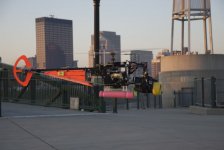
Getting a reliable, safe helicam system up and running that provides smooth video was much more work than I ever imagined. Like Wayne, I have been flying for a very long time so I had a lot of experience to draw from. I agree most would be well ahead to just hire someone with experience who has already done all the homework and rather focus on what you are already good at. Here is an example of some of the unique perspectives that can only be obtained with this type of equipment. These shots were taken summer before last.
http://www.vimeo.com/2638134
We use large twin cylinder gasoline powered models as these engines are as closed to balanced as an internal combustion engine can be and have very minimal vibration. They also are much more powerful and stable than the 90 size electric models, so they can get good results, even in moderate winds, and can carry cameras, like the Red One, weighing up to 25 lbs. without a problem.
Attachments

Joseph Stunzi
Veteran
Man I really wish I could get my hands on a rig like yours Wendell. It'd totally change some of the b-roll and opening shots of my new series!