GH5 How to get the best low light, high quality from a GH5

garya

Member
What's the best settings and gear to get the highest quality 4k video with the the lowest available light? How close to a Sony A7sii can we get the Gh5 for low light? As an example, I need to shoot interviews and B roll in a persons living room with maybe only one table lamp in the room. Another scene can be in a low lit bar so we can stay unnoticed as much as possible. The quality of extreme low light is important without the noise. I do not buy the saying it makes it look more film like.

I am still on the fence for buying a GH5 or an A7sii. I can live with a MFT sensor, but the quality of extreme low light is important. Would a good 17mm f0.95 be the best way? Is there such a thing as MFT to MFT speedbosster for a f0.95 lens on the GH5 and would that also help? What camera setup is best in a GH5 for for what I am asking?

I was hoping to maybe get an A7siii, but it appears to not be coming out anytime soon, if at all. The A7sii has problems that are well known with low life batteries, overheating with 4k, 8bit internal recording, no full articulating display, no 4k 10 bit internal recording, no 4k 60p and a large increase in the cost for the camera and full frame lenses. Although the camera is now only $2400 at B&H.

Would a good 17mm f0.95 be the best way? Is there such a thing as MFT to MFT speedbosster for a f0.95 lens on the GH5 and would that also help? What camera setup is best in a GH5 for for what I am asking?

I wanted a A7siii but it appears to not be coming out anytime soon. The A7sii has problems that are well known with low life batteries, overheating with 4k, 8bit internal recording, no full articulating display, no 4k 10 bit internal recording, no 4k 60p and a large increase in the cost for the camera and full frame lenses. Although the camera is now only $2400 at B&H.
 
It sounds like you really want the GH5, but given your extreme low light needs, the A7S will clearly have that particular advantage.

That said, as much as people will poo poo MFT low light, realize that current MFT sensors are cleaner than older generation full frame sensors, i would take a GH5 iso6400 over a 5d mark 2 iso6400. that isn't to say it isn't noisy, but the noise is more organic and cleanable in post.


iso is iso, and an fstop is an fstop, so you could take any camera you like to test out that situation to see what you need to actually achieve proper exposure (or... a light meter!)

f.95 at iso3200 on the gh5 may very well be workable for your situations, but the A7 undoubtedly would be the safer bet, and give you aperture flexibility to stop down and not have to hunt for focus in mm DOF.
 
I seem to remember that the maximum input aperture for a Metabones Speed Booster is f/1.26. That would indicate that there is no 'speed' advantage in using lenses with apertures larger than f/1.2. If this figure is correct then a f/0.95 lens would be operating at that f/1.26 maximum input of the Speed Booster. Best check with Metabones I guess or is there someone here who has experience with this combo?

Chris Young
 
Given your low-light requirements it really sounds like a Sony A7SII is a better fit. Both the camera and fast lenses will cost more than the GH5, but they will give you what you want.

Myself, I love the results from GH5 4K 10-bit footage, and am willing to bounce low-brightness fill lights off the walls or ceilings to make up for any low-light deficiencies the GH5 has. ( i.e. stick a light in a corner of the room and bounce it off a wall or ceiling, and dial it's brightness down so that the fill matches with the brightness of the practical lights already in the room )
 
You do not have to shoot in the dark. I have never had a customer object to soft full lighting. The exception being when it takes away from atmosphere, churches, etc. Whenever someone asked about the lights, I said "The soft lights hide blemishes, soften wrinkles and light up the eyes"! Really
 
I use the Voigtlander 25mm f/.95 and 42.5mm f/.95 on the GH5 and have no concerns about low light shooting with them. Formally I was an A7SII shooter and have never looked back. Both are good performers but the GH5 offers unmatched value and a superior feature set. Maybe the A7SIII will change that but the for now the GH5 is hard to beat.
 
"What's the best settings and gear to get the highest quality 4k video with the the lowest available light"- no matter what fast lenses you put on a GH5 the A7s will still be better for this scenario as if you put fast lenses on an A7s it will have a superior image in low light. If you wanted a camera for general video use that's another matter and I agree the GH5 is the better allrounder but this was not the OP's question.
 
A full frame sensor is not the end all in low light. How does the camera process 4K? 8 bit vs 10 bit? There is more to making a high quality low light image than the sensor. The A7S can use clean high ISO but has inferior 4K processing and limited to 8 bit. You have to look at the camera as a whole.
 
A full frame sensor is not the end all in low light. How does the camera process 4K? 8 bit vs 10 bit? There is more to making a high quality low light image than the sensor. The A7S can use clean high ISO but has inferior 4K processing and limited to 8 bit. You have to look at the camera as a whole.
Yes a 36x24mm frame sensor with big photsites IS the 'end all' when compared to a M43 sensor for low light / high ISO work - it's not even close. In what way does the A7s have 'inferior 4k processing'?
Yes it's 'only' 8bit but to an external recorder that's 4.2.2 with a superior low compression codec that is easily on par with the GH5's internal 10 bit codec. I owned and A7s and I own an A7r2 and GH5 and I can tell you that in low light / high ISO the GH5 is markedly inferior.
 
Thanx for the good info, Homerc67. This is the hands on info I was looking for. I know it will never be as good as an a7sii, I just want to know if I could use a fast f0.95 lense and get some clean footage for interviews and B roll.
 
I just want to know if I could use a fast f0.95 lense and get some clean footage for interviews and B roll.

Absolutely.

The only issue you may come across is, if you open up the Voigtlander all the way your depth of field will be quite shallow. Could prove problematic if your subject moves a lot front to back.

Not a deal breaker but just something to be mindful of.
 
Yes a 36x24mm frame sensor with big photsites IS the 'end all' when compared to a M43 sensor for low light / high ISO work - it's not even close. In what way does the A7s have 'inferior 4k processing'?
Yes it's 'only' 8bit but to an external recorder that's 4.2.2 with a superior low compression codec that is easily on par with the GH5's internal 10 bit codec. I owned and A7s and I own an A7r2 and GH5 and I can tell you that in low light / high ISO the GH5 is markedly inferior.

I’m just of the opinion that dropping another $1,000 for an external recorder with SSD could be better invested in lenses. By inferior I was speaking of the 100 mbit 4:2:0 xavc codec.
 
They can both be well performing low light cameras it’s just how you want to spend your budget. I just ran into more issues shooting with the a7sii, in particular banding with LED lights and it having no synco-scan setting.
 
I know it will never be as good as an a7sii, I just want to know if I could use a fast f0.95 lense and get some clean footage for interviews and B roll.

One interesting video to check out is from a pair of cinematic wedding shooters that shot with Sony A7SII cameras for the past 2 years, and then this year completely switched over to shooting with GH5 cameras. In this video they talk about shooting low-light with the GH5...

 
Also if you are doing the editing Neat video is your friend, I even had to use it on the a7sii at high ISO.
 
In what way does the A7s have 'inferior 4k processing'?

Shirozina asks the question "In what way does the A7s have “inferior 4k processing?" He is on the right track here. Just because the A7s is working in 8-bit doesn’t mean its performance is in any way is inferior to a 10-bit camera. Far from it when one evaluates and understands the cameras from the point of view the SNR (signal to noise ratio) and its impact on picture noise. Putting aside all other subjective observations such as the “look” or color and the overall aesthetics of a picture let’s look at camera comparisons from a hard cold technical unbiased point of view.

For me the first question that comes to mind when assessing noise besides any other features of any camera is. “What is the signal to noise ratio on this sensor?”
Let’s take the GH5 example. The GH5 has a SNR of just on 41dB (DXO Mark.) The 12.2 megapixel A7S has an SNR of just on about 46dB (DXO Mark.) As both Panasonic and Sony state that for their top end broadcast cameras to deliver a full 10-bit 422 signal pixel depth the camera has to deliver a signal to noise ratio close on 60dB as a 10-bit signal has a maximum dynamic range of 60dB. On the other hand an 8-bit signal has a maximum dynamic range of 48dB.

OK let’s pose the question. What is the Signal to Noise Ratio of a camera?

Signal to Noise Ration (SNR)

Let’s begin with the discussion of signal to noise (SNR) as it applies to a camera. It’s called the system SNR. After all, the image you see represents the system SNR not just the sensor SNR. A luminous scene imaged by an electronic camera converts light from photons to electrons. The electrons are signal processed, amplified and either read or stored in a camera system. Noise is added to the image signal each time it is detected, processed, and converted. In the classical mathematical representation, SNR for an image is defined as the ratio of the light detected on the sensor to the sum of the noise in reading the signal. SNR is expressed in units of power or decibels (dB).

The formula for deducing the signal to noise ratio is as follows:

SNR is expressed in units of power or decibels (dB).
SNR (dB) = 20log (Signal e- / Noise e-)
These are the resultant figures for 8 to 16-bit pixel depths.

8-bit 256:1 48dB Dynamic Range
10-bit 1024:1 ( 4x Increase) 60dB Dynamic Range
12-bit 4096:1 (16x Increase) 72dB Dynamic Range (Some may remember this # from Dolby C days)
14-bit 16384:1 (64x Increase) 84dB Dynamic Range
16-bit 65536:1 (256x Increase) 96dB Dynamic Range (Look familiar? The good old audio CD)

However, in a 10-bit recording saying that all 10-bits represent the actual image signal without noise is not correct. The originating analogue signal has noise mixed in and this signal is converted into the digital domain. In fact, the process of converting the analogue signal to a digital signal introduces additional errors called quantization noise. Quantization noise is reduced to negligible levels when a 12-bit or greater ADC is used. Unfortunately, reducing quantization noise is only a small portion of the possible noise that you will find in an image.

The GH5 can deliver a SNR of 41dB, a fair bit below an A7S at 46dB. This raises the question “What is our recording going to comprise of?” In a 10-bit depth recording that requires a 60dB signal to noise ratio to give you the maximum signal pixel bit depth you will end up with a signal pixel depth of 41dB from the GH5, The rest of that 10-bit signal pixel depth range will be comprised of 19dB of noise to “fill” our 60dB requirement.

Take the case of the A7S as an example. The A7S is an 8-bit camera with a maximum dynamic range of about 45dB. The full well capacity of the larger photosites on the A7S sensor means you end up with a much better signal to noise ratio than you will get from a smaller sensor with smaller photosites. In the case of the A7S you would end up with 45dB of signal depth and around 3dB of encoded noise. Even so the A7S only just qualifies at 45dB to have sufficient signal level to occupy an 8-bit dynamic range which as we will recall from the above table is 48dB. The SNR of the GH5, if it was as good as the A7S's is better suited to 8-bit pixel depth. That I believe is one of the main reasons people are seeing the GH5’s 10-bit recordings shaping up not much better visually, not talking about manipulation but visually than the 8-bit recordings from the GH5. My bet is the best recordings re sensor noise levels that the GH5 will ever make will be the 8-bit recordings. Recording in 10-bit depth with an insufficient signal to noise ratio from the camera signal path is just going to encode more noise at a higher compression ratio. 10-bit encoding requires a much higher compression ratio than that of an 8-bit encoding for any given recording bit-rate.

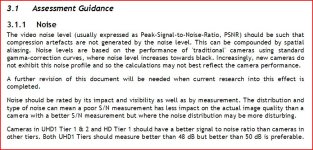
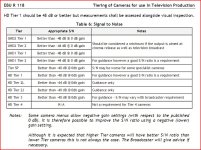
I hope some of this might throw a little light on the confusion surround this whole 10-bit issue with any camera that deliver an SNR of below 60dB . For those of us who have been in this industry for decades the whole SNR thing is well understood right through the signal path from the camera chain to transmission. There are losses throughout this entire path and generally speaking all this talk of the GH5 or many other cameras meeting “broadcast spec” just because they can record a 10-bit 4:2:2 pixel depth is totally not based in any technical reality. Sure they are well and truly “broadcastable” but at the same time they do not meet high end broadcast standards. Knowing that the SNR of the GH5 is 41dB then under current EBU guidelines the GH5 would be struggling to make it into HD Tier 2J. With regards to UHD the camera’s SNR and color sampling is miles outside of the UHD Tier 1 and Tier 2 specs. See EBU R118, page 17 for the SNR levels for the different Tiers. Check the Tiers chart.
https://tech.ebu.ch/docs/r/r118.pdf

Noise.JPG

Camera Tiers.JPG

In fact cameras such as the Canon C300 Mk II don’t even make it into UHD Tier 1. It qualifies for Tier 1 and 2 in HD. An analysis of that camera’s performance can be found here with respect to its failure to reach Tier 1 UHD broadcast requirements. Keep in mind that this is from a camera claiming an SNR of 54dB (typical); at 1920x1080 and either 29.97P or 25.00P; Canon Log base sensitivity ISO 850; Dynamic range 800%

https://tech.ebu.ch/docs/tech/tech3335_s18.pdf

Some of the factors I’ve listed above are I believe why Sony is not prepared at this time to implement a 4:2:2 10-bit codec in its still cameras that deliver SNR levels down in the 40’s. There is no real perceived benefit. Sure 10-bit 4:2:2 looks very attractive from a 'specs' point of view but being able to record 10-bit isn't the final arbiter of picture noise and quality.

Just the observations of an old broadcast hack :)

Chris Young
 
Last edited:
Well, can't argue with math. According to math and engineers the A7S is the winner but don't worry because people spent 10K on the C300mk2 which still falls short of EBU UHD requirements. We should all take math into account when choosing a camera to work with.

I'm just kidding of course, ultimately you have to decide for yourself which route you want to go and we should all consider ourselves lucky for the amount of affordable options out there (thanks all you awesome engineers :thumbsup:).
 
Last edited:
Back
Top