How Reliable Are DSLR Lenses ?

Keep in mind those are rentals and spend a lot of time in transit. It's still a good indicator of ruggedness, but it's not typical of what you'd see if you owned those lenses.
 
It's useful as a relative comparison, but the absolute number means nothing for the typical user. But yes, those samyangs seem to have a problem (though I haven't read any bad reports about them in these boards), and nearly any 70-200 will tendo to have issues.
Also surprising how bad the cooke cine lenses do. And the FS700 too: that ugly LCD-viewfinder design is not only unconfortable to use, also a weak point in terms of damage, it seems.
 
And the FS700 too: that ugly LCD-viewfinder design is not only unconfortable to use, also a weak point in terms of damage, it seems.

I have to completely disagree with this statement. I own an FS700 and after shortening the viewfinder tube, it's a very useful piece of kit. The LCD / Viewfinder becomes a pleasure to use. It's like a Z-Finder that can swivel in many different angles, most importantly up and down. I used to have a 5D2, 7D and a 60D which I used a Z-Finder with it. It was locked off obviously, and the FS700 loupe is so much better because I don't have to constantly crouch down on my knees to view it as I can stand above it like a real viewfinder.

The FS700 gets ergo gets constantly bashed by people who don't use it. I find the FS700 far more easy to shoot odd angles (which I do all the time) and barebones handheld than any DSLR (and I used those extensively for 4 years of video) just because of the pivoting screen that still takes a loupe. Sure you can't use to loupe overhead, but you can't do that with a Z-Finder either. And you can still see the screen clearly over it's 6 inches over your head, so it's not as horrible as people make it out to be.

Obviously, it would have been better if the LCD was on the side, but still light years ahead of any DSLR just because of the loupe integration.

As for the LCD breaking, I'm very rough on my equipment since I film a bit of skateboarding and I've yet to do anything to the camera.
 
Last edited:
Interesting data. I've shot professionally for close to two decades, and the only times I've repaired lenses were due to one factor - walking away from the camera with the (old fashioned) radio slave clipped to my belt and wired to the body. Body hits concrete floor (twice with film cameras, once with a DSLR). OK, one repair was when the neighbor's cat got in the house when I had a setup in my office, climbed a scrim and took the whole setup down...

Yes, I know this is something most people would only do ONCE...

But, with Nikkors and the occasional Sigma/Tamron, all of my repairs but one were due to physical whacks. I have AF nikkors approaching 20 yrs. old that are still weekly workhorses - they've had their share of bumps and knocks. (My 85mm 1.8 AF mysteriously lost its AF drive screw years ago - never have gotten around to fixing it).

I've had far more repairs due to a DSLR getting a slight bump and suddenly losing its focus ability. A D90 and a D7000 both went out of whack and had to go in.

So in my experience, DSLR lenses are pretty dang robust and reliable in a standard commercial studio setting. As rental units shipped by mail? Maybe not!
 
Very interesting report. I thought that their reliability assessment of the Canon 35mm f1.4 L lens was disheartening. I don't own one but I have shot with one and I really like the lens. I do like their suggestion that if you want reliability then one of the best ways to go is with fully manual primes. When I got into this large sensor HD thing I got myself together a set of Nikkor fully manual primes and while they are mostly over 30 years old, they work and look great. I still can't bring myself to buy a fully electronic lens, especially one that does not have a manual aperture. I just don't get that.
 
And old manual primes - big fat focus ring. Beautifully damped focus feel. AF lenses are designed to go easy on batteries - old pre AF glass was designed to feel great.
 
Drive by wire sucks not only because it is more prone to failure, but also because it usually requires power to work (so, no joy with dumb mechanical adapters to different mounts) and because it often has a mind of its own (the worst case I've seen of this is the 40mm pancake: very sharp lens, and lets you carry your camera+lens in a pouch designed only for the body, but I found it absolutely useless if you need manual focus).

The reason drive-by-wire exists is because it is good for fast AF: it allows them to design the lens so that a very small and light element is the only thing that moves for focus, and this makes AF faster. Apart from all the issues mentioned above, this may also be supoptimal in terms of image quality (lens design is a matter of tradeoffs, and you're adding a new target to your optimization).
 
As for the Samyang/Rokinon/Bower lenses, I use the Bower 35mm F1.4 EF everyday and it has yet to fail (for two years and counting)

I either have one from a good batch OR the lenses on the report are failing probably due to perhaps use from a follow-focus system (I don't use follow-focuses). OR perhaps Bower makes them slightly more rugged than Rokinon even though they are spec'd the same?
 
Nah, they're all the same (AFAIK). And if they weren't he'd be buying the better ones.

Somewhere in the comments of the article Roger said the external of RokiBowYang lenses feels fine, but that the internals are cheap plastic. So I'd guess that the problem is careless use, bumps, and falls. Being fully mechanical, it should live a long life if you treat it gently.
 
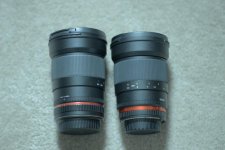
FYI: I just got the new Bower 35mm F1.4 delivered just now and it is SMALLER than the original one from two years ago. Maybe that is why it is weaker today build-wise?

The one I bought two years ago is an EF mount version, the one I got delivered today was the F-Mount version. Although I don't think the mount version would impact the size?
Dsc_8584a.jpg
 
Last edited:
Yes, it does impact the size: the F mount has a 46.5mm flange focal distance (distance from mount to sensor), whereas canon EF is 44mm, so the Canon lens has to be 2.5mm longer if (as it happens) you want each piece of glass to sit at exactly the same distance from the sensor. All the difference between those two lenses should be between the last ring and the mount. Put them on a table, front-end-down, and compare?
 
Yes, it does impact the size: the F mount has a 46.5mm flange focal distance (distance from mount to sensor), whereas canon EF is 44mm, so the Canon lens has to be 2.5mm longer if (as it happens) you want each piece of glass to sit at exactly the same distance from the sensor. All the difference between those two lenses should be between the last ring and the mount. Put them on a table, front-end-down, and compare?

However BH Photo is reporting they are the same size: Approx. "3.27 x 4.29" (83 x 109 mm)"
 
Well, you've got proof on your hands :)
(plus, the bhphoto pictures also show them to be different around the mount)
 
Back
Top