C300: How does Canon maintain dynamic range while changing sensitivity?

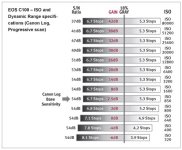
How do Canon cameras like the C100 and C300 change their ISO but keep the same dynamic range in the shadows and highlights?
274206_3.jpg

Does anyone know? This is a very technical question.

Raw cameras don't work like this. Changing the ISO actually does nothing. It just changes the midpoint in the metadata. So you have either less room in the highlights or shadows.

From the diagram it looks like it has something to do with gain. But I guess I don't really understand gain either, though I've tried by reading. They say gain raises noise just as much as signal. So I don't know how that would help at all.
 
I'm sure someone else will chime in about this with more technical knowledge than me, but Canon's doing a lot of magic at the sensor level, very different than other manufacturers. Their raw actually locks in ISO and white balance at the sensor level rather than leaving it as metadata that can be changed like other systems.
 
The C-series cameras applies ISO in analog stage of the image train, before it goes all goes through to the A/D converter.

It's this reason why when you shoot Canon RAW you can't just change the white balance or ISO all willy nilly in post like you can on RED or other RAW formats. But it's also the reason you maintain a consistent dynamic range above the native ISO as you see in the chart, as well as produce what some see as a preferable noise structure.

You can read about it in the C300/C500 white papers when the cameras were first released: http://learn.usa.canon.com/app/pdfs/white_papers/White_Paper_sensitometric.pdf
 
I'm sorry, something's still not clicking.

Dynamic range is the well capacity divided by the noise. Gain raises noise but not the well capacity, of course. So gain should lower dynamic range.
 
If you have a 15 stop raw sensor but you record an 11-12 stop log video codec, there is room burn a few stops in the processing.
 
Gain is applied on the sensor level, actual analog boost, versus other cameras that do it in post. Therefore you don't get the same image at 850 ISO as you do at 3200 ISO, they're two different images, while on other raw cameras shooting at different ISO doesn't change the image, just post-metadata. I believe thus is the reason they can selectively tweak each gain level to get consistent DR.

With the C300/100, shooting at 3200 ISO you still get 12 stops of range in one scene but with more noise, but you actually get the 12 stops DR when you match exposure, while with other cameras clipping points completely changes (decreases)

In effect, Canon C line preserves more DR at high ISOs than other cameras, it's not completely consistent as a chart implies, noise decreases the effective DR, so just better than most others.

The Varicam 35 does the same, having the exact same DR at 800 ISO as 5000ISO, they call it dual native ISO,
 
Thank you, all. I'm thinking it might actually have more to do with noise-reduction circuitry.

Everything I'm reading about gain says that gain raises noise to the same extent that it raises signal. Gain raises noise just as much as signal! So as you raise gain you also lower dynamic range, since you are raising the noise closer and closer to the hard-rock ceiling of the photodiode's full-well capacitity.

However, maybe, if you apply some sort of noise reduction after the gain but before the digitization, then that makes sense, kind of. In fact, from the white paper that Macaholic kindly provided:

The Super 35mm CMOS image sensor developed by Canon is novel in that the gain control system used to alter the camera ISO settings is embedded within the image sensor itself – prior to the on-chip A/D conversion system. This analog gain control is a key element within the overall amplification architecture of the sensor. When scene illumination is low the gain is raised and this tends to maintain an approximately constant signal level going into the A/D converters. In combination with some other on-chip strategies (the dual photodiodes within each individual Photosite used for the Auto Focus feature is also a key contributor to lowering the image sensor noise level) the excellent preservation of constant exposure levels above and below the reference 18% gray with increasing ISO settings is ensured.

(emphasis added)

So they aren't giving all of the specifics: "some other on-chip strategies." But "dual photodiodes within each individual photosite" sounds a lot to me like signal averaging. Signal averaging is theoretically only supposed to give you an extra half-stop of dynamic range. So clearly there's more to this story. But unless a Canon engineer chimes in, I doubt we'll ever know much more.
 
Back
Top