GH2 Hoodman Raw Steel SDHC cards toughness

Gabriel Berube

Well-known member
Hey guys,

While looking for quality 16Gb SDHC cards on B&H, I stumbled upon these http://www.bhphotovideo.com/c/product/751136-REG/Hoodman_RAWSDHC16GBST_16GB_RAW_STEEL_SDHC.html

I saw very few review on the web and was wondering if the steel plating and extra protection is worth it.

I own a Transcend 16Gb cards and while it works well, I'm always worried about its flimsiness. I'll be shooting important stuff soon with my GH2 (nothing too critical but still important enough so that I don't want the card breaking or crapping on me during the shoot) and wouldn't mind paying more than "regular" Panasonic or Sandisk Class 10 cards, but only if these cards really are tougher than them.

Anyone here who uses them? What do you think? Are these worth biting the bullet?
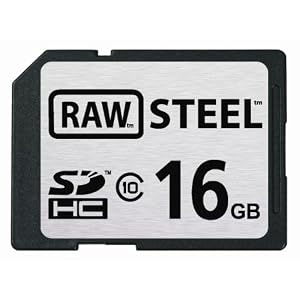
 
Perhaps the photo of the Hoodman is misleading, but I don't see a sliding write-protect tab on the bottom edge of the SD card:

51MkVjeqrWL._SL500_AA300_.jpg


I know from hard experience that an SD card that lacks a write-protect tab will not work at all in a Panasonic G-series camera. It's actually dangerous to insert such a card into the SD slot - there is an internal latch that will click into the slot and permanently lock the SD card inside the camera. Hopefully, the actual card is designed to work properly.
 
Hey, that sounds pretty cool... I watched the video, I love the idea of it being sturdier construction. Only thing I didn't hear is -- have they implemented anything to increase reliability as far as the actual processor and data handling? SanDisk Extreme and Panasonic Gold both tout that they have intelligent controllers that do extensive testing and error correction on the data, which is why I've been using those two brands. But the tougher construction of the Hoodmans is quite appealing. The prices are a lot higher, but if they back it up with enhanced reliability measures in terms of the data writing and verification, then yeah, I would be very interested in these.

And yeah, double to what lpowell said -- write-protection is mandatory so hopefully the picture is just incomplete and the actual cards themselves offer the standard sliding write-protect tab.
 
Thanks for your inputs guys! I just sent an email to their customer support about the data verification and the write-protect tab. I'll post here as soon as they reply.
 
Hoodman 32GB is $209 and Panasonic class 10 is $240. That's the only GB per $ advantage that Hoodman has over Panasonic. Hoodman says that the card exceeds the spec for class 10. I was talking to an engineer at JVC not too long ago and he said the best card test it to set the camera to its highest setting and fill the card up.

According to Hoodman's website:

The World's only Steel Plated/Ruggedized SDHC Card
Uses new Chip on Board Technology (COB)
COB: Miniaturizes all the internal components so there is room for a reinforced internal housing structure
Epoxy Assembly process provides a waterproof housing
Requires fewer solder joints for greater reliability and performance
Above Speed Class 10 Specifications
Lifetime Warranty
 
Thanks for the input Philip!

I just received an answer from a Hoodman corp rep and he said that the card does indeed have a write-protect tab that isn't shown on pictures. He also sent an attached PDF that said the exact same thing as Philip, along with numbers to back the "above speed class" boast (30MB/sec write speed, 200X).

Nothing about any improved data verification or error correction though.

I think I'll bite and try one, lifetime warranty makes it look like they trust their product a lot.
 
We sell these cards and recently made a blog post about them here. The product manager from Hoodman stopped by our store and he had a sample card with him. He had taken it apart to show us the inside. He also had a traditional SD card taken apart too. I thought it would be a great idea if he let us take some photos of the two, and he said "sure, why not". So, that is what we did and we posted them on our blog. The point he made that I found most interesting was about the acid-etched circuitry. According to him, this type of circuitry reduces the amount of noise that can be induced during the transfer of an image or a video to and from the memory chip over a traditional board that uses solder.
 
So, gmcamera, can you answer this question then -- does the Raw Steel card have a write-protect tab or not? The promo photos don't show it, and your photos don't show it. Would be bizarre and disappointing if they don't have it.
 
So, gmcamera, can you answer this question then -- does the Raw Steel card have a write-protect tab or not? The promo photos don't show it, and your photos don't show it. Would be bizarre and disappointing if they don't have it.

It would also be bizarre and disappointing if the write speed was slower than a SanDisk Extreme class 10 card! Any independent tests out there?
 
So, gmcamera, can you answer this question then -- does the Raw Steel card have a write-protect tab or not? The promo photos don't show it, and your photos don't show it. Would be bizarre and disappointing if they don't have it.

Hi Barry,

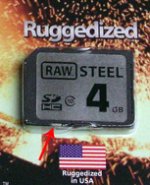
Yes, these cards do feature a write-protect tab. In the photo below it is the white spot at the tip of the red arrow. Sorry, I don't have an open package to better illustrate, but it is there. I didn't even notice it was missing when we took the photos. I assume the product manager has had this disassembled card for quite some time and the tab was probably quickly and easily lost. Regarding the other post about read/write speeds, I have yet to see any independent testing. It would be interesting to see, however. If someone runs across something, please let us know.

hoodman_raw_steel.jpg

Regards,

John
Green Mountain Camera
 
It would also be bizarre and disappointing if the write speed was slower than a SanDisk Extreme class 10 card! Any independent tests out there?
Class 10 means it supports a sustained write speed of at least 10 megabytes per second. As long as it sustains that speed (or more) it can be called Class 10. The SanDisk could be 30 megabytes per second but it would still be called Class 10. And an AData might be 11 megabytes per second, but would still be Class 10.
 
That's right. Hoodman does specify up to 30 MB/s read/write for these cards, which is the same claim Sandisk makes for the Extreme SDHC cards. If I get a chance, and if you are interested, I will test the two. I might throw in a Delkin to test also. I would be interested to see how the Delkin performs too.
 
Back
Top