Hollywood Joins Forces with Kodak to Keep Movie Film Alive

http://www.theverge.com/2014/7/29/5950215/hollywood-joins-forces-with-kodak-to-keep-movie-film-alive

Too late, Hollywood. Way too late. Studios pushed digital for years, fully support digital and thrive off the 'savings' from digital. They don't give a damn about film, yet they are now being painted as patrons-of-the-arts heroically saving film, when in reality they are simply appeasing big directors who favor shooting film while taking financial advantage of a company going down the tubes. 'Negotiating a deal' with Kodak, likely means purchasing large amounts of film at below cost.

I hate to break it to you, but this is like sticking bubble gum into holes in the hull of a ship; a short-term fix to an unfortunate problem.

"...New CEO Jeff Clarke expects Kodak to lose money on film production this year and return to profit by 2016, but believes there's more to the deal than the company's bottom line."

Hahahahahaha, really?!

How does the CEO of Kodak think any film studio deal will be about anything more than the bottom line? Whether that be the studio's bottom line or Kodak's.

Time and time again, we have seen the bottom line squeezed:
People die driving home after 18-20 hour days because they squeeze the bottom line. (Who Needs Sleep?)
Productions get moved to different states or countries because of the bottom line. (Battle of L.A. shot in... Louisiana?)
Entire VFX companies go under because of the bottom line. (Life After Pi)

We shall certainly see how much money WB and the Weinsteins are willing to spend/lose in order to keep film around and make QT and Emperor Nolan happy... but Kodak isn't going to save itself by simply relying on big directors to leverage the use of film.

Also, what seems to not yet be making headlines is that NFL films is currently in the works of continuing the transition from film to digital. Many do not know NFL Films is/was Kodak's #1 customer (larger than all the studios combined) is going largely digital with ARRI Amiras starting this season, from what I gather. Kodak is going to have to make much larger structural changes because the impending loss of NFL films is a large one. Very large.

I am very sad by this as I am crazy about film and absolutely love it. However, I'm pretty knowledgable about the industry, finance and the way the world works, and this is nothing but a drop in the bucket.

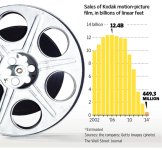
Sales have dropped 96% in the past eight years! (At Death's Door)
 
Last edited:
Well said Ryan! Over the past couple weeks I have seen a few Aaton XTR's owned by NFL films on the Bay. I have to say I love working with film but my work does not allow the luxury of using such a beautiful medium, for financial reasons. I still shoot large format photography, but only B&W and I buy Ilford because I like the images so much more.

I still remember my intro to film class. Huddled in a dark corner over the dim glow of a Steenbeck, watching my images come to life...
 
The fact the deal hasn't been made yet but this has hit the news cycle is a sure sign that Hollywood is about to make Kodak a deal that will result in an even more painful demise for Kodak. Otherwise why would this get any press coverage at all?
 
The fact the deal hasn't been made yet but this has hit the news cycle is a sure sign that Hollywood is about to make Kodak a deal that will result in an even more painful demise for Kodak. Otherwise why would this get any press coverage at all?

We likely will never know the real details, but I have a very strong feeling you are right. The film studios aren't really in the business of charity, so I don't think the studios will be over-paying for film just to keep the Kodak film production division afloat. They will likely over-order to fill a purchase commitment but remember the studios are all owned by shareholders who don't necessarily love film more than they love profit and money. Maybe the studios can persuade a handful of their feature films, like romantic comedies or dramatic narratives (who are on the fence in regards to filming medium) to shoot film since they will be committing to a certain purchase amount of film.


P1-BQ856_FILM_G_20140729173906.jpg

This chart surprised me.

I thought for sure the decline between 2013 and 2014 would be less drastic considering FujiFilm left the market in early 2013. I figured film production using Fuji over Kodak would switch to Kodak. Does not look to be the trend, and if so, it's not enough to make a big impact on sales. Remember, Kodak has 100% of the motion picture film market now. Nobody on Earth is competing for film sales, just digital alternatives.

With falling sales this drastic, Kodak has very little, if any, leverage in these negotiations. In fact, things are so bad, the only negotiating leverage Kodak has is to threaten death; the stopping of film production. With a negotiating position as such, I have a feeling the studios will leave the negotiations with quite the deal.

I never was able to imagine the death of film; what it would be like. Fast, like the abrupt announcement by Fujifilm, would be painful and devastating but I have to say that seeing Kodak as an overall company collapse into bankruptcy, restructure and now simply limp forward to an inevitable death is very very sad. What a great product and a magical medium.

Film production is based an economy of scale. The more they make, the less it costs. The opposite is also true; which presents a difficult situation as demand continues to fall.
 
Last edited:
shooting with kodak film is breathtaking experience...

(here in LA going to film school and 24/7 in post houses or on the set with famous cinematographers…KODAK is the word for the ultimate in image quality)
(i think one of the reasons a studio wants to buy Kodak is the tv series that were shot on Kodak film were very successful critically and financially)
 
(i think one of the reasons a studio wants to buy Kodak is the tv series that were shot on Kodak film were very successful critically and financially)

Has nothing whatsoever to do with studios wanting to shoot TV series on film. Your average television viewer could care less what camera acquisition method was used to shoot a TV show. Either they like the show and watch it, or they don't. Only film geeks like yourself bother to look up what camera or film stock was used on project X.

Just a group of directors throwing a fit, and the studio system trying to keep them happy for the moment.
 
I can't help but feel like we've seen this all play out before in the audio recording industry with analog tape... At the end of the day, most of our technological practices and conventions will ultimately be replaced by new methods and technology. Of course it's sad to see film going away, but the plain truth is that while it might be a big part of Tarantino or Nolan's experience making movies, it's not a core, self-identifiable part of most film-goers experience. What represents a big paradigm shift in production doesn't necessarily have the same impact on the consumer.

It's easy to argue why a studio should spend more money on effects or tangible, on-screen elements. It was even easier to argue why a studio should shell out for film when the medium was objectively superior. We've reached a point where film isn't offering the huge aesthetic and technical advantages that it did even a few years ago, where it doesn't have any special place in consumers hearts, and where the advantages of shooting digital have become pretty much ubiquitous on almost all sets. The only reason I see for the studios (or anyone who doesn't get misty-eyed when they speak of the magic of celluloid) to do anything here is to try and appease a handful of big directors.
 
I can't help but feel like we've seen this all play out before in the audio recording industry with analog tape...

It's funny you should mention analog tape. I moved my Studer tape deck from the for sale forum over to ebay and it sold within 8 hours for $1700.

At least with analog tape you don't have to develop it and have it transferred.
 
It's also the infrastructure. Who's going to be able to process this film for dailies, etc. and still stay in business when the market has dwindled so drastically?
 
It's funny you should mention analog tape. I moved my Studer tape deck from the for sale forum over to ebay and it sold within 8 hours for $1700.

At least with analog tape you don't have to develop it and have it transferred.

For me, this has all played out about 14 years ago now, when digital still 35mm cameras began to be put out with affordable prices, and reasonable resolution for 'the job'. We didn't quite realize things had 'happened' until it dawned on us that we had not used the Hasselblad for about a year's worth of weddings... we had brought the case for all the weddings, but had only used the 35mm digitals for all the wedding coverage including the 'formals' which is were we would use the Hasselblad in the past.

The benefits of getting proofs out to customers via the Internet, or proof sets on CD's which the user could view, just made what we had done before with physical proofs and proofbooks look 'stupid'...

Even more telling was when an old customer came back for a reprint and we 'discovered' that all the labs in our area, had closed down, and there was only one which could print black and white for us from negs...
 
for advertising it is still used heavily in Europe and LA…and some in small movies like STAR WARS….
 
for advertising it is still used heavily in Europe and LA…and some in small movies like STAR WARS….

Heavily is a relative term when talking about scale of economy.

Star Wars? How much film do you think they will really shoot? Want to pick a round number and say one million feet of film? Well to you and I that amount of film is immense. Hell, that's one thousand 1,000' magazines.

But to Kodak?.... Star Wars, although a fantastic PR opportunity would only account for 0.22% (roughly 1/450th) of their projected film sales this year based on Wall Street Journal numbers. In fact, in order for Kodak to sell the same about of film they did in 2008, they would currently need 11,950 feature films to begin production and shoot one million feet of film.

Of course Kodak does not need to return to 2008 levels to be solvent. I am using a large deficiency for exaggerated illustration of my point. Unless my math is terribly wrong, it seems if Kodak wanted to return to levels four years ago in 2010, they would need 8,000 feature films to shoot one million feet of film each. To reach levels of 2012, they need 3,000 additional feature films to shoot one million feet each.

Those big movies are quite small in the large scheme of economy of scale sales.

Of course the NFL, as mentioned was (last time I checked) the largest customer of Kodak. They make Studio film consumption look tame. NFL films would shoot multiple cameras (of s16mm) for every single NFL game. How many games are there every season? 260+? Each one several hours long? Some cameras shoot 120fps for slow motion action too.

I have heard NFL films is making a huge leap in digital this year. NFL film cameras are being sold on Ebay and rumor has it many many Arri Amiras are shipping for the 2014 season. I have a big feeling this is why we are seeing Kodak in some real hurt right now.
 
Last edited:
With a negotiating position as such, I have a feeling the studios will leave the negotiations with quite the deal.


I don't think it's a case of getting a deal, really. The way it's being structured is as a purchasing commitment by the studios, which gives Kodak the predictability they need to keep the plant running. Essentially the studios will be paying for the running of the factory, rather than for the product. If it doesn't end up with Kodak making at least a little cash, the plant will close -- and as of now, it looks like they need that income guaranteed in advance.


It's clear that this has been on the cards for a while now; however, the speed of the decline -- as per the chart you posted -- is shocking. You point out that Kodak have lost 96% of their film sales; so consider the implications of that -- 96% of filmmakers have already switched to digital, and are happy with it. (I don't know how far along the NFL change is at this point, but I guess it's still in progress.)


There are clearly some people -- and some very smart, successful people -- who love film, and want to keep shooting it; and they are understandably working to get their opinions heard, to try to keep the format alive for a few more years. But its clear that they are MASSIVELY outnumbered by people (including, I'm quite sure, many smart, successful filmmakers) who have switched to digital, and who don't need to raise their voices because they're happy.


This doesn't mean that QT, Nolan, etc. are wrong -- shooting film is a valid creative choice, and it will be a shame to see it go. More creative choice is generally good. But folks who make extreme statements about how digital CAN'T shoot like film should look at the numbers, and think again. Kodak's sales didn't collapse because the majority of the world's filmmakers agree that you need film to shoot great movies.


In any case, the clock is ticking. Just as a thought experiment, imagine if that one factory had some kind of disaster. Would Kodak rebuild it? Not a chance. One way or another, if you want film, better order it soon.
 
Last edited:
I was covering the Sunday night preseason game yesterday and NFL Films was shooting on Amira's. I have a friend that shoots for them. I should hit him up and ask how he likes it(he usually works on Hard Knocks, too, so I'm sure he's already used one).
 
I hate to continuously be right, but here we go:

http://rochester.twcnews.com/conten...ffs--some-70-rochester-area-jobs-will-be-cut/

Hollywood studios stepped up to keep motion film in production. In July, several studios agreed to buy enough movie film from Kodak to keep the plant open. Conboy said that wasn't enough to help the ailing industry. "Kodak has sold only 10 percent of the motion picture film that it hoped to sell for calendar year 2014, way behind plan. Here's a case of a company looking to cut costs. From my understanding, only one of those studios has actually signed on to that deal,"

As of October, Kodak has only hit 10% of their sales goals for 2014.

I don't know how anyone thought a handful of studios could save Kodak... their 2014 estimates was roughly 450million feet of film. If a film production shot 1,000, 1,000' magazines (One million feet of film) you'd still need 449 more to do the same. Or 900 films to shoot half-a-million feet of film.

So far this year, NFL films has been shooting digital all season. I find it strange that talking points focus on studio film production and nobody is mentioning how Kodak's #1 client is no longer shooting film.

Get it while you can.
 
Last edited:
Back
Top