hmc40 vs hmc150

kaplanfilms

New member
Hello,
Im a noob to this website so bear with me please. I was origanlly looking at buying a panasonic ag-hmc40 but then started looking into the 150 and found that i like that alot better. I am 16 years old and want to continue learing about videography. I film ski videos but this october im being paid to film a barmitzvah and hopefully will do a few more of those in the future. Im a little short on money. In total i can probably come up with a little more than $2,000. This has to include lenses,filters,tripod, and the camera itself. So i started again looking at the 40 because its much more in my price range. My question is will i still benefit (benefit as in learn about filming) from the hmc40 or is it a complete auto point press and shoot camera? Should i save up and wait awhile till i can buy a ag-hmc150?

also i know that all of that is hard to get for $2,000 but i'll get what i can then save up till i have enough to buy everything i need.
 
Wait as long as you can.
When you can't wait any longer, buy the one you can afford.
Which ever you buy, you start the learning process at that level

You can learn on any camera.


When picking between the two, it is a financial consideration more than which is better.
 
The HMC40 is an outstanding camera, it's even sharper than the HMC150. There are a few things to be aware of:

(1) It is NOT a low light camera. The HMC150 can shoot in lower light levels then the HMC40. This does NOT mean that come night, you have to put away the HMC40, it just limits you to the brighter places. I've shoot night video the different gain and shutter speed levels:


(2) The image sensor is a CMOS sensor. This results in a rolling shutter. Rapid camera movement can cause the image to bend and flash cameras can result in flash banding. How important this is, depends on each person's subjective view.


(3) NO XLR plugs unless you add a $150 --> $300 adapter. You can use the 1/8" stereo mic inputs.


The HMC40 can shoot full auto OR if you want, switch to manual more for everything and you have lots of controls to play with. (Most through menus.)

Green Hornet may not care for the HMC40, but there are others here who differ....


Bob Diaz
 
thank you bob and green hornet thats really helpful. I think that since the 40 seems like a great camera still and is more in my price range (and i dont have much lowlight filming) that i will be looking into that more.

Very helpfull thank you,
Brad
 
Let me add that when it come to cameras, the choice is VERY >>> SUBJECTIVE <<<. One person's ideal camera is another's worse choice camera.

In this forum, the top three stickies are links to all sorts of helpful information. You may want to check them out before you purchase a camera.


Bob Diaz
 
Agreed 100% with Bob.

Also, a lot of people seem to constantly tell us that a camera that is bigger and more expensive is better than a smaller and cheaper camera, as if this is a revelation. They then look down their noses and make sarcastic remarks about the smaller, cheaper cameras, which they often haven't even tried themselves. Ignore that advice, and make the choice that is right for you. You buy what you can afford at the time you need to buy it.

I got my HMC41 because I wanted something smaller and solid state than my last Sony camera. I picked it because it was best functionality for the desired price and size combination. Size was ultimately important to me, as I wanted to be able to carry my gear around without getting a hernia.

When I buy a new camera, I am nerdy enough to make a spreadsheet comparing all the models I am looking at, and I weight all the different features and functionality that is important to me - and give a hefty weighting to price. It becomes very easy to choose then.
 
Last edited:
I got my HMC41 because I wanted something smaller and solid state than my last Sony camera. I picked it because it was best functionality for the desired price and size combination. Size was ultimately important to me, as I wanted to be able to carry my gear around without getting a hernia.

Ditto.
 
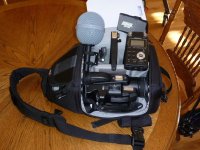
I went hiking in the Cascades on Sunday and here was my kit. The pack is a LowePro Photography Sling. The mic is a hyper, but if I got something like a short shotgun that would fit also. This kit is lite, lite, lite, and has a little room to spare. I use a monpod with a Manfrotto 701 for a walking stick.

Grant
 

Attachments

  • CompactKit.jpg
    CompactKit.jpg
    111 KB · Views: 0
Having done a lot of research recently on the same comparison (40 vs. 150), it's clear to me that there are a few key differences:

-Wide end of the lens... the HMC40's naked lens is not particularly wide, and that can lead to difficulties in tight spaces without an additional adapter, which cuts out a bunch of light in dim shooting environments. If you have no need to shoot a really wide lens in low light, the HMC40 is fine in this regard, otherwise, the HMC150 is substantially better (it's really wide on its own, and has wide-angle adapters available too)

-Control interfaces... the HMC40 has a menu based system for a lot of features like shutter speed, and it only has a focus-by-wire or iris adjustment-by-wire front lens ring. That said, it has a LOT more control available to it than cheaper cameras (i.e. Panasonic TM700K) and others at or near its price point. There are a bunch of user-configurable controls, and features that are very high-end like the waveform monitor (which I WISH I had on my HVX200 at work!). The HMC150 has a dedicated iris control wheel, mechanical zoom ring and focus-by-wire ring. The HMC40 has a zoom rocker on the right hand control area, and so does the HMC150, but the HMC150 also has a user-selectable handle zoom and start/stop recording button on the top handle as well, which can be very useful on low angle, handheld shots (i.e. skate and snowboard vids).

-Light sensitivity... this was my big hangup on the HMC40. The HMC150 is much much more light sensitive at it's +0db gain setting than the HMC40 is at +6db or +12db gain. That said, the HMC40 looks pretty clean at +12db gain, and is certainly usable in low light with an on-camera or off-camera light of some kind. For me, I'm planning to use the HMC40 with a 35mm lens adapter like the Letus35 Mini for sit-down interviews, so I was concerned that I'd have to cook my subject with tons of light to make the camera work... but I think I'll be OK with it. For event videography like that Bar Mitzvah, I'd definitely add an on camera light for any camera, or you're going to regret it later.

-Size/weight... I use an HVX200 and occasionally our old over-the-shoulder BetaCam at work, so I'm used to a much bigger/bulkier/heavier camera, and I have the forearm muscles to prove it ;-) The HMC150 is a big ol' camera, and you'll want a few types of support for it, namely a monopod, a good tripod with a fluid head, and maybe a steadicam... all of which will cost a lot of money with the adequate weight capacity. With the HMC40, you'll be able to get away with less expensive tripod legs, a cheaper/lighter weight fluid head, a smaller steadicam, and your right arm and shoulder will be a lot happier.

If you need the features of the HMC150, good luck with the extra size/weight/price. Otherwise, you may really enjoy the HMC40 and be totally happy with it.

This is just my experience as an HVX200 shooter considering both of these cameras. I have limited hands on experience with the HMC150, which to me felt very much like the HVX200 but about a pound lighter. I have not handled the HMC40 yet, but I've reviewed a few hours of footage on Vimeo, read through pages upon pages of this forum, and have asked fellow shooters their thoughts on the little guy... and everyone seems to be very happy with the HMC40. In fact, I'm buying mine this Friday.

I hope this helps!
 
Be sure to buy a camera light if you're going to film a reception during the evening when there is not much light left!
 
Be sure to buy a camera light if you're going to film a reception during the evening when there is not much light left!

The same thing can be said about the prosumer HD low light king, the Sony EX1 though. These cameras are good in low light...but they aren't miracle workers. Most wedding receptions are DARK and ANY camera will need a sungun or you will be "in the dark" (pun intended). Unless you like the look of infrared night vision...LOL.

For the price the 40 is a helluva camera. Resolution wise it's up there with the EX1. I did have to turn the sharpening WAY down and it still holds up well. And the color rendition is great as well.

My biggest issue with it is the LCD screen/zebra performance. For the life of me it is difficult to expose properly with the 40. Coming from the EX1 with it's LCD I am used to it being relatively accurate in terms of exposure and white balance. Not so with the 40...definitely use a monitor on important shoots. At least from my limited experience with the camera this is what I've found.

And yeah the wide angle isn't so great.

I like it though. Again for what it cost it is an amazing piece of gear.
 
Just curious: why would you ever need zebras with the waveform monitor available?! Just assign that to one of the customizable user buttons and you're set!
 
Just curious: why would you ever need zebras with the waveform monitor available?! Just assign that to one of the customizable user buttons and you're set!

I wasn't aware it had a waveform monitor. How accurate is it? The major problem I kept having was with fleshtones being overexposed outdoors.
 
If it's anything like the HPX170 I've shot with, and the HMC150 (which it borrows many features from), it should be more than accurate enough that you can keep your subject from blowing out! The waveform monitor and price point is one of the reasons that I've been drawn to the HMC40... I don't know of another cam anywhere remotely close to its price that has that feature.
 
Just curious: why would you ever need zebras with the waveform monitor available?! Just assign that to one of the customizable user buttons and you're set!


I use both; my zebra setting is 105% and it tells me when I'm blowing out the whites. HOWEVER, there are shots where adjusting to the whites isn't correct. Mostly when I'm shooting things in shadow or when the contrast range is extreme.

I still like the zebras, because it tells me when I've gone too far. OK, the waveform monitor does that too, but the zebras show me exactly where and how much in the shot it's blown out.


Bob Diaz
 
Good point about finding where the blowouts are in the shot with Zebras. The waveform is just my go-to exposure solution (on my field monitor) while shooting with the HVX200 cams at work, so I've gotten too used to relying solely on that!
 
The information about the HMC40 vs the HMC150 is all good. I am also debating which camcorder to get. I just received an HMC40 from B&H, and included with that camcorder was the HMC book by Barry Green. I have read most of the book. I am wondering if anyone can answer the following questions and direct me to the right camcorder.

Barry states that the HMC40 captures the video at 1920 x 1080 60 frames per second regardless of what mode you are shooting in. And, if you are shooting in the 1920 x 1080i mode, the camcorder then converts the frames in half and creates a deinterlaced image.

My question is: If you shoot in the 1920 x 1080i mode, is this truly deinterlaced footage and when the video editing program deinterlaces it, will there be any loss of quality or
artifacts? The reason I am wondering this is because Barry states that the camcorder actually creates a 1920 x 1080 60 fps image.

Also, I am also considering the TM-700. I understand that there are not nearly as many manual controls as there are with the HMC40 or the HMC150.
Is there any significant advantage to the capability of recording at the 1920 x 1080 60 fps mode that the TM-700 offers.

Last question, my application is obtaining footage of purebred breeding stock and then placing that video on YouTube for sales and marketing purposes. I have read
the comments about the issue with rolling shutter when there is motion. In my application, there is motion; however the motion is about the speed of a fast walk.
Given my application, is there any advantage of the HMC150 over the HMC40, other than the HMC150 being better in low light? Please note that I will usually be
outside when obtaining a video.

Thanks to anyone that can help,

J.C. O'Neill
because I am usually outside.
 
Let me start with the rolling shutter effect:

This is a good video to see a slight bending due to rapid pans as the camera follows the dog on the outdoor shots. You have to really watch for it. Now if we are shooting a bull walking through the image, it's unlikely anyone would ever see a rolling shutter effect. Well, maybe if someone took a flash picture, but otherwise, the movement is too slow.


Now regarding 1080/60i:

In general, I don't like to shoot interlaced, so I would be inclined to shoot 1080/30P. However this is subject to how your editing software deals with it. However, when it comes to editing software, ask others, I have not had a chance to try the different packages.


Bob Diaz
 
The information about the HMC40 vs the HMC150 is all good. I am also debating which camcorder to get. I just received an HMC40 from B&H, and included with that camcorder was the HMC book by Barry Green. I have read most of the book. I am wondering if anyone can answer the following questions and direct me to the right camcorder.

Barry states that the HMC40 captures the video at 1920 x 1080 60 frames per second regardless of what mode you are shooting in. And, if you are shooting in the 1920 x 1080i mode, the camcorder then converts the frames in half and creates a deinterlaced image.

My question is: If you shoot in the 1920 x 1080i mode, is this truly deinterlaced footage and when the video editing program deinterlaces it, will there be any loss of quality or
artifacts? The reason I am wondering this is because Barry states that the camcorder actually creates a 1920 x 1080 60 fps image.

Also, I am also considering the TM-700. I understand that there are not nearly as many manual controls as there are with the HMC40 or the HMC150.
Is there any significant advantage to the capability of recording at the 1920 x 1080 60 fps mode that the TM-700 offers.

Last question, my application is obtaining footage of purebred breeding stock and then placing that video on YouTube for sales and marketing purposes. I have read
the comments about the issue with rolling shutter when there is motion. In my application, there is motion; however the motion is about the speed of a fast walk.
Given my application, is there any advantage of the HMC150 over the HMC40, other than the HMC150 being better in low light? Please note that I will usually be
outside when obtaining a video.

Thanks to anyone that can help,

J.C. O'Neill
because I am usually outside.

Good Morning JC,

I think you misread about the HMC40's formats... The HMC40 shoots the following 1080 formats:
1080p @ 24P, native (no deinterlace in post, no pull-down. It is 24 frames of gorgeous progressive awesomeness)
1080p @ 30P, in a 60i wrapper (deinterlaces great in post with 60i->30p pulldown and no quality loss)
1080p @ 60i

The camcorder does shoot up to 60 fields per second (interlaced odds & evens), but it can only record 24 or 30 full 1080 images per second at its highest quality.

There is no loss of quality in 24p or 30p modes in my growing experience with the HMC40, and 60i suffers from the usual interlacing issues (sawtooth edges with moving subjects).

My advice to you is to shoot 1080p/30 or 720p/60p on the HMC40 if you're shooting for the web, and if you're shooting cute puppies. 60p will offer a smoother, more "Monday Night Football" like quality of motion, 30p will look distinctly more "home movie"-esque, and 24p will have a little "chop" to it like motion pictures. Again for emphasis: If you're shooting for the web, use the progressive modes and save yourself the headaches of interlaced footage and deinterlacing!

The TM-700 is an awesome camera, but there are not as many control surfaces (i.e. buttons on the outside of the camera) and it's more menu driven. Depending on how advanced of a shooter you are, and what you're trying to do while filming, you may be frustrated by the more menu-driven TM-700 vs/ the HMC40's top-level buttons interface. If your fastest motion is the speed of a fast walk, the TM-700 should keep up with the action no problem. Otherwise, the HMC40 has significantly more robust AF performance.

Unless you're shooting in low light, and unless you need XLR inputs built right into the camera, the HMC40 offers sharper footage than the HMC150 (in my opinion, shared by many others on here), and similar color performance to it as well. I regularly mix 720p footage from my HMC40 with my HVX200 and 200a at work. Bright light is where the HMC40 kicks significant amounts of ass, plain and simple.

Rolling shutter can go either way... If you whip pan side to side, or if you shoot sideways out of a moving car going faster than 30-45mph, vertical lines start to get bendy. That said, proper technique will obviate noticeable rolling shutter, though there may be *some* vertical line skew. I have yet to have clients or other video editors at my company mention it as an issue. Until that happens, I am perfectly happy with the level of RS on the HMC40.

I hope this helps!

Best regards,
Jason
 
Back
Top