HDR, holy confusion. What did I miss?

I think the phrase for 709 could be " six stops at a proper contrast ratio".

People seem to lose track of contrast ratio - sure we can show 15 stops of ungraded log on a 709 screen - but it looks crappy as it does not have a proper contrast ratio.

What is contrast ratio? I don't know how it is defined but I know it when I see it.

--
In terms of the linguistics of HDR I prefer to use WDR as the phrase for capture "wide dynamic range" and HDR for the delivery medium - this brings some separation.
 
Currently as it stands the System Gamma for HLG HDR systems is 1.20 and was adopted for the reference 1 000 cd/m2 display. This is the current Rep. ITU-R BT.2390-0 23 6 HLG HDR-TV standard as used by HDR TV manufactures.

How the system gamma of 1.20 came about is very clearly explained here. https://www.itu.int/dms_pub/itu-r/opb/rep/R-REP-BT.2390-2016-PDF-E.pdf

For those who don't want to wade through the whole document here is a brief extract of what would probably interest the casual observer. For those of us who have work requirement to fully understand this minefield in greater depth it's well worth an in depth read.

Rep. ITU-R BT.2390-0 23 6 HLG HDR-TV

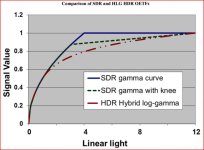
The hybrid log-gamma (HLG) HDR-TV signal parameters were designed from the outset to offer broadcasters and programme producers an evolutionary approach to HDR production and distribution. The signal characteristic is similar to that of a traditional standard dynamic range camera with a “knee” and requires no production metadata. It is therefore compatible with conventional standard dynamic range production equipment, tools and infrastructure. Furthermore, the HLG HDR-TV signal parameters were designed to provide a high degree of compatibility on Recommendation ITU-R BT.2020 colour SDR displays. Thus HDR monitors are only necessary in critical monitoring areas. The design of the HLG HDR signal parameters is intended to allow distribution networks to provide a single HEVC Main 10 bitstream that can target both SDR and HDR receivers, where those SDR receivers support the Recommendation ITU-R BT.2020 colour container (e.g. DVB and ARIB HEVC UHD receivers).

The hybrid log-gamma opto-electronic transfer function (OETF)

In the brighter parts and highlights of an image the threshold for perceiving quantization is approximately constant (known as Weber’s law). This implies a logarithmic OETF would provide the maximum dynamic range for a given bit depth. Proprietary logarithmic OETFs are in widespread use. But in the low lights it becomes increasingly difficult to perceive banding. That is, the threshold of visibility for banding becomes higher as the image gets darker. This is known as the De VriesRose law. The conventional gamma OETF used for SDR comes close to matching the De Vries-Rose law, which is perhaps not coincidental since gamma curves were designed for dim CRT displays. So an ideal OETF would, perhaps, be logarithmic in the high tones and a gamma law in the low lights, which is essentially the form of the hybrid log-gamma OETF. The dynamic range of modern video cameras is considerably greater than can be conveyed by a video signal using a conventional OETF gamma curve (e.g. Recommendation ITU-R BT.709 or Recommendation ITU-R BT.2020). In order to exploit their full dynamic range conventional video cameras use a “knee” characteristic to extend the dynamic range of the signal. The knee characteristic compresses the image highlights to prevent the signal from clipping or being “blown out” (overexposed). A similar effect is also a characteristic of analogue film used in traditional movie cameras. When a hybrid log gamma HDR video signal is displayed on a conventional SDR display the effect is similar to the use of a digital camera with a knee or using film. It is not surprising therefore, that the HLG video signal is highly compatible with conventional SDR displays, because what you see is very similar to the signal from an SDR camera. Indeed the knee characteristic of the HLG characteristic, defined in Table 5 of draft new Recommendation ITU-R BT.[HDR-TV] (and shown below), provides an extended range that is conservative compared with current SDR practice.

In order to determine the appropriate system gamma for a 1 000 cd/m2 reference display, NHK conducted a series of experiments with an indoor test scene. Lighting was adjusted so that the luminance level of the diffuse white was 1 200 cd/m2. The subjects were requested to adjust the system gamma and camera iris with reference to the real scene so that a tone reproduction similar to the scene could be obtained on the display. It was found that personal preference has an impact in determining the optimum system gamma for a given brightness display. But for a 1 000 cd/m2 OLED display (Sony BVM-X300) the average optimum system gamma was found to be 1.18. Similar tests were repeated using a 2 000 cd/m2 peak luminance LCD display (Canon DP-V3010), where it was found that the average preferred system gamma was 1.29. Similarly, the BBC conducted subjective tests to determine the value of system gamma that delivers the best compatible SDR image. For those tests two Sony BVM-X300 OLED displays were used, one in its SDR mode (Recommendation ITU-R BT.1886, 100 cd/m2 peak luminance) and the other a running prototype HLG HDR firmware (1 000 cd/m2 peak luminance). In those tests the BBC found that the value of system gamma that delivers the best SDR compatible picture with a 1 000 cd/m2 display was 1.29. A value of 1.18 was found to be the best value when the peak brightness of the display was reduced to 500 cd/m2. Notably both NHK and the BBC reported values of 1.29 and 1.18 independently, albeit at different peak brightness values.

When designing the HLG HDR system, it was considered more important to weigh the choice of gamma value in favour of HDR production, rather than backwards compatibility with SDR displays. So a value of 1.20 was adopted for the reference 1 000 cd/m2 display.

SDR and HLG HDR courves.jpg

https://www.itu.int/dms_pub/itu-r/opb/rep/R-REP-BT.2390-2016-PDF-E.pdf

Chris Young
 
Last edited:
I think the phrase for 709 could be " six stops at a proper contrast ratio".

People seem to lose track of contrast ratio - sure we can show 15 stops of ungraded log on a 709 screen - but it looks crappy as it does not have a proper contrast ratio.

What is contrast ratio? I don't know how it is defined but I know it when I see it.

--
In terms of the linguistics of HDR I prefer to use WDR as the phrase for capture "wide dynamic range" and HDR for the delivery medium - this brings some separation.

Hi Morgan,
It seems to me that your phrase 'six stops at a proper contrast ratio' is meaningful.
Maybe a better phrase is 'a viewable 6 stops difference between the brightest and the darkest points, or areas, on the screen'. That is, there is a viewable contrast ratio of 6 stops. An image with inherent 8, or 15, or any other number higher than 6 stops dynamic range will be seen, at best, with 6 stops DR, hence, it will look flat and unpleasing to the eye, or 'incorrect'.
 
Hi Morgan,
It seems to me that your phrase 'six stops at a proper contrast ratio' is meaningful.
Maybe a better phrase is 'a viewable 6 stops difference between the brightest and the darkest points, or areas, on the screen'. That is, there is a viewable contrast ratio of 6 stops. An image with inherent 8, or 15, or any other number higher than 6 stops dynamic range will be seen, at best, with 6 stops DR, hence, it will look flat and unpleasing to the eye, or 'incorrect'.

Yep basically :)

We all (humans) have a concept of what the world is supposed to look like. And six (ish) stops on a 709 screen looks 'real' sort of. We know inherently that a person illuminated with one lightbulb should be an amount darker than a second persona illuminated with two lightbulbs 'should' look like. Log (on 709) looks terrible until graded.

---

I watched Alis videos, they are useful but also he shows confusion on verbailising 'a proper contrast ratio' - the poor boy really needs to go back to a bit of Ansel Adams and start again - the trouble with most of the broadcast boys is that they didn't start with a bit of Ansel but learning to cram stuff into an SD box.

-He doesnt really cover that 14 can display on 6 (just badly) or well if you dodge and burn like ol Ansel in his dark room..(pull secondaries in post)

Ive felt him to be an over simplifier since he demoed me the F5/55 raw module.

As for HDR screens I can see they are interesting and also open many cans of worms.

S
 
I think the phrase for 709 could be " six stops at a proper contrast ratio".

Morgan, It seems to me that your phrase 'six stops at a proper contrast ratio' is meaningful.

Our camera sensors captures linear light. For practical reasons, it makes much more sense to store the data non-linearly in order to distribute stops of light more evenly in our files. All the different Log curves that we know and love are examples of this gamma compression that takes place when encoding (recording/shooting) video.

When viewing the video files, we use gamma expansion to make the recorded light look 'correct' again.

If we had a 14 stop scene that was recorded fully by a capable camera and log profile, we could then just invert the log profile to restore the recorded data to view the scene exactly as it was recorded. This would require a 14 stop video format and a display that could handle 14 stops as well.

If our decoding gamma is just the inverted encoding gamma, then our system gamma (total gamma) becomes 1, which is linear. But this is not what happens.

This happens: we shoot images recorded to a Log video file with lots of light captured, we then import them into a Rec. 709 project. We then see the washed out image because there has been no specific gamma expansion to account for the log profile. If we then apply a lut from the manufacturer that transforms that log profile to Rec. 709 you will see the result of the corresponding gamma expansion and all that "detail" will go to hell and get clipped. Why? Because the Rec. 709 system gamma wasn't designed to accommodate that much information.

When we say that Rec. 709 has those 6 stops, we talk about it as a system gamma. In this case what some of you describe as "correct contrast" would mean that if something was shot at Log C, then it had a Log C to Rec. 709 lut applied.

What's pretty common is that we use artistic license to make a subjective contrast selection by grading a log file to better fit into Rec. 709 than it would with a straight up color transform that inverts the log profile and loses all that data since it won't fit in 709. But the result of our grading then no longer faithfully represents how the linear light was captured. But I guess this is what makes what we do "artistic".

Does this make sense? Encoding gamma and decoding gamma results in a system gamma. Encoding and decoding gamma may or may not be each other's counterparts.

Plus, a straight up "gamma" curve is a mathematical function, but our video gammas a often slightly adjusted to include some linear parts (not a pure gamma curve). Hybrid Log Gamma takes this concept further in the realm of HDR.
 
Last edited:
It was interesting to get a concept of HLG from Alis videos.

The muppet camera op kept racking iris while Ali dinked with the monitor which was really dumb.

My take away was HLG seems an intelligent compromise (sony are good at intelligent compromises) but due to the iris racking (and of course SDR delivery!) I could not really evaluate how compromised that compromise is.

S
 
Put up a true black then white signal to the display and measure the difference between the black and the white. In fact just to confirm this I did a quick and dirty test. I stuck a 1 volt 100 IRE white test signal in to a middle of the road pretty representative $2,000 Panasonic 50" LED TV which was set to Standard mode. The exposure reading was f/9.5 at 1/50th second. I then sent a Black 0 volt 0 IRE signal to the screen so the only visible output from the screen was the reflected ambient room light.
Well, there you go. Reflected room light. You are testing the capabilities your particular display under less than ideal viewing conditions. That's not a limitation of BT.709. Try the same test on an LG OLED display in a darkened room.
 
It probably shows up a lot because it's what Wikipedia quotes for the system.

The actual value is derived from having 220 possible quantisation levels in the 8 bit video signal and the assumption that if adjacent levels in luminance differ by 2% or less, then it's imperceptible. But this threshold changes over luminance values—it would for example increase and be more forgiving in lower light levels. If a threshold of 5% is assumed, to allow for a dim display, using an 8 bit signal and a gamma of 2.4 the Weber fraction (the mathematical ratio between quantisation levels) gives a DR of 5.27 stops.
I don't understand why you are talking about perception when talking about the dynamic range of a display. The dynamic range of a display has nothing to do with perception. It's a physically measurable quantity. The EOTF of a gamma-2.4 8-bit display is very simple: x^2.4, where x is in a 0..1 scale with white at 1 and black at 0. The darkest grey has an 8-bit code value of Y=17. That's (17-16)/(235-16) or 1/219 in the 0..1 scale. (1/219)^2.4 = 0.000002415. log(1/(1/219)^2.4)/log(2) = 18.7. Assuming a true gamma-2.4 display and perfect blacks like you get from an OLED display in a darkened room, that darkest grey is 18.7 stops below white.

Of course there are different ways of thinking about dynamic range. There's the dynamic range of a scene. There's the dynamic range of a scene as captured by some camera. There's the camera's dynamic range. There's the dynamic range of a display, under any number of different viewing conditions. There's the dynamic range of a camera as rendered in a particular way on that display under some viewing condition.
 
It probably shows up a lot because it's what Wikipedia quotes for the system.

The actual value is derived from having 220 possible quantisation levels in the 8 bit video signal and the assumption that if adjacent levels in luminance differ by 2% or less, then it's imperceptible. But this threshold changes over luminance values—it would for example increase and be more forgiving in lower light levels. If a threshold of 5% is assumed, to allow for a dim display, using an 8 bit signal and a gamma of 2.4 the Weber fraction (the mathematical ratio between quantisation levels) gives a DR of 5.27 stops.

I ran across this source, which I presume is where you got those figures from.

It's not saying that SDR displays have a dynamic range of 5.27 stops. It's saying that BT.1886 SDR displays have a 5.27-stop range over which banding is not visible. The total dynamic range of the display is much larger than that, though with noticeable banding in the shadows. Indeed, one of the benefits of HDR is that it reduces or eliminates banding.

BTW, that's not what a Weber fraction is. A Weber fraction is the ratio between levels that are a just noticeable difference apart. It's a generalization about human perception, which assumes that the ratio is constant across the range of perception. Incidentally this assumption doesn't hold very well for luminance.
 
Here's the bit of the paper talking about the dynamic range of SDR video, from page 2:

In television systems the luminance represented by the signal is a non-linear function of the signal value. Conventionally this is a gamma curve, exemplified by ITU-R Rec 1886. [...] Using this equation we may find the luminance corresponding to the threshold at which banding is visible, which then gives the usable dynamic range. For conventional, 8 bit SDR video, with gamma 2.4 and a 5% threshold (allowing for a dim display), this yields a dynamic range of only 5.27 stops. This is not a high dynamic range, a bit less than a photographic print, although it can be extended by using techniques such as dither.

So they are defining the "usable dynamic range" as the range over which banding is not visible. Let's think about what that means for SDR video. They're saying that threshold of banding visibility is 5.27 stops below peak luminance, since BT.1886 has the least banding at the top and the most at the bottom (see Figure 5). That means the range is 100 nits (nominal peak SDR luminance) down to 100/2^5.27 or 2.59 nits. 2.59 nits to 100 nits is 5.27 stops. 2.59 nits in BT.1886 corresponds to a video signal level of 0.0259^(1/2.4), or 22%. Below a 22% RGB video signal level, banding is visible on a BT.1886 display.

When you're working with SDR video, do you ignore the RGB range below 22%? Do you use just 22% - 100% and ignore 0% - 22% because the banding is too bad that deep in the shadows? Of course you don't. You use the entire range available to you. They have defined "usable dynamic range" in a way that doesn't correspond to real world usage. It's less than ideal to have banding, but that doesn't make the range unusable.

HDR improves over SDR by eliminating banding in the shadows, and extending the highlight range far above 100 nits.
 
Some good news in the HDR world is the new VESA standard against which monitors can be measured.

Display HDR 400 - Absolute entry level, could be 8 bit and arguably not very HDR, I would personally not bother.
Display HDR 600 - About the lowest rating to call a monitor true HDR, must be a 10 bit monitor.
Display HDR 1000 - A definite HDR monitor

The first two 4K and up monitors I know that have a standard of HDR600 or up are the LG 32UK950 (expected in June) and the 34WK95U 5K ultra wide (expected soon).
I would expect Samsung to announce some QLED 4K and up monitors soon.

VESA%20DisplayHDR%201.0%20Test%20Specification.jpg


https://displayhdr.org/
 
We all (humans) have a concept of what the world is supposed to look like. And six (ish) stops on a 709 screen looks 'real' sort of. We know inherently that a person illuminated with one lightbulb should be an amount darker than a second persona illuminated with two lightbulbs 'should' look like. Log (on 709) looks terrible until graded.
That is not correct, subjective tests have shown that increasing dynamic display range is positively correlated with finding a picture better looking.

See for instance:
http://citeseerx.ist.psu.edu/viewdoc/download?doi=10.1.1.828.9784&rep=rep1&type=pdf

And really, one does not need a test, if you put a SDR and a HDR TV next to each other there is no doubt as to which one looks better.
 
That is not correct, subjective tests have shown that increasing dynamic display range is positively correlated with finding a picture better looking.

See for instance:
http://citeseerx.ist.psu.edu/viewdoc/download?doi=10.1.1.828.9784&rep=rep1&type=pdf

And really, one does not need a test, if you put a SDR and a HDR TV next to each other there is no doubt as to which one looks better.

You are misunderstanding me I guess. My point was that 14stops spread over 100nits looks wrong - 6 stops spread over 100nits looks ok. 10 stops over 600 nits looks even better :)
 
You are misunderstanding me I guess. My point was that 14stops spread over 100nits looks wrong - 6 stops spread over 100nits looks ok.

This doesn't make any sense. It doesn't hurt to have more dynamic range in the shadows. You can use that range however you want.
 
Also bit depth becomes a more important factor for HDR, 10 bit is a big improvement over 8 bit but still not enough to avoid perceivable banding, 12 bit solves that problem for good.

eotf.jpg
 
Chaps - all I'm saying is that is uncorrected flat footage looks rubbish.

Yes Cary I've shot tons of 16bit raw - I owned a digital Hasselblad for half a decade - 10bit might do 709 just, 12,14 and 16 bit are proper aquisition standards.
 
Back
Top