Good quality on-camera mic for a7s ii

Shotgun mics made to go straight into DSLR's are generally cheap-sounding. Compare the Rode NTG-3 to the VideoMic Pro. Compare a Sennheiser 416 to their Sennheiser MKE 400 made for DSLR's. You'll want to throw them across the room.
 
True, but in my opinion, if you are working on that scale--that is to say tiny mirrorless 8-bit camera, light run-and-gun setup, mic capturing nat sound just mounted on the camera, worried about handling noise--it's commensurate with the price, size, and quality, and the full shotgun mics are overkill. There are plenty tests online, so I suppose it's easy enough to judge for one's self but the Videomic Pro has a +20 boost that allows you to bypass the camera's preamp, (which my Sennheiser ME66 doesn't have) so there's really no problem with noise, and the Rycote mount all but eliminates the handling noise.
 
Well, a new a7sII is about $3,000. A new Sennheiser 416, shock mount and iRig pre is about $1100. It's a light setup that can be mounted on the side of a bracket like I have no problem.

So it's about 1/3 the cost of picture expense and arguably more important. In my opinion, sound quality is definitely more important than picture quality to the overall experience.
 
It depends on your needs. If you are a casual shooter or primarily interested in visuals, something like the VideoMic Pro could suit you just fine. I need good audio as much as video, so the only solution is a true shotgun paired with a low-noise preamp, even the DIY iRig. The VideoMic Pro has an unacceptable high level of noise on the A7SII, and it just doesn't have the pickup range that a quality true shotgun has.
 
A question about the iRig Pre.
If I understood correctly, connecting mics directly into the camera is problematic because the gain applied by the camera is low quality.
(BTW, what about the audio specs? Does the a7s ii record 16 or 24 bits? what is the sampling rate?)
So if I get a mic like Sennheiser me64 (which is not the best mic but it's relatively short and compact)...Would you say that connecting it to iRig yields better results than using its own battery and connect it directly to the cam? because with the iRig I can set the audio input level of the camera to minimum and therefore get better sound, right?
Does it work for mics like me64 or only for high-end mics?
 
Last edited:
You need a preamp to generate a strong clean signal, so that you can turn the audio gain level on the A7SII all the way down to 1. Anything above 1 and you begin to hear hiss. A powered shotgun straight into the camera doesn't have enough gain, so you will have to turn up the camera's gain to compensate and that's just going to be noisy as heck.

The iRig has a gain adjustment. Turned up about 2/3 to maximum, it generates a very clean -12db to -6db signal of dialogue 6ft away on a Senn 8060. I have tested the iRig against the JuicedLink, and it's as clean as the JuicedLink.
 
The VideoMic Pro has an unacceptable high level of noise on the A7SII

Have you tried it with +20 boost in the mic's preamp and a7sii preamp turned down to 1? Noise is not an issue, I can tell you first-hand.

The iRig is an amazing find though, I might pick one up!
 
The mics I use and how I mount them don't pick up camera handling noise at all.

Here's my setup:

Sennheiser MKE 600 or MKH 8060 -- pictured with the Sony is probably the 8060
Rycote shock mount
The iRig pre is clamped down tight with a cheese bar with 3/4" and 1/4" holes that's attached to the hot shoe mount. A piece of electrical tape on the iRig prevents it from slipping against the camera and the cheese bar. The iRig is not 100% secured to the camera -- but it's secured enough -- so I am putting a 1/4" hole in it to attach it to the cheese bar.
3' angled coiled XLR cable
3.5mm coiled audio cable
The mic and shock mount go on top of the cheese bar via a cold shoe mount with a 1/4" hole.

Disadvantages of the iRig pre: It's DIY, you have to take it apart and rewire it, mono only to both channels, lacks useful features of a dedicated DSLR preamp.
Advantages: smallest & lightest XLR-capable preamp with phantom power, inexpensive for good audio.

My A7SII setup you see above is purely for run and gun which works well for me. It's mobile and super light I can shoot handheld all day. I can pick up good dialogue 10 ft away with a shotgun. Great for man-on-the street interviews and natural dialogue.

I don't use this setup for talking head interviews and narration. A boomed mic and a multi-channel dedicated preamp or recorder will get the best results. A JuicedLink preamp or a Tascam field recorder works pretty well for studio, but they are way too big for a mirrorless run and gun A7SII kit always on the move to get the best possible shot and audio.

Hi VMT,
The cheese bar in this case is SmallRig? https://www.amazon.com/Smallrig®-Ch...ese+Bar+with+1/4+inch+and+3/8+inch+screw+hole
Thanks
 
Have you tried it with +20 boost in the mic's preamp and a7sii preamp turned down to 1? Noise is not an issue, I can tell you first-hand.

The iRig is an amazing find though, I might pick one up!

Even with +20 boost and the Sony gain at 1, it still has noise i can't accept.
 
Last edited:
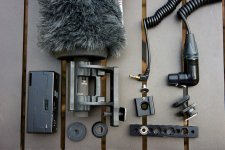
Here's a my kit with all the parts laid out, works for me, may not work for you. Hope this helps.

A7S-iRig.jpg

(The mic shown is a Senn 8060 with the MZF 8000 filter)
 
In my opinion, sound quality is definitely more important than picture quality to the overall experience.

I think that's a bit strident. If I could rephrase that I would say "the overall soundtrack"--the quality, editing, mixing and mastering of the ambience, dialogue, music, SFX--everything.

if I get a mic like Sennheiser me64 (which is not the best mic but it's relatively short and compact)

I haven't tried the ME 64 but I suspect it's more flat and neutral than the Sennheiser 416. Some people prefer that as a starting point to EQ.
 
Last edited:
You got me curious, so I recorded a little test. Rode VideoMic Pro Rycote, +20, a7sii gain set to 1.
https://vimeo.com/170209472
PW: Rode

That is pretty quiet. But I don't have the VideoMic Pro Rycote. I have the older VideoMic Pro, which is what I was talking about. Is there a difference between the two...? I don't know. If I have time, I will put up a comparo between the old VMP and the iRig with the Senn.

Noise aside, I am will to bet either version of the VMP pales in comparison to a professional shotgun for overall audio quality.
 
Noise aside, I am will to bet either version of the VMP pales in comparison to a professional shotgun for overall audio quality.
Totally. Also, a professional shotgun mic will last for a long time and retain its resale value. My twelve-year-old Sennheiser sells for nearly the same price today, and the same cannot be said of my cameras.
 
Here's a my kit with all the parts laid out, works for me, may not work for you. Hope this helps.

View attachment 114493

(The mic shown is a Senn 8060 with the MZF 8000 filter)

Thanks a lot VMT!
Two questions (yes, small details...)
1)
I think you had to use and adapter from 3/8 (of the SmallRig bar) to 1/4 (cold shoe of the mic). The adapter head sticks above the bar...Is there a space between the cold shoe adapter and the bar? Or does the head of the adapter goes through the cold shoe hole? Is it the SmallRig cold shoe? (not sure because the cold shoe in your image looks slightly different than the SmallRig - the latter has two screw holes both sides of the 1/4)
2)
Did you hack the iRig and connected it to the cam via its phones jack? Still not sure if better to change the TRRS cable (originally to iphone) or go with hacking the phone jack. The results should be the same anyway?
 
Last edited:
Thanks a lot for everyone who commented here - it's all very helpful.

Another q: I see that there are certain mics that can get power at various voltage. For example AT875R is 11-52V or the Sennheiser K6 12-48V.
If the main issue of working with self-powered mics is that their voltage is too low (usually 1.5V battery, like K6), what would happen if I supply more power but not the full 48V phantom? Would I still need the gain from the camera? I'm asking because I'm working with external power for the camera and may be able to supply 14V.
 
Thanks a lot VMT!
Two questions (yes, small details...)
1)
I think you had to use and adapter from 3/8 (of the SmallRig bar) to 1/4 (cold shoe of the mic). The adapter head sticks above the bar...Is there a space between the cold shoe adapter and the bar? Or does the head of the adapter goes through the cold shoe hole? Is it the SmallRig cold shoe? (not sure because the cold shoe in your image looks slightly different than the SmallRig - the latter has two screw holes both sides of the 1/4)

The exact cold shoe I use is this one. I don't think it matters which one as long as it has a 1/4" hole.

I use a 3/4 to 1/4 adapter on the bar -- it does stick out a bit -- b/c the cold shoe only takes a 1/4" screw, but the adapter is not really needed. I could instead attach the cold shoe to the 1/4" hole that's on the bar. I use the 3/4" hole because I wanted the shock mount and mic furthest to the left to make room sometimes for attaching a SmallHD 501 monitor.

2)
Did you hack the iRig and connected it to the cam via its phones jack? Still not sure if better to change the TRRS cable (originally to iphone) or go with hacking the phone jack. The results should be the same anyway?

The results could be the same, but I went with hacking the headphone jack for output into the camera. I didn't want the extra cables and clutter. If you don't want to deal with soldering and rewiring, I'd say go with adapting the TRRS.
 
Last edited:
The exact cold shoe I use is this one. I don't think it matters which one as long as it has a 1/4" hole.

I use a 3/4 to 1/4 adapter on the bar -- it does stick out a bit -- b/c the cold shoe only takes a 1/4" screw, but the adapter is not really needed. I could instead attach the cold shoe to the 1/4" hole that's on the bar. I use the 3/4" hole because I wanted the shock mount and mic furthest to the left to make room sometimes for attaching a SmallHD 501 monitor.


The results could be the same, but I went with hacking the headphone jack for output into the camera. I didn't want the extra cables and clutter. If you don't want to deal with soldering and rewiring, I'd say go with adapting the TRRS.


Thanks a lot VMT - just ordered the parts and hope to assemble it soon.
 
Back
Top