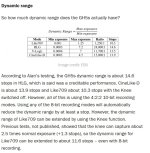
GH5 GH5s dynamic range tests

It's very telling in terms of usable dynamic range that the GH5s is equipped with VLOG-L, not VLOG.

VLOG-L is a subset of the original VLOG. It's literally the same curve, just sliced off flat at 80IRE with no info above it. This is rather wasteful, but assures that both material recorded with Varicams, EVA1's and GH5/GH5s/DVX will mix nicely on the same timeline using the same LUT. In the original VLOG curve, the extra sensor stops beyond 12 would continue with the upper IRE values.

All my testing at the top of this thread supports 12 stops or lower range. Now, you can see beyond 12 stops in terms of faint recording of very hi-contrast imagery, but it's certainly not usable stops, IMO.

Having said that, I've shot a lot with various cameras over the years, and I shot this weekend at the same location I did a bunch of Canon C500/Odyssey testing in the past. The GH5s is absolutely better than that A grade Cinema camera from just a few years ago, to the degree that if someone offered me a near free C500 kitted out for 4K, or a full price GH5s, in my position based off my needs I'd take the GH5s and gladly pay.
Of course Canon has never been known for their dynamic range. Though it is nice to hear such high praise. You'd be throwing away RAW though, which certainly give a lot more flexibility in post then the GH5 codec.
 
Yes it's for stills. Yet camera "bloggers" as well as Panasonic reps continue claiming 14 stops of DR for video on Facebook and elsewhere. Seen it probably 5 or 6 times now. Tell them that it's for stills and that VLOG L maxes out at 12 stops for video and they'll tell you you're an idiot. Haha.
 
I've used Canon RAW quite a bit going back to an almost day one (the beta unit serial # 10002!!!) C500 and the first completely buggy CANON RAW DEVELOPMENT tool... overall, I don't feel I'm giving up much there in the grading, and my hard drive storage space is REALLY thanking me for it! But I do get your point.

And my overall amazement is sort of a long game analysis from someone who grew up in an era where one film camera was much the same as the next, and a silent 35mm camera from a decade earlier was much the same as the most current, and for the first couple decades of his career, change was nearly invisible and incredibly incremental based not on the camera manufactures, but on the progress of Kodak stock... to see this sort of sea-change in a few years is very amazing where an inexpensive tiny camera can play against one of the best from not long in the past... sometimes it's good to take a breath... these are heady times indeed...
 
You have to keep in mind that the GH5s has 12 stops of dynamic range at both native speeds of ISO 400 and ISO 2500, which puts it at the same or better dynamic range than more expensive cameras when shooting at ISO 2500 or higher. ( i.e. Sony A7SII has 11 stops of dynamic range at ISO 2500 )
 
Yes it's for stills. Yet camera "bloggers" as well as Panasonic reps continue claiming 14 stops of DR for video on Facebook and elsewhere. Seen it probably 5 or 6 times now. Tell them that it's for stills and that VLOG L maxes out at 12 stops for video and they'll tell you you're an idiot. Haha.

I've seen those comments from the bloggers as well. Let them prove it with with a waveform grab.

Would I like a couple more stops? Of course, I wilted a bit when I saw that the GH5s was only VLOG-L. But I'm looking at the camera from the overall package point of view, and dynamic range is one factor of many.

Perhaps there's a bit more usable range in some of the Sony models, I don't really know without doing a side-by-side, but I do know that looking at that A7s and the like footage gives me the feeling (to grab from Lord of the Rings) of "too little butter spread over too much bread"...
 
Yes it's for stills. Yet camera "bloggers" as well as Panasonic reps continue claiming 14 stops of DR for video on Facebook and elsewhere. Seen it probably 5 or 6 times now. Tell them that it's for stills and that VLOG L maxes out at 12 stops for video and they'll tell you you're an idiot. Haha.

Because is their haste to be the first one to write/vlog about the camera they mixed up 14bit processing with 14 stops of dynamic range and are too arrogant to admit they were wrong. Because after all they are the gods of this stuff and they know all. There is so much clueless half truths and information out there in this field. I wish we could ban idiots from blogging/vlogging about stuff they clearly know nothing about.

Even if the camera sensor is capable of higher dynamic range V-log L is forever limited to 12 stops no matter who tries to say it any differently. A cap is a cap and doesn't magically just work differently because the internet willed it into existence.
 
It's very telling in terms of usable dynamic range that the GH5s is equipped with VLOG-L, not VLOG.

VLOG-L is a subset of the original VLOG. It's literally the same curve, just sliced off flat at 80IRE with no info above it. This is rather wasteful, but assures that both material recorded with Varicams, EVA1's and GH5/GH5s/DVX will mix nicely on the same timeline using the same LUT. In the original VLOG curve, the extra sensor stops beyond 12 would continue with the upper IRE values.

All my testing at the top of this thread supports 12 stops or lower range. Now, you can see beyond 12 stops in terms of faint recording of very hi-contrast imagery, but it's certainly not usable stops, IMO.

Having said that, I've shot a lot with various cameras over the years, and I shot this weekend at the same location I did a bunch of Canon C500/Odyssey testing in the past. The GH5s is absolutely better than that A grade Cinema camera from just a few years ago, to the degree that if someone offered me a near free C500 kitted out for 4K, or a full price GH5s, in my position based off my needs I'd take the GH5s and gladly pay.

Couldn't agree more.

Shot an interview recently with the C500/Odyssey/Canon Cine Servo 17-120mm and the Gh5 with a Zeis Contax Zoom.

C500:
c500.jpg

Gh5:
gh5.jpg

IMO, The Gh5 (even before the "s" model, SMOKES the C500.

It isn't even close.
 
Jim,
Have you tried your DR test with HLG? Isn't it writing scene IRE up to 100 at video level 940? The comment spreading too little butter over too much bread may apply here as well, it feels a bit more tricky to expose than V-Log/L but grades quite well in Resolve if exposed properly.
 
Tom, I'll have to retry that same test without involving the Odyssey as a handy waveform monitoring device, as it doesn't handle incoming HLG correctly nor scale it per specs. I've passed on the issues to CD so they know, but at the moment it's lower priority as I was the first (and only) person to report it.

After that initial test, I did do side by side comparisons with VLOG-L in regards to green screen and found it to be very clean (and of course it uses more of the IRE range compared to VLOG-L). I think it's a reasonable choice for Green Screen, as you rarely need 11-12 stops in the controlled lighting you usually do in those scenarios, and, perhaps more importantly, it is in the REC2020 color space, which gives it a little edge in the color difference matting department I think. I've managed in camera recorded HLG in post up to now by using Fusion with a color transform from REC 2020 to linear and back to REC 709 after keying and that works a treat.

I'm sure Paul's LUT should be the next step in experimentation. However, there's one issue that I'm unsure of and that's how to really monitor it well on camera. Unlike VLOG, there's no option to bring in a user LUT, just the two different view modes that the GH5 gives you, one favoring "sky", the other favoring "subject". That's a bit vague, and I've yet to see a discussion on this. I'm wondering how Paul monitored HLG in relation to the feature he shot entirely in HLG. Perhaps he will chime in. I'm not sure if Atomos products monitor this correctly? But even if so, it would be nice to understand the in-camera workflow for monitoring better...
 
Jim,
Have you tried your DR test with HLG? Isn't it writing scene IRE up to 100 at video level 940? The comment spreading too little butter over too much bread may apply here as well, it feels a bit more tricky to expose than V-Log/L but grades quite well in Resolve if exposed properly.

Yes, I'm sorry, should have read. I see that you did.
 
Tom, I'll have to retry that same test without involving the Odyssey as a handy waveform monitoring device, as it doesn't handle incoming HLG correctly nor scale it per specs. I've passed on the issues to CD so they know, but at the moment it's lower priority as I was the first (and only) person to report it.

After that initial test, I did do side by side comparisons with VLOG-L in regards to green screen and found it to be very clean (and of course it uses more of the IRE range compared to VLOG-L). I think it's a reasonable choice for Green Screen, as you rarely need 11-12 stops in the controlled lighting you usually do in those scenarios, and, perhaps more importantly, it is in the REC2020 color space, which gives it a little edge in the color difference matting department I think. I've managed in camera recorded HLG in post up to now by using Fusion with a color transform from REC 2020 to linear and back to REC 709 after keying and that works a treat.

I'm sure Paul's LUT should be the next step in experimentation. However, there's one issue that I'm unsure of and that's how to really monitor it well on camera. Unlike VLOG, there's no option to bring in a user LUT, just the two different view modes that the GH5 gives you, one favoring "sky", the other favoring "subject". That's a bit vague, and I've yet to see a discussion on this. I'm wondering how Paul monitored HLG in relation to the feature he shot entirely in HLG. Perhaps he will chime in. I'm not sure if Atomos products monitor this correctly? But even if so, it would be nice to understand the in-camera workflow for monitoring better...

When I looked at the HLG video waveform you posted, I saw the underlying white bar disappear after about the 8th stop while the waveform representation kept going down observably stop by stop a few more. At first confused; 90% scene white or usual reference white is 0.661 volts. The HLG gamma is the same as 2.4 gamma up to 0.5 volts, where it digresses, but for HLG 90% reference white is 0.5 volts, from there to 1.0 volt log gamma means scene brightness gets 12 times brighter (1200% or 3.5 stops). Because we are watching on 709 monitors, the ultimate brightness in nits is not 12 time brighter, it is the same, so in order to display the extra stops in 709, the whole curve gets shifted down; as the bar darkens it disappears sooner as we can only see what the SDR 2.4 gamma can represent, 6-8 stops. In order to see 11-12 actual stops, we would need to see the extra bright ones at the top on a HLG enabled display. The WFM continues to see them though, but the SDR screen can't. That's not the case for V-Log/L because the whole curve is logarithmic, not a hybrid transfer function of two parts of which only the lower half of the curve is shared with 2.4 gamma; played at a lower level, hence darker, bar disappears sooner, WFM continues to show the story. With V-Log/L all the 11-12 stops of the bar are shown in SDR, just very flat because we're seeing a logarithmic *representation* of scene brightness on 709, not the actual stops of brightness itself. By putting the 1200% clipping point of HLG at 100 IRE and counting down, scene stops that would have been clipped from a SDR display are being shown, making no room for the dark stops at the bottom, which now appear as giant drops (and they are) as they can't all be fit into the 6-8 stop SDR display window. The bottom line, the waveform monitor is to be believed, never mind the scaling of it, the whole range is represented in 10 bit code values because nothing is clipped. Your test is valid and shows the DR of the GH5s HLG is more or less the same as V-Log/L depending on how well you can count those tiny dark WFM steps 10-13. I think they are there and significant, but would be impossible to see except on a HLG enabled display or a SDR display with the curve raised to clip the stops it can't show from the top. The difference seen on the WFM between HLG and V-Log/L could be that HLG allocates more bit depth to the upper stops, and fewer to the lower ones. That seems consistent with its mission of presenting HDR in bright viewing conditions for sports and broadcast, not just darkened theater settings. Thanks for doing this!
 
I measured DR of the GH5s, HLG, 320 ISO, 422 10 bit, All-I 400 mbps. 11.67 stops. I did the test a little differently than Jim but I'm still confident it's a good number. Rather than counting down from white clip, I counted up from the black. When I could just see the white patch become visible that became stop "0" so it was not counted. When the last stop white clipped the WFM, I used the previous number before it clipped as the last counted stop. I measured in 1/3 stops near the clipping points.
 
To Matt... thanks for sharing your C500 & GH5 frames, a very nice example and you can see more dynamic range in the window's blown-out areas with the GH5 than the C500... I also dug up my old C500 RAW frames and was looking at the high speed I shot at 3200ISO. Total run-away win on the GH5s compared. Again, the C500 was a great camera that I shot a good number of projects on and was very impressed with at the time, the last one less than two years ago.

To Christopher... thanks, and no problem, I'll continue to do more tests... I did pick up the Lemming LUT pack and look forward to seeing how well matched Paul's VLOG is to the HLG and also how Cine-D measures up as an alternative when shooting 8bit high speed.

To Tom... That number you got for HLG is very close if not right at what VLOG is... certainly gives an option to VLOG when you want to maximize your recording range. When I get time I want to shoot the same scenes back to back on with both to see how they compare over a range of imagery. I'm still less confident in the monitoring of HLG with the camera's built in tools and that will be something to explore as well. I don't know if I'd ever shoot HLG if I was passing the original files on to the client, as most clients couldn't handle even a "normal" log grade if their jobs depended on it, but certainly for stuff I would post in house, why not? It works really well for green screen at ISO's from 320 up to 2500 with little noise anywhere in that range.

Posting in house with your own home brew... it reminds me of an exchange I witnessed on a narrative shoot decades ago when the script supervisor wanted to know who else to give her notes to after the shoot. "No one" says the producer, "If someone other than one of the five people in this room wind up working on this, we've got bigger problems than which side the of the bed the flowers were on.".
 
To Tom... That number you got for HLG is very close if not right at what VLOG is... certainly gives an option to VLOG when you want to maximize your recording range. When I get time I want to shoot the same scenes back to back on with both to see how they compare over a range of imagery. I'm still less confident in the monitoring of HLG with the camera's built in tools and that will be something to explore as well. I don't know if I'd ever shoot HLG if I was passing the original files on to the client, as most clients couldn't handle even a "normal" log grade if their jobs depended on it, but certainly for stuff I would post in house, why not? It works really well for green screen at ISO's from 320 up to 2500 with little noise anywhere in that range.

Agreed and not trying to pick winners and losers, having some fun with it.
 
That's why max zebras in VLOG-L is 80% right?

BTW I checked in some of my past clips and I remember one in particular where a street sign was just barely lit up with zebras (set @ max for VLOG-L) but I'm able to bring it down to not being blown out!

I didn't expect it actually!

Did you guys experienced this too???

Is there a tangible "safe margin" over zebras like 1/3rd of a stop so I can judge better and squeeze some more HL infos?? ;)
 
HLG is now my preferred recording mode over V-Log. A bit more dynamic range and overall better colors (although it does not match the deep reds in V-Log).
 
Not to go against the grain or even beat a dead horse, but why is it you have sites like News Shooter stating that the GH5s has a usable range of 14.6 stops in HLG? Is usable range all subjective? They're not talking about stills either.

I think the key word is "usable" and it is indeed subjective. Is just discerning a pure white patch against black in the noise floor a "usable" stop? Not in my work, thus I don't think of the camera as 13.5-14.6 stop camera as the original BBC tester does, no matter his status or credentials or expertise. The reason I did my tests was to figure out where the comfortable range of the camera is for me... and I encourage all users of any camera to determine the same.

Under the most optimistic conditions I would never, ever claim the GH5s is a "14 stop camera" because in my world, I can't count on using those bits lost deep in the noise for anything other than, I guess, a statistical bragging point when selling the kit to a client... if it WAS a camera with 14 stop range, you could underexpose middle grey one or two stops from where the recommended exposure for where middle grey is, and still have decent, non-crunchy shadow tones while giving you some really good highlight protection. But you can't. Not in VLOG-L, not in HLG. I can think of a couple cameras claiming they're "14 stop cameras" where you actually can do that.

Regards,
 
Back
Top