GH5 Available for Pre-Order at $2k, amazing features.

^ The mistake in your reasoning is that you think Rec709 is close to linear. It's not. Not even close.
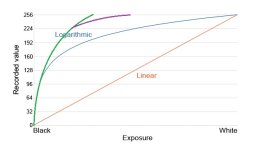
This is what Rec709 would look like in that chart you posted, approximately. The purple bit is what you can get with a knee in the highlights.
log_standardisation_fig_3.jpg
And the difference with log is not that big because I made it thinking of the log line as GH4+vlog. If I used slog3 as reference, then the Rec709 line would have the same height but would be 12.5% as wide.
If you don't believe me, check this article. The Rec 709 graph is at the bottom, and the log lines presented there are the original Slog from the F35.
 
Last edited:
^ The mistake in your reasoning is that you think Rec709 is close to linear. It's not. Not even close.
This is what Rec709 would look like in that chart you posted, approximately. The purple bit is what you can get with a knee in the highlights.
View attachment 120331
And the difference with log is not that big because I made it thinking of the log line as GH4+vlog. If I used slog3 as reference, then the Rec709 line would have the same height but would be 12.5% as wide.
If you don't believe me, check this article. The Rec 709 graph is at the bottom, and the log lines presented there are the original Slog from the F35.
Perhaps I am not reading your chart properly but how many stops of dynamic range difference do you actually think VlogL compared to "Rec.709 like" with a suitable knee has?

Sure the log and the linear curve can go to infinite brightness but I mean would you agree that ultimately the sensor is the limiting factor not the curve that maps sensor values to luminance values?

At any rate I would be delighted if VlogL increases the dynamic range of the GH5 dramatically, I just do not have too many high hopes about it. :)
 
The problem is: I don't know how much you can get with the knee. I drew that with an assumption that it would allow you to match the DR of CineLikeD, which is around a stop less than Vlog.

In theory the sensor is the limiting factor, but in practice it's hardly ever the case. The GH4 has 12.7 stops of usable DR when shooting RAW stills, according to dxomark, yet when shooting video this test finds just about 11 stops in VlogL, and I only see 10 in CineLikeD (they count 11 looking at the waveform, but I think they're being a bit too optimistic there). It's the same with the Canons: around 9 stops, a bit more if you push it with custom color profiles, yet in RAW stills they can go much higher. These manufacturers are applying a gamma curve that clips part of the information coming out of the sensor.

On the Sonys the difference is bigger, but then I'm not sure if it's a curve thing, or a hardware thing. Sony's sensors get lots of DR in RAW stills by using high-bit-depth ADCs, but they have to go to 12-bit ADC mode when shooting in burst mode, for example. I think video will require that fast 12-bit ADC mode as well, and is probably the reason the a7S II can't fill the slog3 bucket: it looks like a hardware limitation in this case.

The GH4 could have that same problem, or maybe it's just a curve thing, only Panasonic knows.

I'd love the GH5 to be competitive in terms of DR, but the fact that Panasonic has been silent about it since launch is a strong sign that it's probably not going to blow my mind away.

(I posted more about that Tom Antos test over here)
 
I don't know, much of that is over my paygrade, but from what I am understanding (and seeing/hearing from Neumann films, and other forum talk) seems to indicate that vlog performance is much better. I am assuming this is due to how much better the camera's noise processing is. If log is extending the mids and producing more noise, this is offset by the excellent noise processing (which serves double duty for excellent lowlight).

The fact that Panasonic is silent means they know DR isn't going to be a selling point. No doubt the GH5 will be superior to the GH4 in practice because of the sum total of its parts, but I think the expectation should be more that it will actually meet the GH4's claimed 12 stops very well, with low noise and good signal.

This isn't bad at all, as many cameras that claim more also fall short. Regardless, it should be "good enough" if you are sold on the rest of the feature set.

All I know is I am looking forward to being able to ETTR in a dim room filming a wedding and be making full use of that histogram. And then still have way more robust images for grading in post, raising shadows, recovering highlights, etc. And neat video does wonders.

I'm interested in learning more about the technical side and curves and what not, so please continue, but long story short from what i know is the camera's end performance is greater than the sum of its part. Noise processing and codec and internal processing improvements all equate to a much better image than the GH4, including DR - just don't expect it to perform past what they are claiming.
 
I'd love the GH5 to be competitive in terms of DR, but the fact that Panasonic has been silent about it since launch is a strong sign that it's probably not going to blow my mind away.

[/URL])

Panasonic has said that GH5 in vlog has the same 12 stops DR as the GH4 in vlog. Panasonic hasn't specified the DR without vlog profile.
 
I think we really need to be careful judging these cameras in terms of dynamic range when shooting video. At best the published specs are marketing and they only refer to very specific situations. DR is very open to interpretation and some times that lowest stop really gets counted when it probably should not get counted. Some companies are more conservative in how they rate that lowest stop in terms of acceptable noise floor. For example lets say we have camera A rated for 12 stops and camera B rated for 14 stops. Camera A is a bit more honest and even though there might be a 13th stop there it has so much noise there are very little noticeable details left. So they say ok 12. Then you have camera B that claims 14 stops but that last stop would be considered virtually useless to every human on the planet. The reality could be more like 12.5 stops vs 13.5 stops. So now instead of having two cameras with a 2 stop difference it may actually only be one stop in terms of real world usage.

DR is also largely affected by the ISO level used. So while camera B may claim 14 stops that may quickly drop to 13 stops by raising the ISO just one single notch. Where this becomes important to know is that people that tend to want a good low light camera tend to use it as a low light camera without any lights. In perfect conditions that camera may have more DR but unless one uses lights even though the camera can see in the dark that DR advantage is really non existent. You really need to shoot in just the right conditions to get that full DR out of each camera. Now the same is true for camera A and it also loses DR the higher the ISO is raised but since camera A may not be considered a low light camera its users have no choice to use lights. So now that 12 stops will stay at 12 stops while camera B suddenly dropped to 10 or 11 stops. Using a camera like the Sony A7S may make sense in the dark at ISO 6400 but the DR has really suffered at that point despite the image looking noise free.

Finally no camera gets the published DR spec when it comes to video unless that camera can record raw. So when Sony claims 14 stops for the a7S that is nowhere near what video actually gets. The thing with Panasonic and V-log is that they say it gets 12 stops with video. Not for shooting raw stills but actually shooting video. 12 stops shooting video may not be all that far off what the Sony A7S gets when shooting video. When you factor in log shooting it gets even more interesting. The GH4 shoots log with a base of ISO 400. The Sony A7S shoots log with a base of ISO 3200. Pretty much any DR advantage the Sony once had is completely gone when shooting log. I'm pretty sure the Gh4 can even beat the A7S when shooting log since the DR can drop a lot on the A7S with ISO 3200.

At best I think there is realistically only about a stop difference between all the higher end DSLR cameras no matter the sensor size. So the take away with all of this is that DR depends on a lot of things and a lot more complicated than camera A spec vs camera B spec. Yes more DR is almost always better but we really need to ask is 14 vs 12 really 14 vs 12.
 
Last edited:
^ You start with a lot of great points, then go for stuff that has been measured to be wrong.

First: manufacturer claims in terms of stops are indeed useless. The worst example I can recall is Sony's claim that the a7S had "unprecedented 15,3 stops of dynamic range". That was utterly laughable. Dxomark measured 13.2 stops in RAW stills, and slog2 was 12.5 stops or so.

Second: DR is indeed subjective, and measurements will change from one tester to another. I will post a link below where I use Tom Antos' recent test, and I claim different numbers than he does, using his footage. So, I never trust measurements in terms of stops. What I do trusts are comparisons ran by the same person with the same methodology on the same day. So, "FS7 has 3 stops more than the original C300" is a very valid conclusion you can draw from this test.

The ISO thing is also true: with the a7S and with the RX100 IV, I've measured that for every stop you increase the ISO above its base slog2 level, you lose approximately half a stop of DR.

Where you get lost is when you say a7S will be hurt by having a base ISO of 3200. No, that's actually the ISO it's been measured at, and people have found it has A LOT more DR than the GH4.
And the difference between state-of-the-art super-awesome cameras is waaay bigger than one stop. The a6300+slog3 has approximately three stops more DR than the GH4+Vlog.

I used this very nice test by Tom Antos to create a very nice table that I posted here (follow link if you want to see it full size).

TomAntosDRtest_.jpg


Panasonic has said that GH5 in vlog has the same 12 stops DR as the GH4 in vlog. Panasonic hasn't specified the DR without vlog profile.
I've now lost all interest on the GH5. Thanks.
(The GH4 does have plenty of DR for most cases, as is shown in the second half of the Tom Antos test. I've worked happily with even less than that just a few years ago, when I was on the Canon bandwagon. But Sony and BlackMagic spoiled me: I won't go back in DR just to get more Mpix and higher bit depth)
 
Last edited:
IN my experience color depth is the other important deciding factor.
Even though the Sony A7S cameras have more DR, they really suffer in their 8 bit outputs.
What the panasonic GH5 offers (though I will stick with my Sony's) is the opportunity for more pleasing colors/color correction.
I just can't deal with the small sensor though.

One thing I wonder is how the 5D3 in ML RAW compared to it's h264 equivalent in terms of an Antos like test for DR.
I think that compression does effect dynamic range.
Personally, I still think it has some of the most pleasing color out there in raw and I am often blown away by how much color correction it can take and yet how right on it can be right off the bat. Amazing.
That is the benefit of 14bit output.

God I wish someone would hack the F3.
 
Last edited:
The 5D3+RAW definitely has the best color I've seen coming straight out of a camera. I don't think it's a result of 14-bit, but a result of nobody messing up with them: they come straight out of the sensor, and are already very optimized because, well, it's a stills camera with a huge heritage.
What it doesn't have is great DR. Check this test (scroll down to see the actual images).
 
^ You start with a lot of great points, then go for stuff that has been measured to be wrong.

First: manufacturer claims in terms of stops are indeed useless. The worst example I can recall is Sony's claim that the a7S had "unprecedented 15,3 stops of dynamic range". That was utterly laughable. Dxomark measured 13.2 stops in RAW stills, and slog2 was 12.5 stops or so.

Second: DR is indeed subjective, and measurements will change from one tester to another. I will post a link below where I use Tom Antos' recent test, and I claim different numbers than he does, using his footage. So, I never trust measurements in terms of stops. What I do trusts are comparisons ran by the same person with the same methodology on the same day. So, "FS7 has 3 stops more than the original C300" is a very valid conclusion you can draw from this test.

The ISO thing is also true: with the a7S and with the RX100 IV, I've measured that for every stop you increase the ISO above its base slog2 level, you lose approximately half a stop of DR.

Where you get lost is when you say a7S will be hurt by having a base ISO of 3200. No, that's actually the ISO it's been measured at, and people have found it has A LOT more DR than the GH4.
And the difference between state-of-the-art super-awesome cameras is waaay bigger than one stop. The a6300+slog3 has approximately three stops more DR than the GH4+Vlog.

I used this very nice test by Tom Antos to create a very nice table that I posted here (follow link if you want to see it full size).

TomAntosDRtest_.jpg


I've now lost all interest on the GH5. Thanks.
(The GH4 does have plenty of DR for most cases, as is shown in the second half of the Tom Antos test. I've worked happily with even less than that just a few years ago, when I was on the Canon bandwagon. But Sony and BlackMagic spoiled me: I won't go back in DR just to get more Mpix and higher bit depth)

You may be right about the A7S having 3200 ISO as its base which is a bit odd because many tests of the stills side of the a7s at ISO 200 is around that level. Not sure how log is increasing the dynamic range with a higher ISO but good for Sony for managing to do so. That Tom Antos test is extremely flawed however. Without a doubt the A7S has more dynamic range but I would not base his test on any form of conclusive information. First his GH4 test is underexposed and the white swatch isn't as bright as the others. This immediately pushed down all the other samples. This is why I don't trust the tests of others very often because each camera has to be shot just right. His test is nowhere near a scientific test. Without a doubt the Sony cameras have more DR but it may not be by as much as you think it is.
 
IN my experience color depth is the other important deciding factor.
Even though the Sony A7S cameras have more DR, they really suffer in their 8 bit outputs.
What the panasonic GH5 offers (though I will stick with my Sony's) is the opportunity for more pleasing colors/color correction.
I just can't deal with the small sensor though.

One thing I wonder is how the 5D3 in ML RAW compared to it's h264 equivalent in terms of an Antos like test for DR.
I think that compression does effect dynamic range.
Personally, I still think it has some of the most pleasing color out there in raw and I am often blown away by how much color correction it can take and yet how right on it can be right off the bat. Amazing.
That is the benefit of 14bit output.

God I wish someone would hack the F3.


Agreed. The GH4 is the only DSLR with 10bit HDMI/HD-SDI output and therefore the only DSLR that can shoot log at 10bits for the most range to work with in post in a professional environment. While the Canon may have nice color out of the box you are still stuck with 8bit color. The same is true with the Sony DSLR cameras. Great sensors but they have been seriously hobbled by their lack of 10bit color, especially if shooting log formats. Log can work in an 8bit format but it is never optimal. I have used S-log on the F3 with their 8bit formats and it always leaved a bit to be desired. It is impressive how clean S-log can be in 8bit but it will never be where it should be or where the sensor is capable of being.

The GH5 is even more unique now because you don't even need an external recorder anymore to get 10bit 4:2:2. Thats a huge deal and while the GH4/GH5 do have their flaws without a doubt, it is that inclusion of 10bit 4:2:2 options that set those cameras way above any other DSLR out there. Cinema cameras have higher DR which is true but they also only record to raw or at the very least 10bit 4:2:2 ProRes formats. In a professional workflow these things are important. Hollywood will never use a 8bit H264 based format for a movie but they have used 12 stop cameras in the past. Some cinema cameras like RED are actually worse in low light than the GH4 is and they are not known to be low light cameras. Sensitivity and DR is something that can fussily be accounted for with external solutions. Being stuck with an 8bit format is something you can never create a solution for on these cameras.

Sony really needs to at least add a true 10bit HDMI output for me to even consider them. I'm sure they look find out of the box but I don't want a camera like that. I want a camera that actually has a professional format and would choose a small Blackmagic Design camera over the A7S any day for this very reason.
 
I'm fine with asking Sony and others to include 10-bit in their cameras, at a minimum for external recording. I still don't find it mandatory *for me*, but it would be nice to have, at least as an option.

Regarding the Tom Antos test, I don't think he screwed up. Looking at the waveform for vlog, it's perfectly horizontal at the top, which means the white patch is indeed clipped. If it doesn't appear as pure white it's because Vlog has a lower white point, but there's no more headroom up there. Same with slog3 vs slog2.
 
The more I look at that clip (and the 'original' from Vimeo) there is something off. Its way way too compressed and noisy.
 
The more I look at that clip (and the 'original' from Vimeo) there is something off. Its way way too compressed and noisy.

I agree there seems to be lots of things going on there. My old HPX170 would look better. Totally uncomparable to some of the other shots I have seen.
 
Back
Top