Glenn Przyborski
Member
I though this might be of interest to forum readers, since most people shoot DLSR video to achieve a "filmlike" depth-of-field.
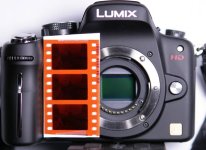
I took a piece of 35mm, academy aperture negative and laid it next to the GH1's imager. The film image is only a couple millimeters larger. Over the past 7 or 8 years, it's become popular to shoot full-aperture 35, but academy aperture (which is offset horizontally to allow room for the optical soundtrack) is still the most popular format. This is due to the fact that most older 35mm cameras have no provisions to re-center the lens mount without permanent modification and collimation. Also, many older lenses, such as the Angenieux 20-120 & 25-250 can't fill a full aperture image without vignetting.
When shooting 16x9 HD, both the film transfer scanner (and the GH1) ignore the top and bottom of the image. You could make the argument that the depth-of-field characteristics of the GH1 are very similar to 35mm academy aperture, movie film.
The 5D's much shallower depth-of-field is like the VistaVision format which moved film horizontally through the camera's gate with each frame being 8 sprocket holes wide. This is virtually identical to the 5D's full-frame 36mm x 24mm imager.