GH1 does not have ALC

Blazer003, put a line pad between your lav receiver and the camera and see what happens. I'm using a Shure variable attenuator -15, -20, -25. The -20 setting works for my lav plugged directly to the GH1. You can try the others to see if they work better for the receiver. The idea is to get the signal below the level where the AGC/limiter/whatever kicks in. It really works.
I haven't tried it with another lav or a shotgun, but I expect the results to be similar.
 
All I know is that when I have plugged in my Senheiser wireless lavs to the GH1, as long as the person is talking it's fine, but if they stop it most definitely brings the background noise up. Now maybe this is actually bringing everything down when they are talking and bringing it back up when they're not, so I will try again to turn the sensitivity of the lav down and do some tests.

It's not just the background noise rising up withing the gaps of someone speaking that's a problem. When you are hitting the limiter in the GH1 that hard it also alters the sound/tone characteristics of the person speaking. Any plosives or spikes in the audio when the person is speaking will sound unnatural. The voice will sound thinner, tinny and raspy. It's an overdriven sound but not distorted. I guess most people can't hear/recognize the difference in audio quality when a limiter is being overdriven but it's definitely a problem with the GH1's external mic input.

Using a Shure SM-58, SM-57 or an Electro-Voice RE50, I've had to use 25dB of attenuation.

Using the Sennheiser ME-64 I had to use 30dB of attenuation.

Using the Rode Stereo VideoMic (with the -10dB switch on) I had to use 10 dB of attenuation.

Using my Shure mixer XLR mic output, i had to use 40dB of attenuation since I have that setup to peak at +8dB and with its limiter set at +8dB.

I just tested my Samson wireless lav system using the 3.5mm mic out of the receiver (set at -30dB) with a short 3.5mm cable and then added a 3.5mm 10dB attenuator to the 3.5mm to 2.5mm adapter to the GH1 and that was not enough to keep it from hitting the limiter. I had to make sure to not connect the attenuator into the wireless receiver output end first since that did not attenuate the signal for some reason. Connecting it to the GH1 end worked using the 3.5 to 2.5mm adapter. The Samson receiver output is adjustable from -10 to -30dB so it looks like it will need another 20-30dB of attenuation even when switched to its -30dB output setting.

Randy
 
Last edited:
It's not just the background noise rising up withing the gaps of someone speaking that's a problem. When you are hitting the limiter in the GH1 that hard it also alters the sound/tone characteristics of the person speaking. Any plosives or spikes in the audio when the person is speaking will sound unnatural. The voice will sound thinner, tinny and raspy. It's an overdriven sound but not distorted. I guess most people can't hear/recognize the difference in audio quality when a limiter is being overdriven but it's definitely a problem with the GH1's external mic input.

Yeah, I hadn't actually paid that much attention to the voice because as soon as I heard the background noise come up, I pretty much just scrapped it and recorded to my H2, but I did some tests yesterday and the voice is definitely overdriven. So I have the Sennheiser ew 100 G3. What would be a good attenuator to combine with this?
 
Barry,

I already have one of those cables on order. That attenuation cable is rated at 25dB and is meant to bring the "Line" level output from external audio recorders down "Mic" level which may not be enough for the GH1 since it typically needs at least an additional 20dB or more of attenuation beyond that basic "Line to Mic" level attenuation.

Now it might work with the output of a wireless mic system that has a Mic level output from its receiver and that's what I will be testing since my 3.5mm 10dB attenuator plug wasn't enough.

Randy
 
Last edited:
Ok, I've been testing out how to get a clean audio signal from the Line-Level output of the Sony PCM-M10 audio recorder to the GH1 Mic-Level input while shooting.

Here are the test results and setup. I connected a Shure SM58 handheld mic to the Sony PCM-M10 Mic Input. After much testing, I ended up having to attenuate the Line Out of the Sony M10 by 70dB, that's Seven Zero, going into the GH1's Mic Input so that it wouldn't hit the GH1's audio limiter and reduce/alter the sound quality. The room had background noise from 2 computers, a fan and a central AC was on and blowing from above. This made easier to check for any rise in background noise between words and any difference in overall background noise between the GH1 and PCM-M10.

The audio levels were not changed in either WAV file, they are at their original levels. Coincidently, the Sony PCM-M10 audio ended up being only a couple dB's louder than the GH1's audio so if you want to do a better comparison load the audio files into your audio/video editor and raise the GH1 audio by a couple dB's to even them out and then compare.


Panasonic GH1 audio from original MTS file. I put the MTS file in the timeline of Edius and exported it as a 16bit 48K WAV file:

http://dl.dropbox.com/u/2204694/Panasonic_GH1_audio.wav (11MB)


Sony PCM-M10 audio from original WAV file. Simply copied the 16bit 48K WAV file off the recorder's built-in memory. Here it is:

http://dl.dropbox.com/u/2204694/Sony_PCM-M10_audio.wav (11MB)


I'd say after comparing them myself that it's pretty close considering the GH1 audio file was recorded at 192Kbps 48K AC-3 compared to the uncompressed 48K WAV recorded with the Sony PCM-M10. The GH1 audio is certainly usable for an initial edit without having to sync all the audio from the Sony recorder to the GH1 video and should provide a much more accurate sync once you do that since the audio waveforms will line up perfectly since they came from the same audio source.

Let me know what you think,

Randy

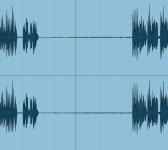
Here is an audio waveform comparison between the Panasonic GH1 and Sony PCM-M10.

GH1_PCM-M10_Audio.png
 
Last edited:
Hey, great work. The GH1 audio doesn't sound "limited" at all. What is highlighted here, I think, is the inherent noise of the GH1.
Here's what I don't understand about the whole issue: if you run your audio through a Juicedlink--or some other device which applies pre-amps--and then go to the GH1 isn't the camera still applying it's own noisy pre-amps not matter what you do to avoid the limiter? Certainly avoiding the limiter is great, but you're still left with significant hiss. The demo videos from Juicedlink seem to indicate that their product reduces this hiss. So how is it done or are we being duped?
 
I wouldn't blame any additional noise on the GH1 preamps just yet. I had to use 7 pieces (3 different attenuators) to lower the audio signal coming out of the Sony PCM-M10 by 70dB and still have the ability to hook my headphones to that line output also. Any one of those pieces could have been a "weak link" and added additional noise. I also had the output of the Sony recorder at its max output level which may have introduced its own noise.

It could have also still been hitting the GH1 limiter which would make the background noise sound louder in the GH1 when compared to the Sony recorder which did not have its limiter on. Remember also, that mic was picking up background noise from 2 computers within a couple feet of the mic, a fan and an central AC blowing in a small room. Not a great test environment to determine how noisy the preamps are which I wasn't concerned about at this point anyways.

I could have lowered the Line Out level from the Sony recorder (it's adjustable from 1-30) but it was maxed out so I could get full volume level to the headphones which shared the output with the GH1 via a stereo 1/8" Y-splitter. I added a volume control adapter to the headphones also since I couldn't adjust the audio level from the Sony recorder without it affecting the the level going to the GH1.

List of pieces used in the order going from the Sony PCM-M10 to the Panasonic GH1:

1. Stereo 1/8" Y-splitter (one signal goes to the GH1 and one to the headphones which had its own volume control adapter added to it)
2. 35dB stereo 1/8" audio cable 9"
4. Stereo 1/8" barrel connector
5. 25dB stereo 1/8" audio cable 9"
6. 10dB M-Audio stereo attenuator adapter
7. Stereo 1/8" to stereo 2.5mm adapter to plug into the GH1

More testing has to be done and less pieces/attenuators used to conclude that the GH1 preamps are noisy but the overall conclusion to draw here again is that there is no AGC in the GH1.

Randy
 
Last edited:
Hi, guys. The latest development version of PTool 3.40 has the mysterious "Auto Gain" item (switchable to On/Off) now showing under "Auto Bracketing" menu when applying the following patch -- Patches For Testers -> Middle Level Research -> Menus Related -> Bracketing -> Multiple Exposure. It's not clear what the exact function here is, as as far as I understand Vitaliy discovered this [apparently hidden] menu option looking through images encoded in firmware. I tried the On/Off switching, but I am somewhat of a noob, so the only thing I can attest for sure is that nothing seems to break in the camera. Does anyone with understanding of the whole AGC/ALC issue and testing skills to match (looking at you in the cave ;) want to give it a shot? If you haven't yet applied PTool mods, let me know and I can walk you through the process.

Thanks.
 
"the overall conclusion to draw here again is that there is no AGC in the GH1."

I agree. Just from practical experience attenuating my senn. ME66 it really behaved like there was a limiter.
 
So is -40db the accepted ballpark number for a typical shotgun? I have an NTG that I wouldn't mind toting around if I can wire an adapter/attenuator.
 
I have managed to get some audio tests done with the GH1 last night and have attached screenshots of the difference between AVCHD audio and MJPEG audio. There is definitely a difference in the noise on these two tracks. The AVCHD bumps it up by about 10db rms whereas the MJPEG totally flatlines and to my ears the noise isn't even audible. Very acceptable, if only it were higher than 16K sample rate.

My estimates put the microphone input on the GH1 to be in the 1mV range or .001 Volt

To figure out what attenuator to use, you need to know what your output is. There is a handy calculator online to help convert 0dbV or 0dbu to match the voltage.
http://www.sengpielaudio.com/calculator-db-volt.htm

I bought a cheap voltage meter at Radio Shack for $20 that measures voltage and it took the guesswork out of the process. -60 to -70db attenuator is normal for pro audio mixer outputs.

In AVCHD, I can't seem to get rid of the hiss at all, but it is possible in MJPEG. Whether that is because the lower sample rate loses the higher frequency audio that the hiss resides in, I can't tell for sure.

I still think the Dolby AC3 encoding has something to do with the gain and compression settings on the GH1 in AVCHD mode. Dolby has a .pdf online explaining the profiles used for different audio streams. All AC3 audio streams must be encoded to carry some form of this metadata, so does the GH1.

From the Panasonic website:

"Audio Quality that Further Enhances Your HD Movies
The GH1 also comes with the high-quality stereo sound of Dolby® Digital Stereo Creator, the global standard for superior audio recording. The stereo microphone on the upper body records dynamic, true-to life stereo sounds that bring out all the power of your HD movies. "

Dolby's encoding and data parameters are listed here under Dynamic Range Control:
http://www.dolby.com/uploadedFiles/zz-_Shared_Assets/English_PDFs/Professional/18_Metadata.Guide.pdf

It also sheds light on why bitrates higher than 192kbps won't playback in camera, it seems they are usually used for multi-channel audio streams by Dolby AC3 standards.

Hope this helps anyone.
 

Attachments

  • mjpeg gh1 file.JPG
    mjpeg gh1 file.JPG
    51 KB · Views: 0
  • avchd gh1 audio.JPG
    avchd gh1 audio.JPG
    51.9 KB · Views: 0
So is -40db the accepted ballpark number for a typical shotgun? I have an NTG that I wouldn't mind toting around if I can wire an adapter/attenuator.

Without a mixer, it really depends on what you are recording and your particular microphone model.

Rode NTG-3 info from the Rode website

Maximum SPL 130dB SPL
Maximum output voltage 8.2dBu
Sensitivity -30 dBV (31.6 mV @ 94 dB SPL)

The GH1 input is around -60dbV. Using this chart will help do the math.

Sounds dB SPL
Rocket Launching 180
Jet Engine 140
Thunderclap, Air Raid Siren 1 Meter 130
Jet takeoff (200 ft) 120
Rock Concert, Discotheque 110
Firecrackers, Subway Train 100
Heavy Truck (15 Meter), City Traffic 90
Alarm Clock (1 Meter), Hair Dryer 80
Noisy Restaurant, Business Office 70
Air Conditioning Unit, Conversational Speech 60

Light Traffic (50 Meter), Average Home 50
Living Room, Quiet Office 40
Library, Soft Whisper (5 Meter) 30
Broadcasting Studio, Rustling Leaves 20
Hearing Threshold 0
 
"the overall conclusion to draw here again is that there is no AGC in the GH1."

I agree. Just from practical experience attenuating my senn. ME66 it really behaved like there was a limiter.

It's interesting. Today I measured sound characteristics of GH1. I found out that GH1 is reducing audio gain in the presence of louder sound signal, similar to AGC.

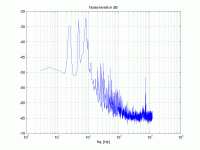
On the other hand, when there is no signal at mike input, few frequencies are particularly "loud" (see the attached chart). Those are 50Hs and 82Hz on PAL camera (if we forget about 25Hz and take it as close to inaudible). When the camera reduces gain due to noisier signal, 50Hz signal reduces its strength while 82Hz remains practically the same. It seems that 82Hz signal is coming AFTER AGC (or limiter - whatever) control circuit.
 

Attachments

  • 14.zip
    14.zip
    300.3 KB · Views: 0
  • noise_r220a.gif
    noise_r220a.gif
    58.7 KB · Views: 0
Last edited:
Not scientific, but I find using the built-in -20dB pad on my Rode VideoMic directly into my GH1 sounds pretty good to my ears.
 
I found out that GH1 is reducing audio gain in the presence of louder sound signal, similar to AGC.
In crude terms, an AGC circuit tries to increase the preamp gain to compensate for low levels. A limiter does the opposite, reducing gain in reaction to high levels only. If you record medium level audio into the GH1 then room silence, you won't hear the room silence ramp up over a period of a few seconds, which is what AGC does. However, if you record some more medium level audio into it, then something loud like a dog barking, the level will be very briefly knocked back during the barking, then recover almost immediately to 'normal'. That's a limiter in operation.

Almost all audio you hear is limited one way or another - especially on radio, TV, or cinema - only purist classical engineers really avoid it (despite which it gets limited anyway when broadcast). AGC audio is thankfully pretty rare these days, chiefly being encountered in cheap camcorders.
 
In crude terms, an AGC circuit tries to increase the preamp gain to compensate for low levels.

Note that GH1 has extraordinary (read: suspiciously) high audio gain for lower sound levels, which could be attributed to AGC (although it could be attributed as well to ALC and very high-gain input amplifier).

If you record medium level audio into the GH1 then room silence, you won't hear the room silence ramp up over a period of a few seconds, which is what AGC does.

Note that everything depends on chosen time constants. If ramping time constant is small, you can't hear the difference. However, my experience showed that GH1 ramps the signal up after some louder parts (it takes several seconds). See attached the mp3 file. Please, open it with any editor which shows the waveform (e.g. Audacity or some video editor).
 

Attachments

Last edited:
Without knowing how you recorded that, it's hard to comment.

Subjectively I've not noticed other than rapid dips in level in the presence of loud transients. For instance, I'm listening to the audio from a shot taken outside a suburban house on a quiet street. People are talking inside and you can hear that softly in the background. There's a small child in the foreground. After about half a minute, she starts calling her 'Daddy' quite loud, very close to the GH1. There's no perceptible change in the level of the conversation in the background, and no gradual rise in the level of that beforehand which you would expect if an ALC/AGC circuit was in operation. Personally I think the GH1 audio is at least good as you'd expect from such a device, bearing in mind that as there's no manual control of level they have had to configure it to deal with a wide dynamic range of incoming levels into a mic/preamp combo which can't be expected to be 'boutique' class. I'd describe it as "very acceptable" or "inoffensive" - but of course others' opinions may, and doubtless do, differ.
 
Back
Top