GH13 Getting the Noir look

dumile

Member
Shooting a Noir style cinematic PSA on my hacked GH1. Do you guys have any advice on how to shoot it or what to do in post? I've taken some footage in the Dynamic B&W that looks pretty good but the contrast isn't as dramatic as I'd like.

Should I forego shooting it in B&W and then make the switch in post?


In my opinion, you should shoot in the 'native' color of the camera, then in post perform the monochrome conversion using a 'channel mixer' type adjustment, which Premiere and Final Cut Pro have.

The other aspect of noir is lighing, and the 'contrast' of lights needs to be done in camera, but with a mind for the limitations of the camera, processing that the data is given to encoded it.

So, shooting with an overall 'flatter' scene, but still maintaining a good contrast on the talent, then tweaking the blacks and whites in post, would give you reasonable results...

The original B&W 'noir' was shot under massive lights, with ASA 32-64 film...

I would also recommend getting a sample of movies of the B&W era, and analyzing the lighting...
 
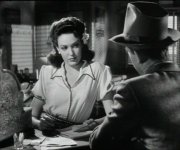
^^ What he said. Having your camera set up and exposed properly is important, but how you light your scene is how you accomplish the classic noir look. Here's a screengrab from a short film a friend of mine shot on a P2. Notice the lighting on the subjects. He had lots of blinds, cookie cutters and custom shaped barn doors to mold the lighting into interesting shapes. This casts all sorts of cool shadows on your subject and your background.


207q92r.jpg
 
If you're trying to get the classic noir look from the 1940's, remember, as J1clark said above, they used massive lights on slow-speed film. And they shot on a soundstage with most lights up high on a grid. And it was all HARD LIGHT. So here's what I suggest. Don't bounce light. Don't augment available light. Use a hard key light, and use hard back light. Black-and-white needs backlight on the subject to separate the monochrome subject from the monochrome background. And everything else mentioned above applies, too. Lots of venetian blind shadows, cookie-cutter shadows on walls. Try to make the frame contain more black than white. That's one reason why it was called Noir. If cigarettes are acceptable, backlit cigarette smoke always helps. And fedoras. :-)
And as much as I like the Dynamic B&W of the GH1, I'd recommend shooting color Smooth, and using Channel Mixer to create the B&W in post. I think using more of the green channel and less of the blue and red creates the most faithful B&W film look. And add Contrast.
 
Last edited:
Important thing Iif you really want to go that far) - look at those:

https://www.google.de/search?q=film...ct=mode&cd=2&ved=0CBwQ_AUoAQ&biw=1785&bih=994

You can easyly spot the originals from the replicas at one glance.
Even if they used hard light and all, Why is that so?

They used massive make up and powder back than. Faces where often only one single tone.

sstcm4.jpg


Also use a diffusion filter or diffusion in post (subtle please, no Hammilton look).
Use cocoloris for background effects (and yeah, those venetian blinds of course)

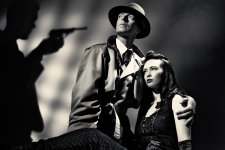
Film_Noir_by_AvaJinx.jpg


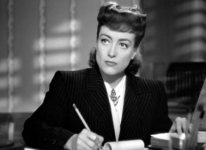
Women always had one or more soft front lights, no nose shadow

noir06.jpg

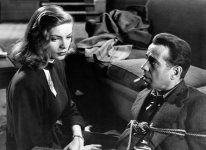
, men had hard light - even if they are in the same frame

noir_faulkner_bigsleep.jpg


Hope that helps, Frank
 
Wow. Between Postmaster and Dvbrother - I'm schooled on the finer points of Noir cinematography now!

Thanks folks!
 
Important thing Iif you really want to go that far) - look at those:

https://www.google.de/search?q=film...ct=mode&cd=2&ved=0CBwQ_AUoAQ&biw=1785&bih=994

You can easyly spot the originals from the replicas at one glance.
Even if they used hard light and all, Why is that so?

They used massive make up and powder back than. Faces where often only one single tone.

View attachment 51028

I recall someone recently posting a 'makeup diagram' that they had excavated from somewhere. It would appear that each actress was 'evaluated' for makup, and a diagram made for them.

The Wife use to add shadowing and contour because she normally shot with a 'flattish' light, which eliminates blemishes, but then, is... well... flat... While she was shooting stills, I'm sure that was part of the makeup techniques of yore for films...
 
"Also use a diffusion filter or diffusion in post (subtle please, no Hammilton look)."

I agree, though the 1940's saw most cinematographers NOT using diffusion like they did in the 1930's. Faster film stocks, faster lenses, and the rise of the contrasty look of Noir didn't jive with lots of gauzy diffusion on the lens. So, if you use post diffusion on this project, use it to recreate the softness of old lenses only. Subtle.


"Women always had one or more soft front lights, no nose shadow"

Key lights were always hard. They just looked soft because they were filled in by zip lights or other scoops on the grid. Soft keying just didn't happen in the old studio days. Film stock was too slow, and the artistic approach hadn't developed yet. But, yes, the women were always perfectly, beautifully lit no matter how contrasty and rough the rest of the shot looked. I actually love that about old movies.
The only reason I bring this up is that I recently did a lot of research into the look of the 1930's vs. the 1940's for a project of my own. Learned a lot about how cinematographers approached their craft back then.
 
Don't forget the best modern Noir B&W...Pi.


If I was doing BW, I'd go for the Pi look. Also I feel a lot of that look can be really manipulated in post. Just mess with levels, contrast, push the image to the edge AND beyond. B&W doesn't have to look perfect...and personally I prefer a grittier...dirtier BW. Too clean and crisp and clear...it' just grey.
 
Eupraxia

Eupraxia

Don't forget the best modern Noir B&W...Pi.


If I was doing BW, I'd go for the Pi look. Also I feel a lot of that look can be really manipulated in post. Just mess with levels, contrast, push the image to the edge AND beyond. B&W doesn't have to look perfect...and personally I prefer a grittier...dirtier BW. Too clean and crisp and clear...it' just grey.


Im also in the making of my fisrt feature film, its still on rolling stage but Pi was an inspiration , as tarkovsky. It says 2011, but is this year 2012 the one.

http://www.youtube.com/watch?v=5REuK_vaMqk
 
I hope it's not an anti-smoking PSA! I don't have any advice to add, but you could try for that jazzy noir look in color, too, and come up with something cool. What was that one Kasdan made? Or LA Confidential. That kind of stuff. Nice neons and what-not. Still high con cut by smoke if possible. I'd be scared of B&W noir, I wouldn't trust my talent to make it look anything more than parody. Also I'll throw in a vote for best modern BW noir for "Man Who Wasn't There". What a piece of work! (and worth studying or just enjoying if you like that kind of stuff)
 
Cool trailer, btw, Jonathan. Getting off topic I guess, but maybe a little "Hour of the Wolf" era Bergman too? Wish I knew the language.... Keep up the good work
 
Don't forget the best modern Noir B&W...Pi.


If I was doing BW, I'd go for the Pi look. Also I feel a lot of that look can be really manipulated in post. Just mess with levels, contrast, push the image to the edge AND beyond. B&W doesn't have to look perfect...and personally I prefer a grittier...dirtier BW. Too clean and crisp and clear...it' just grey.

I think "PI"(1998) is more along the lines of "nouvelle vague" aka "French New Wave". "New Wave" did have conceptual roots in "Hollywood Noir"... and we get the "Noir" from the french film critiques who looked to other side of the then Hollywood tracks for inspiration.

But the "PI" film techniques have more to do with cinema verite, changing from subjective to objective perspectives or feelings, etc. that Classical Hollywood Noir did not have. And of course the complete difference between studio sets, and location sets...

However, "PI" and "Requiem for a Dream"(2000) both have the common 'noirish' element of personal, the underbelly of society, the 'grimier' look at life. But Classical Noir was limited by Hays Code conventions as to what could be depicted, what stories could be told, and often one would have to look between the frames to see the 'hidden message'...
 
Yeah I maybe thought Pi was a bit Ron Rice underground New York kinda stuff, maybe Jonas Mekas a little, never thought of it or Requiem as noirish, but I guess they are, to quote a noir classic indeed, "a little cold around the heart."
 
Nice trailer Briceño.

j1clark@ucsd.edu good point, hadn't thought of that and you're right. I'm also a fan of the french new wave. I especially like how those techniques were developed from a low budget perspective. A lot of those techniques still apply to modern film making.

Going classic Noir look would be harder, more time consuming, and more expensive than going for a Pi/French New Wave look.
 
Aronofsky's "Pi" was also very much influenced by the look of "Tetsuo: The Iron Man" a 1989 Japanese film that had an American art house theatrical release in the mid-1990's

 
Aronofsky's "Pi" was also very much influenced by the look of "Tetsuo: The Iron Man" a 1989 Japanese film that had an American art house theatrical release in the mid-1990's


Ah, those japanese... blur out actual human genitalia in porn, but don't seem to mind dildos from hell in infinite detail...
 
Eupraxia neo noir lol

Eupraxia neo noir lol

I was making this film independently, but resived an offer from a film production company. So the proyect is i asume geting bigger. Here in Peru, this kind of film is new.

i dont know if noir was the name of this kind of look, but pi shure was an influence in my looks.

i hope you like it.


Back
Top