Other: FX9 demo footage and testing

I've made Donny 123 text understandable but he really has to learn how to write:

Ive had hands on the fx9 a couple of times and the AF was one of my main interests. Its pretty good and there are 7 settings each for speed and sensitivity.

One is "lock on" you "register" the face that has the box and a yellow line underneath but pressing the joy stick on the handle grip or the menu dial mid way back ion the camera body and you will see two white boxes around that face. It will stay on that face till you change it to another.

On a tripod its sort of hard to do with that switch mid body pressing the up/down /right /left to move to another face. On the handle grip its pretty easy and I think with practice would be very quick, but not on a tripod. Its awkward to reach back with your left hand for that dial.

There is also face priory and face only so it will only AF on face, nothing else. Face leaves frame if wont go to the background.

Also there is focus assist. So in manual focus,with focus assist on, you focus manually but AF will "check" what is most in focus and tweak it if needed. This could be the best feature for doc work. End of the day if your hand handle and changing the focus all over the place its just easier to do it by hand and your brain is going to be better than AF.

It depends on your work. I do a lot of interviews and I think the target buyer is that market, doc, corp.

FF with 85/55 f1.8 Sony stills AF lens, S Cinetone will look great for a cheap price and very light weight set up. It looks better than an F55 with a T2.8 PL $25,0000 cine lens in my opinion or at least as good. A lot of corp are not requestioned Slog, Cinetone does look a lot nicer and tAF will work really well. In this situation you still need to operate and frame the thing and check its not going pear shaped. But I´ve left totally unmanned A7III 85mm f1.8 as B camera and face detect/Zone and it has never failed me.

It will just be a nice thing to have in your back pocket for very tricky focus shots that pop ups sometimes and interviews. But I don´t think anyone will be just using it all the time. Its a tool.

People look down or turn around and you lose it, then you have to know your zone, expandable spot, wide options, but interviews it will work bang on for sure. Cars zooming towards you totally kill focus. Roaming around an Indian wedding party surrounded by faces and foreground loveliness then I wouldn't use it.

The machine can´t know when you want the focus to be right on the edge of the frame and when to pull focus catch a smile and focus back to some else. It can but you have to set it all up, totally depends on your work. I would guess the target buyers are shooting a lot on interviews and it will work in that situation 100%

I found it the first camera I´ve checked out since buying my F5 that I thought, ok this is worth changing too and on top of that it s so damn cheap! Which also means it will become the next big thing and every production company and their pony will insist on FF "Venice look".

The loupe is rubbish hopefully the Z finder FS7 model works on the FX9 and 35W is bit power hunger for FS7 owners. Not that much more than F5 and why 19V? Need new V mount plates.

Thank you sir.. I do suffer from Dyslexia and pretty good at defeating any spell check.. I don't any idea of paragraphs or sentences structure etc.. as you can see :) .. thanks for sorting it out ..
 
Hi Donny. I sympathise about the Dyslexia bit - a close relative has it. Just a simple tip, in case it helps: after each sentence you could hit "return" twice which would create a line space. Also, my relative types everything in Word then copies it into wherever he wants to post, using the "double return" routine. Hope you don't mind me offering that.
 
A HUGE thank you to Doug for taking the trouble to do these tests and for sharing. Much appreciated. I was pretty convinced I would plump for the Canon 500 mk2 but I'm not so sure now.
 
Hi Donny. I sympathise about the Dyslexia bit - a close relative has it. Just a simple tip, in case it helps: after each sentence you could hit "return" twice which would create a line space. Also, my relative types everything in Word then copies it into wherever he wants to post, using the "double return" routine. Hope you don't mind me offering that.

Not at all.. thanks for the tip.. appreciated ..
 
Thanks for the report and the footage, Doug!

The lack of S&Q motion with FF 4K is disappointing but I suppose that might be added later. Maybe it has already been announced, I've not been paying attention.
I believe it's coming in the first firmware update. Although it will be a 5K crop so only 83% of FF. This is a bummer. I hope they can manage to up that to 60p 6K eventually if people demand it.

Personally, I don't see why the hell someone would buy a camera with a FF sensor and then put a f/4 lens on it.
Well, a f/4 lens makes more sense on FF than S35 to me! And there's not many other options than the 28-135 if you want a FF power zoom with AF. I've gotten some use for the lens already with my FS700.

I was hoping (but not really expecting) S-LOG3 on the FX9 wouldn't clip at 94 IRE, but it does. That difference in clipping from 94 IRE with S-LOG3 to 109 IRE with S-LOG2 is very important for shoots where you don't have control over the lighting
This really is bad. Do I understand it correctly that this would mean that if there's bright lights you don't want to clip, you have to expose darker than if you were using SLog2?
Apparently SLog2 only fits 14 stops and that's why it's not in this camera.

I'm sure the improved AF would be a great boon when shooting faces when there is a lot of random movement, but I rarely find myself in those situations
I'm in these situations 90% of the time. So the improved AF might be the biggest selling point for me.

But the F55 can do 120 fps 4K RAW, so that is probably reason enough to keep it longer. Decisions. Decisions.
The FX9 will have 120fps 4K RAW in S35 mode as well! (although you need that damn extension module and a recorder).
 
The FX9 will have 120fps 4K RAW in S35 mode as well! (although you need that damn extension module and a recorder).

Good to know! I wasn't aware of that. Suddenly the FX9 is looking like it is in my future. I'll need the XDCA back anyway for v-mount batteries and the slot-in microphone receiver, which I already own.
 
My testing of the FS7 said that Slog3 is much cleaner in the blacks than Slog2 so where the thing clips is not the only factor - effectively one is mapping the DR to a different place onto the 'capture'.

Say log has a theoretical max of 16 stops for a really good camera (venice? future camera?) where you map 12-3 stops is not that relevant

I still prefer Slog2 though :)
 
All good cam ops are dyslexic. More of ones brain is 'mapped' to understanding the visual 3d space than the text space. I did not make this up I was told it when interviewing an authour (!) of a book on understanding the benefits of dyslexia not recognised by society.
 
This really is bad. Do I understand it correctly that this would mean that if there's bright lights you don't want to clip, you have to expose darker than if you were using SLog2?
Apparently SLog2 only fits 14 stops and that's why it's not in this camera.

How does SLog3 have 15 stops if it is only mapped to 94%, same as before?
 
You can map (very theoretically) 15 stops with a clip of 15! Some banding though.

The Slog3 curve cleary is designed for wider DRs than 15, some future camera (or venice today?) with 16 or 17 stops may hit 110?
 
How does SLog3 have 15 stops if it is only mapped to 94%, same as before?
That’s above my knowledge.
But it’s just what I’ve read, that SLog2 was designed for up to 14 stops and SLog3 up to 16, if I remember correctly.
This clipping thing was new to me, and I agree that it feels like it kinda defeats the benefit of having a larger dynamic range...

Maybe this is a good question for anyone who attends any of the FX9 presentations?
 
These cams are basically designed capable of 8bit delivery 254 or so colour levels.

I very much doubt that a compressed codec sony can resolve more than 800 levels of colour. (per channel) which is (edit!?) 800x800x800 differnt available outputs per pixel

The cams write to 10bit bucket which can collect potentially 1023 levels of colour (per channel), now if you only write the collected data to 800 odd levels you still have more than 3X the colour information you need to deliver decent 8 bit that is free of banding even after a hard grade.

This chat.. "we will write 15 stops to 800 levels and it will cut (with the same LUT) with a future 17 stop camera which we will write to 1023 levels" - it makes sense.

Ultimately 10bit is pretty flimsy and certainly not enough to deliver decent stuff at 10 bit.

12 bit has 4000+ colour levels.. which it can potentially store.. and is the minimum for a DCI https://en.wikipedia.org/wiki/Digital_Cinema_Initiatives#Specification
 
Last edited:
Looking past the technical mambo I've never felt Slog3 being limited and I actually did test and compared Slog2 to Slog3 when I first got my FS7. I quickly concluded I preferred Slog3.

Like always get to know your camera and its limitations.
 
Looking past the technical mambo I've never felt Slog3 being limited and I actually did test and compared Slog2 to Slog3 when I first got my FS7. I quickly concluded I preferred Slog3.

I did the same thing and came to the opposite conclusion . . . I prefer S-LOG2.

One advantage I have that other people may not share is the ability to shoot 16-bit RAW with my F55. It is neither S-LOG2 or S-LOG3 at the time of capture, so I must choose one or the other in Resolve as my first step of grading. So I have done quite a few tests over the years (I come back to it every now and then just to re-test and confirm my earlier conclusions) with the exact same clips decoded both ways. Most of the time there is really no difference after grading between the two, but sometimes there is a significant difference in highlight handling and noise. And S-LOG2 is always the winner. In other words, most of the time it won't matter, but when it does, S-LOG2 is always my preferred. I've done my testing and know exactly where I stand, as others should do themselves.

I also contend (even though Sony won't say it) that S-LOG3 came about as a dumbed-down version of S-LOG2 that could be easily incorporated into an Arri-centric workflow. Whatever you do to Arri footage in post you can do the same thing to S-LOG3 and get good results. A lot of people don't want to be bothered learning new tricks, so Sony gave them what they wanted . . . a dumbed down version of S-LOG2. And after all, 3 must be better than 2, right? Another reason S-LOG3 is more popular is because the necessary LUTs are already built into Resolve. But if you choose to shoot S-LOG2 then you've got to seek out the right LUTs and install them yourself. Apparently that is quite a hardship for a lot of people.

But, what I prefer is moot because clearly all we are going to get from Sony now is S-LOG3. Live with it, Doug!
 
I also contend (even though Sony won't say it) that S-LOG3 came about as a dumbed-down version of S-LOG2 that could be easily incorporated into an Arri-centric workflow. Whatever you do to Arri footage in post you can do the same thing to S-LOG3 and get good results. A lot of people don't want to be bothered learning new tricks, so Sony gave them what they wanted . . . a dumbed down version of S-LOG2. And after all, 3 must be better than 2, right? Another reason S-LOG3 is more popular is because the necessary LUTs are already built into Resolve. But if you choose to shoot S-LOG2 then you've got to seek out the right LUTs and install them yourself. Apparently that is quite a hardship for a lot of people.

Right on! (Except for the part about Resolve, it has the S-LOG2 LUTs now.) From blog:

Alister Chapman said:
http://www.xdcam-user.com/category/cinematography/page/5/
S-log3 is based on the Cineon film transfer log gamma curve developed back in the late 1980’s. Cineon was carefully tailored to match film response and designed around 10 bit data (as that was state of the art back then). It allows for around 16 stops of dynamic range. Much later, Arri and many others then adapted Cineon for use in video cameras – The “C” in Arri’s LogC stands for Cineon.
When Sony started doing wide dynamic range cameras they developed their own log gammas starting with S-Log, then S-Log2. These curves are matched very precisely to the way a video sensor captures a scene rather than film. In addition they are matched to the sensors actual capture range, S-Log can record 13 stops as that’s what the sensors in the cameras with S-Log can see. Then S-Log2 is 14 stops as the second generation cameras can all see 14 stops. As a result of being purpose designed for a video sensor, when using S-Log2 you maximise the entire recording range because the sensor is matched to the log which is matched to the record range.
But, these curves drew much criticism from early adopters and colorists because they were very different from the Cineon curve and all the other log curves based on this old school film curve. Colorists didn’t like it because none of their old Cineon LUT’s would work as expected and it was “different”. In response to this Sony then developed S-Log3 and surprise, surprise – S-log3 is based on Cineon.

But, what I prefer is moot because clearly all we are going to get from Sony now is S-LOG3. Live with it, Doug!

Echoes of Patrick Henry!
 
You can map (very theoretically) 15 stops with a clip of 15! Some banding though.

The Slog3 curve cleary is designed for wider DRs than 15, some future camera (or venice today?) with 16 or 17 stops may hit 110?

Alister Chapman said:
http://www.xdcam-user.com/category/cinematography/page/5/
So S-log3 is based on a 16 stop film transfer curve, but the current cameras can only see 14 stops. What this means is that the top 14% of the gamma curve is never used (that’s where stops 15 and 16 would reside) and as a result s-Log3 tops out at 92% and never gets to the 107% that S-Log2 can reach. If Sony were to release a 16 stop camera then S-Log3 could still be used and then it would reach 107%.

A rhetorical question; We have 15 stop cameras now, FX9 and Venice. Why does s-Log3 still top out at just 92%?

Answer: Chasing DR numbers is the new spec frontier, and the way you pull a better number is with in-camera temporal noise reduction. In other words, increased DR is not happening in the highlights, it's happening in the very lowest low-key where there are very few data points. Alister has mentioned this as well; for Venice. It's real, it's actual, it's not faked but in the context of Arri highlight handling and HDR, it's not where we're expecting to see it. It's increasing DR at the depths of luma and chroma. It's a cleaner image, but isn't doing anything for the highlights. Looking at the subject candle footage and the practicals in Doug's clips, no change from FS7 and no change in SLOG-3 recording level, still 92% as before. More to your point Sam, yes there is plenty of room to accommodate more DR stops in 0-1023 code values, but SLOG-3 is a gamma curve which means it's a mathematical transfer function. You can change the function to squeeze more stops in 0-1023 but then it's not SLOG-3 anymore. Mathematics is stubborn that way. For compatibility with other SLOG-3 cameras, SLOG-3 is SLOG-3 and the FX9 and Venice have to play in that same sandbox too. And what Doug's most important finding reveals, no highlight DR extension, it's all found way below mid gray, most noticeable as a cleaner image. Taken for what it is, most people would say that is a good thing.
 
Looking back on material I shot with my Sony F3 straight old Slog worked great but that on the only hand was the only LOG available. Back then I always shot a bit underexposed and lifted exposure in post and got excellent organic footage. I can compare that to how I do with FS7 overexposing a bit and bringing things back a tad. It comes down to finding something that works for you for each camera in the end.
 
You can change the function to squeeze more stops in 0-1023 but then it's not SLOG-3 anymore. Mathematics is stubborn that way. For compatibility with other SLOG-3 cameras, SLOG-3 is SLOG-3 and the FX9 and Venice have to play in that same sandbox too.

Now Im going above my paygrade here because I dont really know how sensors a/d conversion works.

BUt let us say that the 7 can pump out 1v when the pixel is fully driven (white clip) now say the venics clips at 1.5 volt

When wrinting the A/D conversion algorythm you make 1v to be a digital value or 92 and 1.5v to be a digital value of 110 then they can both be put in the same sandbox while still running on the same mapping algorythm. (slog being an algorythm) ???

edit
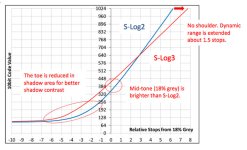
Here we can see that Slog3 actually goes to 100%.. it is the FS (and 9?) that do not. It has space for more DR that those cameras can capture or sony chose to write.

S-Log2vsS-Log3.jpg
 
Last edited:
That should mean that when you’re using SLog3, exposing to the right isn’t really the best idea? While in SLog2 it makes sense?
And having both is to be preferred so you can choose the best one for the scene. And ideally there should be a specific Log curve for each camera tailor made for its sensor?
 
Back
Top