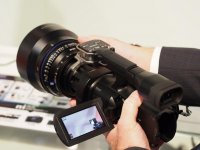
Full-frame Sony NEX-VG900 Video Camera

I think with cameras like this VG900 as well as the NXCAM line's new S35 model EA50, Sony are testing the waters for potential full frame video camera successors to add to the EA50 and FS100 lines. The way they have it now, they can introduce an affordable full frame video camera and see how the EA50 series does. If the VG900 and EA50 sell well and pros speak up about wanting a true professional full frame video camera, then Sony have room to go up and get people to upgrade. So perhaps in a year we'll see an EA100 and an FS500 or something along those lines, both full frame sensors of course. That still leaves room for an upgraded S35 sensor FS100s or FS200 or whatever numbering system they think sounds best.

So perhaps the reverse of the trickle down from the higher end cameras we usually see. Normally I wouldn't think this strategy sounds plausible, but the FS700 coming after the FS100 seems to point to the notion that perhaps Sony have decided to take a different approach. Also, people saying the VG900 and A99 video has moire and false detail, this makes me wonder if Sony are just trying to whet people's appetite for higher end full frame video cameras while protecting future sales of such a thing.

Still though, interesting stuff with all these full frame and S35 video offerings from Sony. I'm curious to see how the A99, VG900, VG30, and EA50 stack up against each other. If you include the VG30 plus 18-200 powered zoom kit, they all come in around the same basic price range ($2700 to $3600).
 
Consumers who buy this camera wont be using MF vintage glass. They will want AF. The whole concept of Full Frame for the consumer market is nuts. No point at all. No benefit. No demanding users will buy into this product. The A99 is a stills camera and will do this very well with the benefits of movie mode being added to a primarily stills camera. A99 is a non consumer product (or at least less consumer grade than the VG9000) meaning the full frame AF glass will be a viable option to its potential user.

My criticism is very realistic. Just wait and see how many people here and in the real world actually buy and use the Vg9000 in proper situations where a full frame sensor actually benefit. next to none -I'd bet my life on it

Joe sixpack and soccer mom walk into electronics bazaar. Salesman says "The VG-900 has a full frame sensor". Mr and Mrs sixpack go home with a new toy. Well that's how it played out pre GFC.
 
Yeah, shocking. Manufacturers are really making some strange decisions this year! Alas, with all the talk of Canon possibly coming out with a full frame video camera, Sony beat them to it. Sony is the new Canon!

Now, lets see how crippled this thing is...
 
pointless product IMO. Full frame for video is completely pointless for a consumer product. Users of this thing wont consider old ff glass, and wont stretch to A mount glass prices either - not for purely video work. Price point sits it in the 'expensive consumer' area. Consumers dont buy A mount glass. The frame size is a gimmic and this will become clear when everyone gets bored of this current pot at the end of the rainbow hankering for full frame.

The A99 on the other hand, priced in a similar area will be nuts. apparently it bins pixels., clean hdmi, continuous AF, etc. If the VG9000 does the same then maybe it'll be usable, but I bet they cripple it like the VG10 and VG20.

Also, the design of the case looks soooo bad. Why not put this in a professional looking case? I dont want to use a product with 'handycam' written on it for pro jobs, its too well branded within the consumer market.

I think you underestimate the sophistication of serious hobbyists or prosumers that a camera in this price range will appeal to. It would be nearly perfect for my artist wife for instance. She needs to shoot teaching and demonstration videos of her work for web and DVD publication. She also needs to shoot high quality raw stills for print reproduction too. I will wait until I can play with one or at least download the instruction manual to see what the capabilities are. If Sony has learned its lessons with the VG-10/20, hopefully they will provide practical manual controls similar to the A-series DSLR's. B&H's market blurbs say the new VG's will have comprehensive manual controls. And I already have a nice set of Minolta Rokkors that would match up nicely, so vintage lenses will be used on these cameras.
I would rather have a practical camcorder with better audio, controls, and form factor for video along with excellent stills potential than a DSLR that shoots video any day. I like the small size, light weight and general design of the VG series. I didn't like the menu and control functions of the earlier ones or the aliasing performance. We will see how these have improved. A proper anti-aliasing filter and pixel binning instead of line skipping could make these cameras very appealing even if the stills were a little softer than the A-series.
 
"B&H's market blurbs say the new VG's will have comprehensive manual controls."

Unfortunately, that's what their (and Sony's) webpage also said about the VG20 - even months after initial buyers found out otherwise. Sony still has offered no public apology for this "oversight."

I'd take their ad materials with a very large grain of salt. I'd also guess that the VG20/VG900 will NOT have fully manual controls. I'm not even sure if the AE 50 has fully manual control despite an array of new knobs/buttons and large price tag.

Which is why I will wait for some hands on or a download of the manual to see what made it through the Sony market grinder. The VG-30 will do a 2x tele crop down to S16mm sized frame, still a decent oversample for HD video, and I could adapt my 16mm glass to it. I wonder if the crop choices for the VG-900 will go that far. Full frame to S16mm in one camera would be very appealing to me. I can see mounting this camera to my Angie 12-240 which is more than a stop faster on the long end and constant speed through the full range at f4.8 compared to the 18-200.
 
Last edited:
I think this camera is meant for indie/prosumer type of filmmakers. In fact it is in the middle ground. A $ 3k+ camera won't appeal to the general consumer and the build, ergonomic etc won't appeal to the pro working day in day out. But the indie that does not have too much money, but who is prepared to make some sacrifice for a certain image quality won't mind. That is why Joe indie filmmaker made all sort of rigging etc to a no so practical photo camera like the 5d to do video because of a certain look. Today we have a ton of choices, but if it came out one year ago everybody here would have flock on it.
 
I think this camera is meant for indie/prosumer type of filmmakers. In fact it is in the middle ground. A $ 3k+ camera won't appeal to the general consumer and the build, ergonomic etc won't appeal to the pro working day in day out. But the indie that does not have too much money, but who is prepared to make some sacrifice for a certain image quality won't mind. That is why Joe indie filmmaker made all sort of rigging etc to a no so practical photo camera like the 5d to do video because of a certain look. Today we have a ton of choices, but if it came out one year ago everybody here would have flock on it.

This sounds about right.
So, add the XLR attachment, and can this replace an FS100? Same codec, same lenses. About the same price, with the XLR handle. Plus, it has the zoom rocker. I'd sure like to try a FF video camera.
 
If the VG900 downscales with pixel binning rather than line skipping, its low light performance will obliterate every other video camera on the market. That's enough to attract many serious amateurs as well as indie filmmakers.
 
Potentially, yes. But sadly, as the VG curse goes, it will (probably) only get to ISO 3200. Very, very, very clean ISO 3200 if it does the downscaling properly, but no low-light killer when others are getting their ISO 2.7 stops higher.
 
Potentially, yes. But sadly, as the VG curse goes, it will (probably) only get to ISO 3200. Very, very, very clean ISO 3200 if it does the downscaling properly, but no low-light killer when others are getting their ISO 2.7 stops higher.

Sony is still using gain on the video side vs ISO on the still side. 0-30dB gain, 5 stops over base, whatever that works out to be. On the stills side the range is 100-25600 ISO. Specs are up at Sony.com. http://store.sony.com/webapp/wcs/st...&productId=8198552921666489355#specifications

I think the high ISO spec race is BS. You give up a stop of DR for every stop of speed over the optimum 0 gain exposure. Unless you absolutely have no choice to get a shot, it is not worth going beyond 3200 ISO with any of the new cameras if you care about your image quality. Flat washed out night scenes with severely blown highlights that have been gained up to daytime value ranges are not very cinematic.
 
I didn't say ISO 20000 could be used as your workhorse option, just said that this won't be a low light monster unless they unlock the ISO... which from that 30dB gain you mention, seems not to be the case (that's the same max value previous VG models had, so, if the base sensitivity is the same too, ISO 3200 it is)
 
I didn't say ISO 20000 could be used as your workhorse option, just said that this won't be a low light monster unless they unlock the ISO... which from that 30dB gain you mention, seems not to be the case (that's the same max value previous VG models had, so, if the base sensitivity is the same too, ISO 3200 it is)

Will the vg900's image be significantly better than the vg20/vg30/EA50/nex5n? Or is it just full frame and nothing more? Also, is the vg30 still using the same chips as the vg20?
 
Will the vg900's image be significantly better than the vg20/vg30/EA50/nex5n? Or is it just full frame and nothing more? Also, is the vg30 still using the same chips as the vg20?

Can't wait to find that out

...and, what if you throw the same 18-200 power zoom lens on both the VG30 and then on the VG900 which will "automatically put it in APS-C mode"...I wonder then if their images will look the same or if the FF sensor helps even when its cropped down to APS-C size. So many questions.
 
I think the high ISO spec race is BS. You give up a stop of DR for every stop of speed over the optimum 0 gain exposure. Unless you absolutely have no choice to get a shot, it is not worth going beyond 3200 ISO with any of the new cameras if you care about your image quality. Flat washed out night scenes with severely blown highlights that have been gained up to daytime value ranges are not very cinematic.

Mmm. No.

Iso 100 and Iso 400 on the 5d mark III are basically almost the same, dynamic range wise. It starts to slowly drop off so that at 6400 ISO it's still a respectable 9 stops of DR.
 
it's trying to do two things at once, which usually isn't a good thing: be a dslr, and an eng cam. but hey, if it packs the low light of the 5d3, with the electronic zoom of an eng cam, this could potentially replace both my 5d and my ex1. and i said POTENTIALLY, not LIKLEY
 
Sony is still using gain on the video side vs ISO on the still side. 0-30dB gain, 5 stops over base, whatever that works out to be. On the stills side the range is 100-25600 ISO. Specs are up at Sony.com. http://store.sony.com/webapp/wcs/st...&productId=8198552921666489355#specifications

I think the high ISO spec race is BS. You give up a stop of DR for every stop of speed over the optimum 0 gain exposure. Unless you absolutely have no choice to get a shot, it is not worth going beyond 3200 ISO with any of the new cameras if you care about your image quality. Flat washed out night scenes with severely blown highlights that have been gained up to daytime value ranges are not very cinematic.

I wonder how Canon does it. Apparently their C100 (along with the C300) maintains 12 stops of Dynamic Range throughout the 20,000 ISO range.
 
Finally there are opportunities to explore the NEX-VG900 full frame video camera. All the cameras are fitted with A-mount adapters, given there are no full-frame E-mount lenses. The use of E-mount gives plenty of room to use adapters for other mount lenses, though.

While we were there, a delegation from Carl Zeiss arrived to see whether its E-mount Cine lenses would work without vignetting on the VG900. Since its designs are essentially full frame lenses with a long throat to extend the lens away from the mount, it seemed likely that they'd work, so long as the throat wasn't too narrow (which it might have been, given the expectation that it would only be used with APS-C/Super 35mm sensors). Sure enough, the CP2 50mm T2.1 Macro could be racked through its focus range without any shading appearing in the preview image.
http://www.dpreview.com/articles/1583535123/photokina-2012-sony-stand-report

8003059919_fbb883a8ee_b.jpg
 
Back
Top