Fuji X-T3 released

You mean like that horrible Panasonic Lumix DMW-YAGH Interface Unit for GH4 power supply XLR abomination? It didn't power the camera, but it was terrible.
As an audiecentric person, forget trying to get good sound from mirrorless cameras, just tap out and do it right. Buy a Mix Pre 3 or a Zoom F4 and be done with it.
The mic pre-amps and audio circuitry in all mirrorless cameras cost about $2.00 for the manufacturer and the cameras sound like it.
Been shooting a LOT with the Tascam DR-10Ls on talent with the X-T3, they are cheap, replace the stock mic with an OST 801 and Bob's Your Uncle.

I don't think that should be a hard and fast rule. For some projects it may be completely acceptable to use the camera's audio. I ran a sony uwp-v1 system staright into a gh4 and it sounded fine when played through speakers at a theater and on youtube (https://www.youtube.com/watch?v=cgB5fxYjZXE). The interview was still recorded with a SD 702 so I guess it can be a blend of techniques within the same project too.
 
He's just saying that just to say it; of course it's perfectly fine to record audio internally with a mirrorless/DSLR camera and it can sound great, especially with the right equipment and mic placement.

And per usual no one would ever notice a difference (when it's done correctly internally or externally).
 
@rob yeah had a 1st gen GH4 (noise bug never fixed) and it worked ok with an external preamp. Canon 5D3 also worked OK. The trick is to set camera mic gain to 1 click above off and run the external preamp high enough to get to whatever your comfortable level is for gain (and never clipping). In my experience Sony's have better preamps (A7S I,II), 1DX II with an F4 + CMC641 sounds better than the C300 II (internal preamps).

@Dan- have you tried this with the MixPre3 + X-T3? A single blind example showing the same clip with internal audio + external preamp vs. external recording, both normalized to the same peak level would be interesting to see if anyone can tell the difference on YouTube.
 
He's just saying that just to say it; of course it's perfectly fine to record audio internally with a mirrorless/DSLR camera and it can sound great, especially with the right equipment and mic placement.

And per usual no one would ever notice a difference (when it's done correctly internally or externally).

No, according to Dan it's not perfectly fine to record audio internally using mirorless cameras. Me saying it shouldn't be a hard and fast rule is just a different view. I'm sure audio professionals and puredrifting would notice what they call huge differences. Audience members, clients etc. are a different story, which is the group you're referring to as no one.

I struggled to hear the difference between the wireless mic going straight into the gh4 vs. recorded with the 702 but I was using the recorder more for its amazing limiters. That's a more important reason to record externally IMO. When using mirorless I'd probably rather the sound take a hit to take full advantage of the small system.
 
You mean like that horrible Panasonic Lumix DMW-YAGH Interface Unit for GH4 power supply XLR abomination? It didn't power the camera, but it was terrible.
As an audiecentric person, forget trying to get good sound from mirrorless cameras, just tap out and do it right. Buy a Mix Pre 3 or a Zoom F4 and be done with it.
The mic pre-amps and audio circuitry in all mirrorless cameras cost about $2.00 for the manufacturer and the cameras sound like it.
Been shooting a LOT with the Tascam DR-10Ls on talent with the X-T3, they are cheap, replace the stock mic with an OST 801 and Bob's Your Uncle.
The Tascam DR-10Ls is fricken killer! I keep mine with me just in case my wireless isnt working on location. It's saved me on a couple shoots and I use it for pickup audio so I dont need to drag the camera out. Yes i'm cheap and waited for the Storm Trooper edition to go on sale for $99.
 
Yes, I can read. According to Dan.

I shared my own opinion.

And 'no one' is regular people. We make videos for regular people; not nerds in a room listening to different microphones hanging over their heads or clipped on their shirts. Same for cameras and lighting.

["Well, you know...I noticed a difference between 5599 Kelvin and 5600 Kelvin."]

OBVIOUSLY someone is always going to notice a difference with something, but if a direct claim is made that you can't record internally using mirrorless cameras (or it doesn't sound good) then another one claim (mine) will be made that you can. Because in 2009 if I read that post by Dan I would never, ever try to record internally because I would trust those words.

So anyone who may come across this thread now has two firm viewpoints.
 
  • Like
Reactions: jcs
Yes, I can read. According to Dan.

I shared my own opinion.

And 'no one' is regular people. We make videos for regular people; not nerds in a room listening to different microphones hanging over their heads or clipped on their shirts. Same for cameras and lighting.

["Well, you know...I noticed a difference between 5599 Kelvin and 5600 Kelvin."]

OBVIOUSLY someone is always going to notice a difference with something, but if a direct claim is made that you can't record internally using mirrorless cameras (or it doesn't sound good) then another one claim (mine) will be made that you can. Because in 2009 if I read that post by Dan I would never, ever try to record internally because I would trust those words.

So anyone who may come across this thread now has two firm viewpoints.

It's too frustrating talking to you, I'm done.
 
  • Like
Reactions: jcs
Sorry if you didn't like my response, but I was basically supporting you and you respond to me like I'm some kind of imbecile. (I know what he said.)
 
As for recording directly into a mirrorless camera. It works fine with a good preamp. I still use a JuicedLink Riggy 2-ch. Simple and clean. Really depends on the production type and the client's expectations. Sure it would be better using an audio recorder but if you can't afford one or don't want to sync in post internal is just fine. Like others mentioned use the lowest setting you can on the camera and adjust with the preamp.
 
Last edited:
As for recording directly into a mirrorless camera. It works fine with a good preamp. I still use a JuicedLink Riggy 2-ch. Simple and clean. Really depends on the production type and the client's expectations. Sure it would be better using an audio recorder but if you can't afford one or don't want to sync in post internal is just fine. Like others mentioned use the lowest setting you can on the camera and adjust with the preamp.

erik-

good to know that with the riggy it works for you.

especially because i have the beachtek version of the riggy and would probably use the same set-up.

thanks for the sharing.

thumbs up.

rob
smalltalk productions/nyc
 
Riggy’s are pretty fun. Sad they discontinued, and never got refined. That said, i believe they are still the best solution so far.
 
You mean like that horrible Panasonic Lumix DMW-YAGH Interface Unit for GH4 power supply XLR abomination? It didn't power the camera, but it was terrible.
As an audiecentric person, forget trying to get good sound from mirrorless cameras, just tap out and do it right. Buy a Mix Pre 3 or a Zoom F4 and be done with it.
The mic pre-amps and audio circuitry in all mirrorless cameras cost about $2.00 for the manufacturer and the cameras sound like it.
Been shooting a LOT with the Tascam DR-10Ls on talent with the X-T3, they are cheap, replace the stock mic with an OST 801 and Bob's Your Uncle.

I never trusted Bob.
 
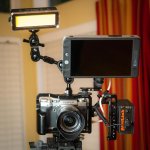
I took this setup for interviews and broll to CES. I shot myself so no camera op. Worked perfectly and sounded great with a Rode Reporter microphone.
I needed to see all the kit to make sure everything was working.

Fujifilm X-T3 CES build Ver 2.jpg
 
Wow, you make a post and go shoot for a day, come back and all hell has broken loose ;-)

We are talking about three different but related things here. The audio acumen of camera oriented people, the audio acumen of unknown audiences and various audio playback devices ranging from cell phone speakers to a full 7.1 Dolby Atmos mix in a certified theater and everything in-between. I don't make my assertion just based upon test measurements (when was the last mirrorless camera review you read or viewed on YouTube that performed REAL audio testing? I thought so, nobody does real audio testing with mirrorless cameras, it's all anectdotal), I also make it off of simple economics. Digital Cinema cameras in general have never sounded great, some of then sound okay/adequate like my C200 and my older C100MkI and C300) and some sound terrible (cough, cough...every RED ever made). And we are talking cameras that cost from $80k down to about the $5k to $10k mark like the FS7, C200, C300 MKII, EVA 1. Now extrapolate those same audio factors down to a camera that retails between $1,000.00 and say, $2,500.00. On an inexpensive mirrorless camera, say one that retails for about $1,500.00, how much do you think it costs the manufacturer to produce? Let's just throw out a completely fictitious number and take a WAG and say that $1,500.00 retail camera costs the manufacturer say, $800.00 to $900.00 to actually make.

Factor in R&D, testing, engineering, marketing, packaging, writing documentation, I could go on and on but yes, somewhere in there when all of the heavy lifting has been done, the engineering teams say to themselves, "Oh, yeah, I guess this thing has to have some kind of audio recording capabilty to go with the bitchen pictures we have created it to shoot!" So what do they do? Do you think they actually ENGINEER the audio chain in their mirrorless camera? Uh, no, they don't. Have you heard of YKK? They are the foremost prolific zipper company in the world, they have something like 85 or 90% of the world's maket for zippers. Audio components at this level, for a mass market product, are bought from a catalog, by the audio equivalent of YKK, they are the standard parts and everyone buys basically the same or with just slight variations in size mainly (you've noticed that SMALLER mirrorless like my X-T3 are coming into vogue?) None of the camera companies specify, "Could we order these .99 mic pre-amps with a better S/N ratio?" because they just don't care about audio. I don't have exact numerical breakdowns and I doubt any camera company has ever publicly released them, but I used to work with a lot of big audio companies in another life, JBL, Harmon Kardon, Onkyo, Yamaha, Denon, but I can guarantee you that the proportional costs for all of the audio components in a mirrorless camera are miniscule compared to imager development, picture DSP, noise reduction, Bayer overlays, etc.

How many mirrorless cameras even have a metal 3.5mm headphone jack? Not my X-T3, it's the same plastic piece of crap that all of the mirrorless cameras have, you know, the one rated for 100 insertion cycles before it has no more spring retention and begins to short out? And that's for a class of cameras where buyers are thrilled if it even has a headphone jack, up until recently, many mirrorless cameras didn't even have a headphone jack, and no way to monitor audio. Let me take a good hard look at the microphone input jack on my X-T3 as well. Hmm, plastic, crappy, mine is loose already having only owned the camera for four months, you can see that this is some majorly quality stuff. Don't you think that this same sort of engineering approach extends to the internals like the DSP, mic pre-amps and output stages, A/D and D/A convertors? They're all generic stuff out of a parts bin. If you A/B plugging the same the same audio source into any mirrorless camera and even a cheap audio recorder like a Tascam DR60 MKII, the difference in noise floor, grittiness and distortion becomes immediately apparent or it should, even to a non-audiophile. Believe it or not guys, audio works in a certain way, just like video, the lousier the input, the lousier the end product. And just like video, if you correctly expose, know how to light, 8-bit lousier video can look amazingly good. But when you push that same video in a grade, it falls apart quickly. Audio is identical, garbage in, garbage out and the defects and undesirable artifacts become apparent when you try to EQ, noise reduce, quantize, etc. I really wish every camera buyer could just experience one mixing session on a real Hollywood mixing stage in real life, you would hear things that you never noticed and you would realize that sound behaves the same way as video in a lot of cases, if it's not perfect, when you push it or try to fix it, the crappy stuff falls apart a lot quicker than the good stuff.

If material you are recording on your mirrorless ever makes it to a theatrical mixing stage, all of that nastiness that you couldn't hear on your $10.00 earbuds is going to become apparent really quickly when you hear your magnum opus through some real monitors at high volume. Harsh, grainy, hiss filled, all of the artifacts you couldn't detect on your playback system become amplified and you can't fix crap, you can only make it a little less painful. Sure, if you're only making material that people will hear as they playback YouTube on their phone, a mirrorless camera's audio may be perfectly acceptable to you. But you might be surprised how many people watch YouTube now on their Apple TV, Roku, etc. through fairly high end speakers with a lot of gain. Not saying you won't be able to hear what you recorded, you will. But it may just sound harsh and nasty or it may be filled with clipping (did you know that the coarsely segmented audio metering on cameras are NOT accurate?!?) and that you can get all kinds of clipping without lighting up the metering on your camera? Ever wonder why sound mixers like to record your audio to your camera with analog -0dB = -20dB peaking on your camera? Camera people like to crank those levels up bub, let's make it LOUD, let it peak right below 0dB, right? That's because most camera people are clueless about sound, that's why we have sound mixers ;-) Someone on set needs to know what they're doing with the sound.

I stand by my assertion if you CARE about your sound, you aren't recording it on the parts bin crap mic preamps, A/D, D/A convertors that are in all mirrorless cameras, you go through the extra hassle and record it at least on a halfway decent audio recording device and sync it in post, it's so easy as to be almost effortless to do nowdays. Even the Tascam DR-10L, a low-end $189.00 audio recorder that sells for as little as $99.00 on sale as Eric mentioned, sounds MASSIVELY better than the most expensive digital cinema cameras in the world, that's how low of a priority audio is for camera manufacturers. I've sat in meetings with engineering teams at Canon, Panasonic, RED and even Arri once and asked them sepcifically about this and trust me, audio has never been and probably will never be a design priority with any camera company but especially on their lower end cameras like mirrorless. Most of you are too young to have gone through the audio debacles with some super popular cameras back in the day like the Sony VX-1000 and the ensuing class action lawsuit that came about from pissed off buyers who had purchased a camcorder that had absolutley garbage, unusable audio that had so much hiss that you couldn't even make out the signal buried in the hiss. Sony promised a fix that never came and angry owners were stuck with camcorders that were useless the audio was so bad. We've only came a couple of steps above that in present day. Camera manufacturers don't give a crap about audio because buyers don't. It's not surprising on the high end because it's a given that if you are shooting with an Alexa or a Monstro and your project has sound, you are going to have a sound mixer on set.

Not saying you can't use in-camera audio, if that's what you like to do because you are too lazy to do it right, more power to you. It's your audio and your chance you are taking. If you are confident that your audience will only playback your content on crappy laptop or phone speakers, rock on, you are right, they'll never hear the difference. But if you are shooting stuff that will be broadcast or make it to a theater, take it from someone who ran a sound for picture post house for eight years where my main job was trying to fix low budget producers crappy audio for their films, documentaries and TV shows, just know that you are recording the single most important part of any sound project with the cheapest, crappiest possible sound recording device with the lousiest specs and quality. It's really the same as buying an Alexa and mounting it on a Manfrotto head or putting a thrift store Vivitar zoom on your RED. Can you do it? Sure. Is it an intelligent choice? Probably not. Rant over.
 
Last edited:
I take no position on how someone wants to record their audio but I love the Tascam DR10L. An important consideration for me is that a field recorder keeps on recording in between camera takes. Sometimes at a wedding, something happens during a toast or a vow that the camera gets shut off; if you have the audio you can fill the gap with stock footage or still photos or whatever. I also use the Zoom h4n Pro, and (2) Tascam DR701D with timecode capability on HDMI and SDI. I try and capture everything, the PA system, soundboard, musicians, groom's mic. Sometimes the musicians are acoustic with no plug-ins, and sometimes more than one group of musicians, or wireless mic on a PA system separate from the DJ. For me, it seems not worth the trouble of trying to externally record audio into the camera, and where speed and agility for run and gun are vital, a GH5/GH5S on each hip, ready to grab and shoot hand held, or on a gimbal, unencumbered by audio connections.
 
Back
Top