Fuji X-T3 released

Exposure is an important one. From my tests the other day, the camera appears to be 2/3rds of a stop slower than Fuji rate it (when shooting FLOG at least). So 640 ISO (for FLOG) is actually only 400 ISO by meter (in order to put middle grey at 46% IRE, per Fuji's recommendations).

The 400 ISO base doesn't bother me that much. But it's really irritating having to do the mental math every time you adjust the ISO.

It also means the cameras usable top end (which I'd put at its 6400 ISO setting) is actually only 4000 ISO.
 
Check out the Viltrox EF-FX2, has video AF-C and is also a decent quality .71x focal reducer:
https://www.youtube.com/watch?v=wp6JS-Q9nv4
https://www.youtube.com/watch?v=5m9LnZXmqXA
http://www.viltrox.com/en/index.php?m=index&a=show&cid=145&id=227

A different Viltrox focal reducer vs. Metabones (Viltrox looks better): https://youtu.be/qKjgh-8tAQA?t=305

Ships from Shenzhen China; have seen USA suppliers on eBay.

Decent FF and AF-C with excellent 10-bit color- will still be an attractive option once the ~$3k A7S III drops.

This looks intrguing, I may order one today. This would be great on the wider angle end, but counterproductive on the tele end.
 
Exposure is an important one. From my tests the other day, the camera appears to be 2/3rds of a stop slower than Fuji rate it (when shooting FLOG at least). So 640 ISO (for FLOG) is actually only 400 ISO by meter (in order to put middle grey at 46% IRE, per Fuji's recommendations).

The 400 ISO base doesn't bother me that much. But it's really irritating having to do the mental math every time you adjust the ISO.

It also means the cameras usable top end (which I'd put at its 6400 ISO setting) is actually only 4000 ISO.

I noticed this when shooting yesterday. My client was taking a feed from my C200 into a 17" Panasonic production monitor that didn't have the ability to apply a LUT. The dolly and jib arm cameras were EVA 1s shooting V-Log. My C200 was the C camera and we shot C-Log 3 in the hopes of matching the V-Log. The editor asked me to shoot F-Log on the Fuji too as the scenes we were shooting were very constrasty with stage lighting only enhanced with some LED Leko lights for edging. When I switched from shooting the Eterna preset to F-Log, I noticed I lost a decent amount of exposure. I exposed with my peaks in the 60 to 65 IRE range according to the production monitor's waveform. Hopefully it won't be too noisy once edited.
 
I noticed this when shooting yesterday. My client was taking a feed from my C200 into a 17" Panasonic production monitor that didn't have the ability to apply a LUT. The dolly and jib arm cameras were EVA 1s shooting V-Log. My C200 was the C camera and we shot C-Log 3 in the hopes of matching the V-Log. The editor asked me to shoot F-Log on the Fuji too as the scenes we were shooting were very constrasty with stage lighting only enhanced with some LED Leko lights for edging. When I switched from shooting the Eterna preset to F-Log, I noticed I lost a decent amount of exposure. I exposed with my peaks in the 60 to 65 IRE range according to the production monitor's waveform. Hopefully it won't be too noisy once edited.

Interesting.

I can't really see any circumstance in which I'd shoot the internal picture profiles (instead of FLOG), as everything I shoot goes through a grade. But I'd be interested to see if the picture profiles respond correctly to the ISO as rated by the camera, and only FLOG doesn't.
 
I noticed this when shooting yesterday. My client was taking a feed from my C200 into a 17" Panasonic production monitor that didn't have the ability to apply a LUT. The dolly and jib arm cameras were EVA 1s shooting V-Log. My C200 was the C camera and we shot C-Log 3 in the hopes of matching the V-Log. The editor asked me to shoot F-Log on the Fuji too as the scenes we were shooting were very constrasty with stage lighting only enhanced with some LED Leko lights for edging. When I switched from shooting the Eterna preset to F-Log, I noticed I lost a decent amount of exposure. I exposed with my peaks in the 60 to 65 IRE range according to the production monitor's waveform. Hopefully it won't be too noisy once edited.

The white paper suggests 18% grey at 46-47 IRE and 90% white at 70 IRE in Flog. O% should be at 3.5 IRE, so you may be a touch underexposed.
 
The white paper suggests 18% grey at 46-47 IRE and 90% white at 70 IRE in Flog. O% should be at 3.5 IRE, so you may be a touch underexposed.

Yes, that's what I figured. Gaffer was told to light for and DP wanted to run all cameras at ISO 800 so they were cool with it when I asked.
 
This looks intrguing, I may order one today. This would be great on the wider angle end, but counterproductive on the tele end.

I'm curious if the quality is good enough re: DOF to replace a FF Canon for stills (in addition to video). I do my pro stills work with the 1DX II- would be cool to be able to use all the Canon FF lenses. There's not a lot of native options for shallow DOF (really needed for portrait stills). What's the crop equivalent of the Canon 85 1.2 or 135 F2* :) The Fuji 50-140 F2.8 on crop is the closest to the Canon 70-200 F2.8 II/III, however it would have to be F1.8/2 to match shallow DOF.
* 85mm F1.2 at 1.53 crop => 56mm F.78 (not many 50mm F.7 NASA/Kubrick lenses running around :) ), Fuji makes a 56mm F1.2 though, 135 F2 => 88mm F1.3. Fuji makes a 90mm F2. Both lenses produce decent shallow DOF + bokeh, perhaps a worthy tradeoff if truly going for small & light moving forward. Example images: https://www.thephoblographer.com/20...ortrait-photography-lenses-fujifilm-x-series/
 
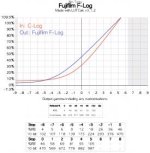
Fuji F-Log is not as flat as most other logs and has the same basic range as Canon Log (slightly deeper blacks) with a different effective gamma (brighter mid tones):
LUTCalcFCL_Page_1.jpg

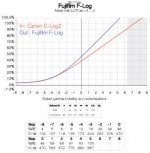
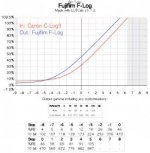
Compare to Canon Log 2 & 3:
LUTCalcFCL2_Page_1.jpg
LUTCalcFCL3_Page_1.jpg
 
Fuji F-Log is not as flat as most other logs and has the same basic range as Canon Log (slightly deeper blacks) with a different effective gamma (brighter mid tones):
View attachment 134266

Compare to Canon Log 2 & 3:
View attachment 134267
View attachment 134268

In just looking at the clips today as I was transferring the Fuji files, I agree, it doesn't look very flat, nothing like CLog 2 and it's contrastier than Clog3 for sure. Glad we have it, I am overdue to shoot some tests to compare F-Log against C-Log/2/3 and to see what I can do as far as color matching. Has anyone seen an article or YT video in matching F-Log to C-Log variants yet? I would think a lot of Canon C camera owners are picking up XT-3s?
 
In just looking at the clips today as I was transferring the Fuji files, I agree, it doesn't look very flat, nothing like CLog 2 and it's contrastier than Clog3 for sure. Glad we have it, I am overdue to shoot some tests to compare F-Log against C-Log/2/3 and to see what I can do as far as color matching. Has anyone seen an article or YT video in matching F-Log to C-Log variants yet? I would think a lot of Canon C camera owners are picking up XT-3s?

You can use LUTCalc to create an F-Log+F-Gamut to Canon WideDR 709 LUT: https://cameramanben.github.io/LUTCalc/LUTCalc/index.html
Here's the 33x33 LUT (.cube): View attachment FLogFGamutWDR709.cube.zip

If you run LUTCalc you'll see that WideDR is the same as F-Log gamma with more contrast (slight s-curve) and lowered blacks.
 
Just to let you guys know I'm getting much better results using HLG on X-T3, cleaner colours (no magenta artifacts that sometimes show up in F-log), and better overall dynamic range.

I use LUTCalc to convert HLG to ARRI Log-C.

Still chasing Fujifilm for a whitepaper regarding their HLG implementation.

This is interesting too. Magenta artifacts, huh? I'll have to check that out.
 
View attachment 134276

Shoot sky with F-log and you're almost guaranteed to get magenta banding like this (LUT applied to make it more visible), even with 10bit 400Mbps codec or external ProRes HQ.

Try turning noise reduction completely off or as low as possible. Noise will provide dithering and is especially important when using a compressed codec.
 
Try turning noise reduction completely off or as low as possible. Noise will provide dithering and is especially important when using a compressed codec.

This is completely unrelated to compression. It happens with 400Mbps ALL-I HEVC and ProRes HQ.
 
This is completely unrelated to compression. It happens with 400Mbps ALL-I HEVC and ProRes HQ.

See if you can spot the macroblock artifacts (Dehaze from ACR in PS CC):
FujiMacroBlock.jpg

How much is that image zoomed/cropped? The only way to prevent this kind of macroblock issue is to alter the H.264/256/ProRes quantizer (high frequency coefficients) and/or let more noise through (or in Fuji's case, adding film grain in camera). In some cases, banding/quantization/solarization can be reduced by adding grain in post, however this particular issue is macroblock/compression related and adding noise in post won't help. Thus getting more noise in-camera is the best option.

Try shooting the sky with film grain enabled (perhaps not possible with F-log?), and NR turned down/off and/or stop down or use an ND and boost ISO to increase noise.
 
See if you can spot the macroblock artifacts (Dehaze from ACR in PS CC):
View attachment 134279

How much is that image zoomed/cropped? The only way to prevent this kind of macroblock issue is to alter the H.264/256/ProRes quantizer (high frequency coefficients) and/or let more noise through (or in Fuji's case, adding film grain in camera). In some cases, banding/quantization/solarization can be reduced by adding grain in post, however this particular issue is macroblock/compression related and adding noise in post won't help. Thus getting more noise in-camera is the best option.

Try shooting the sky with film grain enabled (perhaps not possible with F-log?), and NR turned down/off and/or stop down or use an ND and boost ISO to increase noise.

Of course this screenshot has macroblock, it's a 200% crop screenshot from 400Mbps HEVC F-log recording, at base ISO, in a sunny day, NR -4.

Again it's unrelated to compression artifacts as it's visible in ProRes HQ recording as well (magenta bands).

With the exact exposure/codec settings, HLG and film simulations do not show these artifacts at all.

The only reply I got from Fujifilm is that it might have something to do with F-log tone curve and colourimetry.

Post a ProRes screenshot and if it has the same artifacts it's also macroblocking related to compression (ProRes is basically Apple's MJPEG: it can macroblock too). HLG, film simulation (noise) all show it's compression related to limited code values (lack of variance/noise). Try getting F-log noisy- NR off, and add noise manually via higher ISO. It will reduce this 'magenta banding' issue. Sky naturally has magenta (R+B); your complaint sounds like it's the banding (quantization) vs. the magenta color.
 
Back
Top