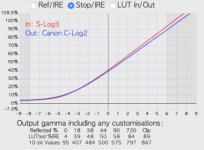
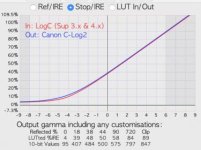
scorsesefan
Veteran
Does anyone know how well Fuji's F-log will match with S-log 2/3 (fs5/fs7)? Thanks

Follow along with the video below to see how to install our site as a web app on your home screen.
Note: This feature may not be available in some browsers.

Does anyone know how well Fuji's F-log will match with S-log 2/3 (fs5/fs7)? Thanks
Does anyone know how well Fuji's F-log will match with S-log 2/3 (fs5/fs7)? Thanks
F-LOG is extremely close to the original Sony S-LOG. Practically the same exposure values for 18% Grey and 90% white for instance. No trouble color correcting the Fuji, and what I like most is that there is much greater retention of color information in faces, especially in the traditional highlight areas of the forehead and nose in contrasty situations. This is one of the chief strengths of this camera.
SLOG2 and 3 have never stood up as well as the original s-log. They are compressing the values in different place on the curve and I find that they yield too much noise.
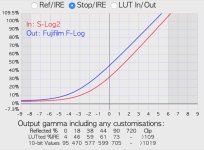
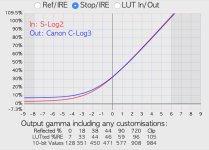
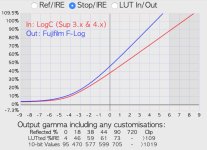
I’ve read that any Sony model with less than 14stops DR, S-log 2 may be all that is needed.I think slog2 is recommended for 8 bit - at least on the fs5.

Ah well. Doesn't look like the XT3 will get compatibility with Sound Devices Mixpre's.
I can tell the Fuji support guys are bored talking about the exciting aspect of using a Fuji with a sound recorder.
Unfortunately, that is a no go for me, and my short foray into the Fuji eco system is now over. The 10bit is nice, but H.265 is not. The bit rates are nice, but other companies should follow suit soon.
Another half baked set of features, that gets attention, but doesn't fully deliver.
Between the auto focus flubs and the time-code out only working with Atmos, then it comes down to video quality alone. And the moire in HD is not nice, and the noise from iso1600 on degrades the image. To me, the video interface is rather over complicated to setup and learn. Nice options, but ultimately reinventing the wheel. It is not a video camera you can just take out of the box and start shooting. As a stills camera, it is intuitive, but as a video camera, not so much. If some of the selling features worked better, it might be worth the time getting new lens mounts and learning a new menu and setup. But if you aren't the kind of person who really likes getting new things to try out, the Fuji is not worth the detour.
It is an odd camera, that goes out of its way to add pro video features that ultimately don't work.

The ergonomics and speed with which you can adjust settings is world's better than the rest. The quick menu makes switching recording formats/framerates a breeze.
+1They were actually the last ones to the party...all of the main players with their major releases have had quick menus and tons of programmable buttons (Sony has the most on any of their newer cameras and was offering this when Fujifilm didn't even have a 4K camera yet).
And some systems now utilize buttons or switches to change formats/framerates so it doesn't get any quicker than that.
And also IMO, Fujifilm has probably the worst menu system I have ever seen. Swiping the screen is fantastic though.
The lack of timecode with the Mix Pre 3 is a shame, but I can't agree with your general summary. For all the compromises that mirrorless stills cameras pose for video work, I think the X-T3 really does stand out head and shoulders above the rest for ease of use. The ergonomics and speed with which you can adjust settings is world's better than the rest. The quick menu makes switching recording formats/framerates a breeze. The 10-bit is fantastic. h265 is a pain in the arse, but apparently the only option for internal 10-bit recording in a large-sensor mirrorless stills camera (as evidenced by Panasonic's upcoming options).
The bitrates are remarkable, and nothing (not even the big Panasonics that are coming) can touch Fuji on that front.
As a tool to do video with, that isn't a video camera, I think they've done a wonderful job.
But it's still not a video camera, and it sticks you with a bunch of compromises as a result. The compromises are so much less than everything else out there though, that I think it makes a strong contender. I've been using my two more and more as b-cameras. Combined with something small like a Ronin-S, it's an incredibly powerful 10-bit, autofocussing tool to keep in the kit for those moment when you need stabilised camera movement, but production can't afford the real thing.
The lack of timecode with the Mix Pre 3 is a shame
Ah well. Doesn't look like the XT3 will get compatibility with Sound Devices Mixpre's.
I can tell the Fuji support guys are bored talking about the exciting aspect of using a Fuji with a sound recorder.
Unfortunately, that is a no go for me, and my short foray into the Fuji eco system is now over.
The 10-bit is fantastic. h265 is a pain in the arse
The 10bit is nice, but H.265 is not.
The bitrates are remarkable, and nothing (not even the big Panasonics that are coming) can touch Fuji on that front.
The bit rates are nice, but other companies should follow suit soon.
But it's still not a video camera, and it sticks you with a bunch of compromises as a result
Another half baked set of features, that gets attention, but doesn't fully deliver.
Between the auto focus flubs and the time-code out only working with Atmos, then it comes down to video quality alone. And the moire in HD is not nice, and the noise from iso1600 on degrades the image. To me, the video interface is rather over complicated to setup and learn. Nice options, but ultimately reinventing the wheel. It is not a video camera you can just take out of the box and start shooting. As a stills camera, it is intuitive, but as a video camera, not so much. If some of the selling features worked better, it might be worth the time getting new lens mounts and learning a new menu and setup. But if you aren't the kind of person who really likes getting new things to try out, the Fuji is not worth the detour.
It is an odd camera, that goes out of its way to add pro video features that ultimately don't work.