FS7: FS7 RAW woes & data distribution between: 12-bit RAW, 16-bit RAW, & 10-bit S-Log

Wow. That is pretty terrible. Never seen it that bad before.

If you've got a very busy scene the bits will be spread across the image and you won't see these artefacts, however, if you've got a highly detailed scene with areas of low detail the low detail areas will be starved of bits and cause the blocking. For example shoot a wavy sea scene with 30% blue cloudy sky then in post want to add more contrast to the sky you can easily find these block starting to appear as banding. If you go to extremes you'll see blocks like those above.

I must stress this was an extreme test with a narrow key and lots of contrast to expose the underlying compression. The sky on the day was a very light blue with lots of distance haze. But nevertheless it is a good example of what is waiting for you in the blacks too if you under expose then want to bring them up in post.

Was this shot in SLOG3 though?
 
Yeah. I definitely think the issue is there. SLOG3 is starving certain parts of the spectrum for bits.

Yes and combined with the way XAVC "sees" the image areas there's a recipe for a nasty surprise in post with these rather "mechanical" looking artefacts. Burning in LUTs helps as there's more contrast in the image prior to compression but that obviously has other limitations.

I applaud Sony for their cunning.
 
Recapping as i've missed this for a while.

Like Ben, i was talking to many people long, long ago about this.

I have a bit of an issue with the fact that 12 bits linear isn't that either. It's 11, because the lowest bit is always 0, this has been confirmed too. It's 11 bits packed into 12.

Did i throw a wobbly about this? Not really, because i understand that bit is usually noise and in actual real world situations i liked the output i was able to get out of the FS700 and i didn't get any banding issues. 4K RAW -> HD, wonderful images for that price. For that price, right? The O7Q gave a whole lease of life to this camera and was one of the best purchases i made. Frankly i saw worse issues with some cameras and vertical stripes of unbalanced noise, which mean hardware replacements and that wasn't that uncommon either allegedly. Or strange compression generated noise in the RAW signal too.

Going through that understanding process though showed me how ropey all cameras were in terms of what you really get out of them. True of every camera i've owned or seen.

I know Sony want to produce the best they can but it's a bit disingenuous to suggest that marketing and product segmentation doesn't have a lot to do with this too. Afterall Sony could have applied a log curve to that 12 bit output and that would give you everything the sensor had. They didn't and they have their reasons, quite obviously to do with a holistic approach to their range. At the end of the day they could technically stream off RAW from an A7sII and perhaps there's movement being made there too. But the advance in cameras are throttled by the reality of markets and revenue, especially if what they do affects products in the rest of their range.

We seemed to have moved on to compression issues and Nirv shows a good example there. There's still cause to record prores although even prores will suffer artefacts at certain times and certain light levels. This is one reason, despite the compression issues at certain qualities, why RedCode is good.

However that Vimeo video is pointless as all tests on youtube/vimeo. If anyone has tried to accurately post something on those sites will know, it's nigh impossible to get good results. It is in both services interests to compress the hell out of any video. The download link may or may not be the camera original, i'm not sure it is actually. A good test is to take a nicely balanced image on a calibrated monitor. Run that off and see on different machines and different hosting services how different the levels can be.

cheers
Paul
 
I applaud Sony for their cunning.

Well if you had bought the F5 you could have shot this stuff in HDCAM SR, a proven codec that was used on films like Avatar. You get what you pay for.

I applaud Sony for moving forward and near enough killing off the competition. A few years ago all we had was internal XDCAM EX. Now we have SR, RAW, XAVC, DNxHD and ProRes. I don't see many of the competitors offering all these codecs.
 
I have to say when I bought the FS7 I thought I was buying an F5 with fewer buttons and external displays but the more I use it the more I see the value in what the F5 brings to the table.
 
I have to say when I bought the FS7 I thought I was buying an F5 with fewer buttons and external displays but the more I use it the more I see the value in what the F5 brings to the table.


I bought my F5 the day the FS7 was announced. I went for the F5 just to shoot SR. Films like Harry Brown and Avatar were shot in this codec so it made more sense to me, we didn't even have the 4K XAVC upgrade then. I film in XAVC more these days but I think SR is the business. I will be buying the R5 in 2016 I hope.

You should sell up and move on to the the F5, you won't regret it. If I had the money I would have gone for the F55.
 
Well if you had bought the F5 you could have shot this stuff in HDCAM SR, a proven codec that was used on films like Avatar. You get what you pay for.

I applaud Sony for moving forward and near enough killing off the competition. A few years ago all we had was internal XDCAM EX. Now we have SR, RAW, XAVC, DNxHD and ProRes. I don't see many of the competitors offering all these codecs.

Sony created the XAVC compression scheme, they engineered it to be more limited than it need be. Sony limit the bitrates for HD material when the camera is capable of much higher bitrates when recording UHD.

Sony have only moved cameras forward by way of marketing specs and on paper the FS7 looks amazing compared to the competition. The reality is there are some very cunning limitations that have been engineered so the camera isn't too good for the money.
 
yoclay,

what do you mean by SLog3 starving the spectrum? Just to be clear, S-Log3 is a transfer function - fundamentally it affects contrast rather than the storage of colours. S-Gamut3, S-Gamut3.cine and S-Gamut all determine what happens colour-wise. Feeding into a codec then S-Gamut3 and S-Gamut are trying to contain a very wide range into the limited quantization capacity of a codec (whether the codec itself is YUV or RGB). There again, at the same bit depth so are Arri Wide Gamut, Canon Cinema Gamut or any of the other explicitely wide-gamut options in various cameras.

Fundamentally however, at a basic 10-bits or more you should have plenty of colour information to respread things to a nice colourful image without problems for your eyes. Where things get screwy is in compressing the wide gamut. In most shots not a lot in a wide-gamut image will stretch very far out on the vectorscope. As I say, fundamentally that should not be an issue at 10-bits or beyond, but when values lie close to each other more care has to be taken in the codec to avoid overcompressing useful detail causing artifacts and banding. I'm pretty sure that that is a big part of why the 8-bit C300mk1 CP-Lock colourspace was not a wide colour gamut.

Lossy compression has been conventionally based around what you can take out of an image before your eyes become aware of it. At one level that is the choice of 8-bit for colours and the use of YUV rather than RGB, at another dropping detail information using DCTs or wavelets and the more recent tricks of video compression, and does not necessarily mean taking it to the extreme lengths where it becomes apparent in fast motion or on big screens.

The trouble comes when you are talking about trasfer functions and colourspaces not designed to be looked at, but to pass on as much useful information as possible for use in colourspaces which are for the final display. The threshold where artifacts can come into play becomes amplified by the fact that down the line things are going to be expanded. The codec needs to be a lot more carefully designed, even if there will inevitably always be some tradeoff in lossless compression.

If I have misunderstood you, very sorry, and I would be very interested to hear you expand a bit on what you meant, but S-Log3 (as with - in data spread terms - near identical LogC, C-Log2, Cineon and V-Log - though maybe not so much on an 8-bit GH4!) gives a rich, well tuned spread of data from 10-bits and up. What a particular codec does with that is another matter,

Ben
 
Last edited:
I bought my F5 the day the FS7 was announced. I went for the F5 just to shoot SR. Films like Harry Brown and Avatar were shot in this codec so it made more sense to me, we didn't even have the 4K XAVC upgrade then. I film in XAVC more these days but I think SR is the business. I will be buying the R5 in 2016 I hope.

You should sell up and move on to the the F5, you won't regret it. If I had the money I would have gone for the F55.


Financially it makes zero sense for me to get an F5. The FS7 is an earner and is small and versatile enough to be used on all sorts of jobs and in Producer's eyes the F5 doesn't bring anything else to the table. The F55 is a different beast capable of amazing images (I love the look of Sense8) but at that price point I am more interested in Red offerings. Perhaps even a basic Amira.


Just to keep it fun, the new Avatars are being shot on Red ;)
 
Does anybody know how this was shot and posted in detail?

No unfortunately, it was a video posted on Facebook so then I went hunting for that information but to no avail. I'm trying to find out what I can, but I agree that there can be a number of reasons to what we were seeing. It could have shot in mpeg, compressed to 1mbps H.264, then uploaded to vimeo. who knows, I might have held back posting it and causing a social outbreak of panic.
 
Financially it makes zero sense for me to get an F5. The FS7 is an earner and is small and versatile enough to be used on all sorts of jobs and in Producer's eyes the F5 doesn't bring anything else to the table. The F55 is a different beast capable of amazing images (I love the look of Sense8) but at that price point I am more interested in Red offerings. Perhaps even a basic Amira.


Just to keep it fun, the new Avatars are being shot on Red ;)

I think the only real difference between the F5 and F55 is the global shutter. The so called F65 colour gamut is not something we can see displayed on real monitors, but I may be wrong on this. Well with the F5 you get SR, 16bit RAW, a robust PL mount, a proper EVF and far better build quality but I get your point. For me this camera is a keeper, I don't know what more Sony can add to the next generation so I suggest they upgrade the F5/55 cameras rather than release a new model. This may sound like wishful thinking but who would have thought that an internal ProRes board could be installed at a latter date. I think Sony may be following RED's lead.

Hey I have nothing against RED but was put off by all the horror stories. I mean read Mr Bloom's blog on his experience with Epic, and he is a major voice with clout in this camera gear sub-culture that I find myself addicted to. As for Cameron filming on RED well I'm sure he can afford to buy RED's by the dozen. I'm surprised he's not shooting on the F65 in 8K because he can afford it. I think he's spending too much time with Peter Jackson :)

Arri must know something we don't, like can we even see 4K unless it's displayed on a super huge screen? I think with 4K we have surpassed the resolution of film and do we even need to go further? I keep watching Skyfall and I keep thinking do we really need more than this? Perhaps Amira is the way to go.
 
yoclay,

what do you mean by SLog3 starving the spectrum? Just to be clear, S-Log3 is a transfer function - fundamentally it affects contrast rather than the storage of colours. S-Gamut3, S-Gamut3.cine and S-Gamut all determine what happens colour-wise. Feeding into a codec then S-Gamut3 and S-Gamut are trying to contain a very wide range into the limited quantization capacity of a codec (whether the codec itself is YUV or RGB). There again, at the same bit depth so are Arri Wide Gamut, Canon Cinema Gamut or any of the other explicitely wide-gamut options in various cameras.

Fundamentally however, at a basic 10-bits or more you should have plenty of colour information to respread things to a nice colourful image without problems for your eyes. Where things get screwy is in compressing the wide gamut. In most shots not a lot in a wide-gamut image will stretch very far out on the vectorscope. As I say, fundamentally that should not be an issue at 10-bits or beyond, but when values lie close to each other more care has to be taken in the codec to avoid overcompressing useful detail causing artifacts and banding. I'm pretty sure that that is a big part of why the 8-bit C300mk1 CP-Lock colourspace was not a wide colour gamut.

Lossy compression has been conventionally based around what you can take out of an image before your eyes become aware of it. At one level that is the choice of 8-bit for colours and the use of YUV rather than RGB, at another dropping detail information using DCTs or wavelets and the more recent tricks of video compression, and does not necessarily mean taking it to the extreme lengths where it becomes apparent in fast motion or on big screens.

The trouble comes when you are talking about trasfer functions and colourspaces not designed to be looked at, but to pass on as much useful information as possible for use in colourspaces which are for the final display. The threshold where artifacts can come into play becomes amplified by the fact that down the line things are going to be expanded. The codec needs to be a lot more carefully designed, even if there will inevitably always be some tradeoff in lossless compression.

If I have misunderstood you, very sorry, and I would be very interested to hear you expand a bit on what you meant, but S-Log3 (as with - in data spread terms - near identical LogC, C-Log2, Cineon and V-Log - though maybe not so much on an 8-bit GH4!) gives a rich, well tuned spread of data from 10-bits and up. What a particular codec does with that is another matter,

Ben

Hi Ben,
What I mean is that whenever you transform something linear into a curve, which is essentially what slog does, where you chose to bend the curve will experience a loss of data. A lot more information needs to be contained in a narrow space, and this is done by throwing something out. Now you can do this in a gentle way or with a hard shoulder. However the upshot is that in order to retain shadow and highlight detail, whenever you compress black and white values at the ends of the grey spectrum towards the center something has to give. Where that sacrifice is made you will find noise and eventually artifacting when the spectrum is re-expanded with a LUT or by hand. Essentially the spectrum is being starved in order to make space for the values which are being crammed into it. This is what allows for the additional info contained in those extra stops of dynamic range for example. However, for this reason too there might be more noise at 30% than at 15% for instance. Further artifacting occurs when a codec tries to compensate for the missing data.

Both SLOG2 and SLOG3 are tweaked curves, they have bumps and shoulders which we dont know too much about. Thus they wiil have strengths which we can see, but also incongruities we dont know about. Every now and then someone happens on one and this may be the case in the image above. So if SLOG 2 or SLOG3 has been tweaked to provide better skin tones for instance you will inevitably find data is thinner somewhere else as a consequence. This can show up in a sudden shift of red's somewhere else for example. Or as in the case of skies - banding where blue information has been thrown out in order to pick up detail in another part of the blue spectrum.
 
Last edited:
I think the only real difference between the F5 and F55 is the global shutter. The so called F65 colour gamut is not something we can see displayed on real monitors, but I may be wrong on this. Well with the F5 you get SR, 16bit RAW, a robust PL mount, a proper EVF and far better build quality but I get your point. For me this camera is a keeper, I don't know what more Sony can add to the next generation so I suggest they upgrade the F5/55 cameras rather than release a new model. This may sound like wishful thinking but who would have thought that an internal ProRes board could be installed at a latter date. I think Sony may be following RED's lead.

Hey I have nothing against RED but was put off by all the horror stories. I mean read Mr Bloom's blog on his experience with Epic, and he is a major voice with clout in this camera gear sub-culture that I find myself addicted to. As for Cameron filming on RED well I'm sure he can afford to buy RED's by the dozen. I'm surprised he's not shooting on the F65 in 8K because he can afford it. I think he's spending too much time with Peter Jackson :)

Arri must know something we don't, like can we even see 4K unless it's displayed on a super huge screen? I think with 4K we have surpassed the resolution of film and do we even need to go further? I keep watching Skyfall and I keep thinking do we really need more than this? Perhaps Amira is the way to go.


In all honesty I am really not a fan of Philip Bloom and his ethics statement is a joke. The man is a shill. I'll leave the other more serious accusations levelled at him to one side.

That said he had issues with the Epic when it came out - and Jim Jannard's response was unbelievable in its aggressive and combative nature. Frankly that whole episode (and Bloom didn't come out of it smelling of roses either) caused a huge shift in the way the company was run and not too long after Jim Jannard moved permanently behind the scenes and left Jarred Land to be the more public face of the company. On the client-facing side, the Red of today is not the Red of 2010/2011. That goes for the company as well as the cameras in my opinion.


As for Arri... They are winning on just about everything else. It's cool that they are behind on resolution and price.

The biggest issue currently is how slow consumer 4K panels have been to actually become decent and affordable. There isn't a single sub £1,000 4K TV out there worthwhile having yet.
 
I don't agree at all with the smear of Philip Bloom, nor the no decent and affordable 4k panels opinion. 4k HDR and WCG is spectacular. It's here and affordable.
 
I didn't smear him. I said I am not a fan of him. If you don't think he pushes gear and get preferential treatment then I really don't know what to say. As I said, I'll leave the other stuff to one side as it's not really our place to have a say on it without all the information.

Can you link me up to a great sub £1,000 4K tv? I have been looking for one for ages.
 
Hi yoclay,

S-Log2 is defined by:
if x>=90 {
IRE = 219.0 * (power(10.0, (( (x–64)/(940-64) – 0.616596 – 0.03 ) / 0.432699 )) – 0.037584) / 155.0
} else {
IRE = ( (x-64)/(940-64) – 0.030001222851889303 ) / 3.53881278538813
}
where 'x' is the 10-bit code value (or whatever bit depth scaled to 0-1023)
source: Sony S-Log2 Technical Paper

S-Log3 is defined by:
If in >= 0.01125000 {
out = (420.0 + log10((in + 0.01) / (0.18 + 0.01)) * 261.5) / 1023.0
} else {
out = (in * (171.2102946929 – 95.0)/0.01125000 + 95.0) / 1023.0
}
Where:
in = reflection
reflection = IRE * 0.9
out 0.0 - 1.0
Source : Sony S-Log3 Technical Paper

Those are the precise transfer functions used - there are are no unknown bumps and shoulders. The primaries and white points are also defined in the sources, and since these are equated in strict linear space (confirmed if you look at the ACES IDTs) the definitions are exquisitely exact and comprehensive. In fact the only significant point not mentioned but which I fairly easily found out using the spreadsheet of matrices which Sony published with the S-Log3 documentation is that CIECAT02 seems to be the chromatic adaptation model used to shift white points.

The cameras will likely use lookup tables rather than do the calculations on the fly, but this is unquestionably what gets recorded. As might be a bit obvious, I have written an app to shift between colourspaces, perform log exposure shifts and other adjustments and in testing and in my work as a cameraman I check on this over and over again.

You are quite right that by reducing the contrast to fit more at the extremes, you also reduce the contrast in the midtones and hence the spread of possible data values in the midlle stop to stop (when compared to linear, or frankly more usefully Rec709 or sRGB). However...

Rec709 is generally viewed at an 8-bit colour depth, and whilst any sensible Rec709-based camera curve incorporates a knee, I'll use the base display curve as an example since it makes things as difficult as possible for log. The Rec709 display curve spreads the highest stop (going from mid gray, that is stop 1 1/3 to stop 2 1/3) roughly between 70% and 100% IRE. in 10-bit land 0%-100% is 876 code values (64-940), so 30% IRE would be about 263 code values. Divide by 1023 then multiply by 255 to get the 8-bit equivalent and rounding up that's about 66 8-bit code value. Again, no knee and the greatest spread. In a real 8-bit Rec709 camera curve no stop is likely to get near that, particularly stop zero to stop one which is the skin tone mids area which really sets how many code values you need to trick the eye.

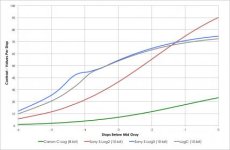
Anyway, getting back to 66 code values, here is a chart I prepared for an article a while back which uses the defining equations to give an idea of code values per stop for various 10-bit log curves (plus 8-bit C-Log):
Contrast.jpg
Zero on the x-axis is 18% gray, so what this plots is the shadow stops. With all of the included curves the values per stop increase above stop zero. If you look at the y-axis, you can see that both S-Log3 and Arri LogC pass 66 code values at stop -2, with S-Log2 only a little behind. What that mean is that in purely available information terms, you could expand the contrast of any stop from two stops below mid gray through to white clip (in the Sony cameras this is exactly six stops above mid gray for both S-Log2 and S-Log3) and have as much data available to you as broadcast display Rec709 in the top 30% IRE. Again, the stops above mid gray still have more data spread in the log curves, but this is showing the worst case scenario.

The two biggest issues I have come across in the end results from log are the codec choice and the appropriate use of the right tools for 'de-logging' to image for display

Very sorry to have been so long-winded, but it often comes up that people think that log curves are ambiguous or unknown, but at least in Sony's case the documentation is extensive, detailed and publically available. I really do think that it is important to be clear about that.

I've included pretty much every mathematically documented log curve I could find in my LUTCalc app, and posted links to the bulk of the sources on the webpage if you are interested,

Ben
 
Last edited:
Back
Top