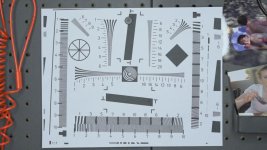
FS100 good enough for Blu-ray ?

Man.... I have seen FS100 look as good as any red footage I have seen on bluray, and online. Enough with pixel peeping. What normal person cares about charts and lines etc. If it looks good then go with it, if something else looks better to you then go with that, but to even ask if the FS100 is good for bluray is a stupid question IMO. I mean if your that concerned about the FS100 resolution then buy a 4k camera and a 4k display then u will be happy, geesh.. This pixel peeping is getting ridiculous not so long ago ppl where just happy to be able to shoot Dslr now it's become ridiculous how much people want more rez more rez! It's going to get to the point that 1080p,2k,4k,5k wont be enough you will want 8k, 20k, 100k rez. When will ppl be happy? To me the more rez I see the more it starts to look like those 120 motion flow tv's and less filmic and more Videoish, this is just IMO. The FS100 has impressed me with the resolution I have seen out there so much so that sometimes I and other ppl I work with can't tell if it's RED or FS100 footage that we are looking at, and to me that says allot about the FS100 =)
 
Thing is, 800 € camcorders like the Pana TM900 or the latest cheap Canon consumer camcorders resolve at the absolute maximum AVCHD 1080p can achieve.
For me the FS100 is a greatr camera, the best in its class, but it´s a real shame it cannot resolve full 1080p for that price! It´s not a 1500 € DSLR! So I expect more. The little lack of resolution is the only downside of the FS100 for me. But of course, it´s still good enough for bluray.

Just look at this still from the TM900: http://img4.fotos-hochladen.net/uploads/tm900001dpnf7gyxj3.png
 
Last edited:

Looks oversharpened. Oversharpening adds to the feeling of "detail".

Not sharpened 7d: http://hmcindie.pp.fi/hx9v/Canon_7d_iso_1250_no_sharpening.jpg

Sharpened 7d: http://hmcindie.pp.fi/hx9v/Canon_7d_iso_1250_sharpened.jpg

You can see how the 7d suddenly looks much more sharper. Eventhough it resolves the same.

Personally I feel that the FS100 looks sharp. But it has none of those horrible oversharpening artifacts as in the previous TM900 image. In the Philip Bloom test the FS100 was on an overcast sky and it looked too grey. Contrast increases "apparent sharpness".

The FS100 resolves very well.
 
Thing is, 800 € camcorders like the Pana TM900 or the latest cheap Canon consumer camcorders resolve at the absolute maximum AVCHD 1080p can achieve.
For me the FS100 is a greatr camera, the best in its class, but it´s a real shame it cannot resolve full 1080p for that price! It´s not a 1500 € DSLR! So I expect more. The little lack of resolution is the only downside of the FS100 for me. But of course, it´s still good enough for bluray.

Just look at this still from the TM900: http://img4.fotos-hochladen.net/uploads/tm900001dpnf7gyxj3.png

that looks pretty sharpened to me!

Not sure about all this quantifying resolution stuff.

All i know is if i point the FS100 (or whatever) at a detailed and complicated scene and record (uncompressed) with no detail enhancement, i see a lot of real details. I could choose to go on and sharpen it if i wanted it to appear super sharp but usually that's not a look i want.

I do wonder whether these resolution tests are being run with decent lenses for example? That sample was a wide angle and to get a decent sharp wide on a APS-C sensor size needs a reasonable lens. Not a kit lens.

cheers
Paul
 
I don't like to tell anyone that they asked a dumb question....but the question about whethere or not the FS100 is "good enough" for Blu-Ray is off the chain... There's really no question.

Not to add to the "pixel-peeping" that's going on here but since you all are talk about sharpening vs real resolvable detail etc....have you guys and gals really took a good look at the C300's image? While its resolution is probably good....the image has crazy sharpening artifacts al lover the place. When Phil Bloom did his comparison between the F3, FS100, C300 etc. and blew up those images 400% that is what stuck out to me.
 
Hi Everyone,

I'd like everyone to see these two images. They are frame grabs from my 7D & FS100 against a chart. Both used the same lens at the same f-stop, a Canon 24-70L. I wont say anything on what I think, i would simply like to post my results. The first image is from the FS100 and the 7D follows.


FS100.jpg


7D.jpg
 

Attachments

  • FS100.jpg
    FS100.jpg
    68.9 KB · Views: 0
  • 7D.jpg
    7D.jpg
    67.8 KB · Views: 0
Last edited:
Problem 1: You need to frame the charts to be the same size in both. Given that the FS100 sensor is larger than the APS-C in the 7D. You'll have to push in a bit with the FS100 because of this. This is the only way to compare how they are solving equally. You got kinda close, but it artifically makes the comparison worse since the chart is larger on the 7D and therefore looks like it will resolve better than it does compared to the FS100.

Problem 2: If you are looking at this, make sure you actually open up those images at 1920x1080 and not look at them in the post. The difference is VERY easy to see.
 
Hey Rick,

Totally agree with you, i set this up and shot it in 5 minutes. This is nothing like the Zacuto shootout, and I have no idea how to actually read this chart. What I wanted to do was to show an example of the resolving power of two cameras instead of people bickering back and forth over incomplete data.

To everyone reading this please go print off a resolution chart online, setup your own tests, and come to your own conclusions. Even though my test is not completely acurate I came to the conclusion that the resolving power of my FS100 with a good quality lens is greater than my 7D with the same lens.
 
I will also say that I gave the 7D more of a chance in this test. Because of the camera's crop factor (1.6) the image appears closer and is therefore closer to the chart. The closer a camera is to finely spaced lines the easier it is to resolve the seperation.
 
Agreed! :) I have printed out charts and tested as well. What is funny though is when you can resolve so well, you see the stair stepping from the printer and not the camera!

I have a 7D as well and when I first shot with the FS100 I was floored at the difference. The BIGGEST difference is shoot a wide deep shot with both. Wow, does the 7D get soft.

Given I have followed Adam Wilt's stuff for awhile and actually conversed with him about camera testing, even contributing my own tests and recreating his, I will take his word on what he found.
 
I will also say that I gave the 7D more of a chance in this test. Because of the camera's crop factor (1.6) the image appears closer and is therefore closer to the chart. The closer a camera is to finely spaced lines the easier it is to resolve the seperation.
If you frame correctly for the test, 7D shouldn't have any advantage over 5D since 5D will have to be physically closer to the chart to get the same framing.
 
jetswing,

Your exactly right. But I was comparing the 7D against the FS100. The 7D has a crop factor of 1.6, and the FS100 has a crop factor of 1.5. My lens was set to 50mm. That means the focal length on the 7D was equivalent to 80mm. However when the lens was placed on my FS100 the focal length was equivalent to a 75mm lens.

The reason I said I gave the 7D more of a chance was because the 7D had a larger focal length, and should be able to resolve more lines of detail.
 
I don't think that's how it works. If that were the case the 5Dll would kick everyone's proverbial &$$.
 
I don't think that's how it works. If that were the case the 5Dll would kick everyone's proverbial &$$.

Haha, I think the problem is people aren't realizing what he is saying. He let the 7D be a longer focal length to give it more of a chance to resolve on the chart based on the lines, not on the overall sharpness of the image. In this case, he is correct, the same set of lines will be further apart on the 7D and make it easier on it, that's all. Just means, from a resolving standpoint, not apples to apples.

:)
 
Ian-T,

I'm sorry if I was unable to properly explain myself. I've included two pictures below both from the 7D taken on the 70-200 2.8L lens. The first image was taken at 200mm. The second was taken at 70mm. By increasing the focal length and zooming in on the fine lines of the chart the seperation of the lines becomes more apparent to the 7D and has less trouble rendering those lines of seperation without image artifacts (moire & aliasing)

This demonstrates the test I did between the FS100 and 7D and is an extreme example of the differences in the crop factor. But because we both know the FS100 is able to resolve more lines of resolution, and my original test between the FS100 and 7D was botched because I did not properly move the 7D back because of the greater crop factor, is the reason I said I gave the 7D a better chance at resolving lines of resolution.

Sequence01Still004.jpg


Sequence01Still003.jpg
 
Our 5d looks great on Bluray (astonishing when authored correctly), so so should the FS100. The RED looks even better, but they do cut most of the time.
 
I don't spend time shooting charts myself, I find all those concentric rings give me a headache.
However, when it comes to objective camera evaluations and technical insight, I tend to trust Adam Wilt.
He tested 800 lines horizontal and 1000+ vertical:

http://provideocoalition.com/index....ony_nex-fs100_super35_lss_avchd_camcorder/P2/

Adam Wilt of course did the test correctly -- he also used the right terminology, save for the fact that ultimately he confused horizontal and vertical. It is impossible, that is to say there is no way on earth, that a 1080p delivery can deliver 600 line pairs of vertical resolution. The maximum line pair resolution for a 1080p format would appear to be 540 until Mr Nyquist pointed out that even that would be unreachable. Confusing line pairs with TV lines per picture height is problematic, so too is speaking of horizontal resolution instead of vertical. For the record, a line pair requires that two lines be resolved, one white one black -- so the maximum possible resolution in a 1080p file is 540 black lines on a white background, counted vertically (and produced using photoshop or some such, to avoid Mr Nyquist.) Any value higher than that (and frankly even those approaching that) are optical illusions or misreadings of the line chart. Similarly, speaking of horizontal resolution as a measured value runs counter to the normative standard -- resolution, whether presented in TVL or LP is described as that measured in the picture height.


[It is wrong for me to accuse Mr Wilt of confusing horizontal and vertical -- let me instead say his results are surprizing but may be entirely correct: they are certainly possible]
Cheers,
GB
 
Last edited:
Yes, but it´s definitely not the full 1080 lines like an EX1 or a GH2. I recently made a DVD and a bluray of the same film and of course the BD looks better but it´s not that flash, when you compare them.


Depends how big your screen is. I have a 90 inch projected screen and DVD's are almost unwatchable.. whereas blurays looks superb.
 
Back
Top