FF vs MFT

jump to 6min, if you already know the basic differences of MFT and FF35.
 
All of the formats have pros and cons.


2/3"
8mm
16mm
1"
MFT
s35/APS-C
APS-H
FF35
VV
Medium Format
Large Format (stills 6x7 or larger etc)


given all of the options and design compromises, I feel for motion that s35 is perhaps still the best. though, that can be beaten by a m43 and FF35 A/B cam combo.

However, with mirrorless s35 now common, we may see less advantages of M43 over s35 than we used to. So, the question in my mind, does the advantages of FF35 and MFT outweigh keeping s35 around?

Personally, I like APS-H and s16. APS-H has most of the advantages of FF35, it also allows for proper 2x anamorphic, and all that..... but one big problem is that no one uses the APS-H format, and there are no lenses designed for it, so there is no use in trying to make that format happen. I do however, like using FF35 prime lenses on APS-H, as it uses just the best part of the image circle.


We are lucky that we have all of these formats right now, but it also seems like manufacturers are really timid about improving designs because everything is so uncertain and markets spread out. And buyers are not confident, because even if they make an educated decision to go M43, the could be left hanging should manufacturers and clients just end up forcing them to go FF35.

I really like how small s16 zoom lenses are, but think that M43 can get mostly there, while having advantages on the sensor level, in terms of pixel design to resolution.
 
Last edited:
Considering that the top global sensor foundries (Sony, Samsung, etc.) can pack 108 MPX onto a 70mm2 area, this discussion really becomes "horses for courses".

For the long range stills, a high res small sensor gives phenomenal reach off a moderately sized zoom.

Long range video will need fewer pixels, where 4K/6K ought to be enough.

Studio portraits should seek FF or MF (there are lots of rumors about the 75-90 MPX FF models from Sony and Canon, which mostly render MF moot).

Interior video production will probably settle on FF, with MF providing only marginal improvement at a substantial cost hike.

Vloggers of all countries will unite on some sort of a PTZ with a 2/3".

Sport broadcast will be able to work with 2/3" to 1" to get range and s35 for the CU's.
 
Considering that the top global sensor foundries (Sony, Samsung, etc.) can pack 108 MPX onto a 70mm2 area, this discussion really becomes "horses for courses".

For the long range stills, a high res small sensor gives phenomenal reach off a moderately sized zoom.

Long range video will need fewer pixels, where 4K/6K ought to be enough.

Studio portraits should seek FF or MF (there are lots of rumors about the 75-90 MPX FF models from Sony and Canon, which mostly render MF moot).

Interior video production will probably settle on FF, with MF providing only marginal improvement at a substantial cost hike.

Vloggers of all countries will unite on some sort of a PTZ with a 2/3".

Sport broadcast will be able to work with 2/3" to 1" to get range and s35 for the CU's.
They can cram those pixels in there, but they still can't get the image quality out of those tiny pixels yet.
 
I've read and seen data to suggest that DR is independent of pixel pitch. Although noisiness is not
 
Then neither is DR. Having cake and eating it are two separate things.

"If you look at DxO Mark’s data for sensor dynamic range the cameras with the best dynamic range are basically newer cameras, not those with the largest pixels."

https://www.lensrentals.com/blog/2012/02/sensor-size-matters-part-2/

According to Brawley, the Alexa 65 and LF only achieve marginally better DR because of higher quality control and production standards of the sensors. That's a tangent - but it makes me think about all the other technology and manufacturing processes that go into processing the signal.
 
On a related note: Years ago, Mitch once said the Leica SL had one of the cleanest and quietest sensors he's ever seen.

I found that interesting because out of all of the cameras he's presumably worked with, he said it about a Leica which made me also think about everything else that takes place in the creation of an image.
 
"If you look at DxO Mark’s data for sensor dynamic range the cameras with the best dynamic range are basically newer cameras, not those with the largest pixels."

https://www.lensrentals.com/blog/2012/02/sensor-size-matters-part-2/

According to Brawley, the Alexa 65 and LF only achieve marginally better DR because of higher quality control and production standards of the sensors. That's a tangent - but it makes me think about all the other technology and manufacturing processes that go into processing the signal.

I could have sworn you demonstrated knowledge of signal to noise ratio before. Wondering how this is even a discussion right now. You really are just looking for an argument, haha.
 
I could have sworn you demonstrated knowledge of signal to noise ratio before. Wondering how this is even a discussion right now. You really are just looking for an argument, haha.

There are types of read noise that scale up as the pixel pitch scales up.

I mean - what you say makes sense to me, but it's not borne out by observation.

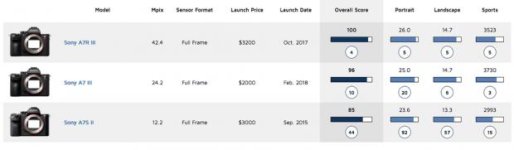
The A7RIV even comes in at 0.1 EVs above the A7RIII:

Screen Shot 2020-09-25 at 4.25.04 PM.jpg

Might be hard to read - the A7RIII and A7III are tied in DR and the A7SII is 1.4 stops behind
 
There are types of read noise that scale up as the pixel pitch scales up.

I mean - what you say makes sense to me, but it's not borne out by observation.

The A7RIV even comes in at 0.1 EVs above the A7RIII:

View attachment 140609

Might be hard to read - the A7RIII and A7III are tied in DR and the A7SII is 1.4 stops behind

Sorry, I am tired man. I have gone toe to toe with you on almost all of your posts the last week, and this one is a bit too much. I mean, we aren't even arguing subjective things here. I have no idea what you are trying to argue. You've already said that smaller pixels are more difficult to get a clean signal. or something to that effect.

The A7sIII is cleaner on the pixel level than the A7RIII, otherwise, the higher megapixel camera would have been the clear winner... why? because neither camera is completely noiseless, so eventually the resolution would have helped the A7RIII jump to the lead. BUT... it didn't, instead, it tied with a 12MP camera.

Comparing an A7R and an A7S is one thing, but try comparing an A7SIII with a 2/3" 100MP cellphone sensor.... how much of that noise is going to be cleaned up with tech that exists in cameras today?


So, I really have no idea why we are even having this discussion. You can keep going on with circumstantial and hypothetical facts that don't really make the case for 1" 100MP sensors yet. Maybe in the future, but not yet. I'm sure the forum is tired of us turning every thread into a debate about who said what meaning why. Most of the time we aren't even really disagreeing or have any conflict in our views. Sometimes it is just semantics, or arguing to argue. Or who knows what.
 
Last edited:
I mean, I think there is a limit to how much you can shrink the pixel pitch without deleterious effect, but I don't know what it is.

From Lensrentals:

"You might think the effects of pixel size on dynamic range should be similar to that of noise, discussed above. However, dynamic range seems to be the area where manufacturers are making the greatest strides – at least with reasonably sized pixels. When measured at ideal ISO (ISO 200 for most cameras) dynamic range varies more by how recently the camera was produced than by how large the pixels are (at least until the pixels get quite small). If you look at DxO Mark’s data for sensor dynamic range the cameras with the best dynamic range are basically newer cameras, not those with the largest pixels.

There is no simple formula for calculating the effect of pixel size on dynamic range, but in general both large and medium size pixel sensors do well at low ISOs, but dynamic range falls more dramatically at higher ISOs for smaller pixels."

Now, is there a caveat that the newest cameras with the largest pixels have the highest DR (at low ISOs, not high ones which is already proven)? Let's find out...

PS missed my A7SIII delivery signature. Tomorrow will be the blessed new arrival
 
No one is disagreeing with that lens rental article.


Congrats on the camera purchase.
 
Oh I get it now... you are arguing strictly about cellphone imagers. I am tired as well. I was debating more abstractly.

I don't think it's a fair fight given the rest of the architecture that pro cameras have around the sensor. And also, based on the lensrental article, one might think that at high light levels, the tiny pixels would do fine.

If there's an actual physical limit to how much you can shrink the photosite before DR or other qualities suffer, maybe one of the science-inclined guys knows what it is.

Incidentally, the edge of the visible spectrum has a wavelength of .7 micrometers. In September of last year, Samsung introduced a phone with the then-smallest pixel pitch on a sensor - .7 micrometers. I wonder if that figure is related, I wonder if that's the lower bound, and I wonder if performance suffers near the lower bound.

The recent 108MP sensors seem to have 1 micrometer photosites.
 
Dude...what's wrong with you? lol

I'd be waiting outside!

i was on a shoot lol. anyway daddy life is so busy (im burping a baby right now) that i probably wont even get to acquaint myself adequately before my next shoot
 
ha, fair enough...you could most likely pick it up tonight at the shipping location if you wanted to/could.

(That's what I do if I ever rarely miss a package.)
 
Oh I get it now... you are arguing strictly about cellphone imagers.
Actually, I didn't mention cellphones at all in this thread. I was talking generally about small sensors with triple digit megapixel counts. More specifically in cameras like the XC10 or RX10.

If there's an actual physical limit to how much you can shrink the photosite before DR or other qualities suffer, maybe one of the science-inclined guys knows what it is.

Incidentally, the edge of the visible spectrum has a wavelength of .7 micrometers. In September of last year, Samsung introduced a phone with the then-smallest pixel pitch on a sensor - .7 micrometers. I wonder if that figure is related, I wonder if that's the lower bound, and I wonder if performance suffers near the lower bound.

The recent 108MP sensors seem to have 1 micrometer photosites.

Very interesting stuff. I was not aware they have met that sort of threshold. Maybe now they can focus on dynamic range? I assume they technically can make the pixels even smaller, but wonder what kind of data they are able to record? ultra violet? haha.
 
Back
Top