GH3 Fast zoom lens for the GH3 needed for my 1st wedding video... Olympus 14-54mm?

Another Leica 14-50/2.8-3.5 devotee here... I'd planned to sell mine after buying the 12-35, but found I usually needed that extra 15mm more than that extra third-stop on the longest end.

Autofocusing only works in the legal defenition of the term, not in anything approaching true usability... which isn't bad, because it's delightfully easy to focus manually.

Do you have the 14-50 Leica on the GH3? My question to you would be about the lens stabilization... how good is it on the GH3?
 
I mostly use it on AF100 and sometimes GH2. OIS is steady on both.

Might be able to try it on a GH3 in a few weeks (not that that helps anyone right now)
 
I see now that the Leica 14-50 goes around for about 1000 bucks. That's too high for me atm unfortunately.

What do you guys think of the Olympus 14-54 mm? More in my price range :(
 
Considering your circumstances (1st wedding, fast zoom, budget) the 14-54 is probably the best option for you, but of course, not THE best option. Between my 2nd shooter and I, we use about 11 lenses throughout the day. I got the 14-54 as a cheap option for the groom "getting ready" footage that my 2nd shooter gets. Now that we have two 25mm lenses, the 14-54 is even more limited in where I use it, even though, on paper, it seems like a great choice. It's a lens I expected to get a lot of mileage out of, but if you're going for "cinematic", a contemporary lens (Pansonic/Olympus that is) isn't going to cut it...I also have the Panasonic 35-100 and Canon FD 50mm. The 35-100 is superb and will use it as much as I can. but it does lack the filmic look Canon FDs offer which I've come to re-appreciate after coming from the Panasonic. The Olympus 14-54, to my eye, also lacks this filmic quality. This is super subjective so I don't mean to stir the pot with anyone, it's just my opinion. If you're disregarding the comment earlier about taking on a camcorder because you want a filmic look, the Olympus 14-54 won't give it to you (again, my opinion).

I do think the 14-54 is a lens you have to see for yourself (I did). A couple things if you do decide on it, please, don't make the same mistake that I and many others have in thinking "yes, the AF is slow, but maybe I can still use it." You can't. It's too slow for wedding videography, and it doesn't track focus. I could almost guarantee you will find yourself manual focusing within a couple minutes of use in the field. Even for photos, I'd rather MF as I would be faster at getting the shot even if I may not nail focus. The AF for photos is I guess usable for subjects who are posing for you. But that is it.

I forgot to mention I have the mark i of the lens. From what I gathered, the more expensive mk ii would AFS, but not AFC. Optically, they were about identical. May I ask what the rest of your lens lineup is?
 
Last edited:
Considering your circumstances (1st wedding, fast zoom, budget) the 14-54 is probably the best option for you, but of course, not THE best option. Between my 2nd shooter and I, we use about 11 lenses throughout the day. I got the 14-54 as a cheap option for the groom "getting ready" footage that my 2nd shooter gets. Now that we have two 25mm lenses, the 14-54 is even more limited in where I use it, even though, on paper, it seems like a great choice. It's a lens I expected to get a lot of mileage out of, but if you're going for "cinematic", a contemporary lens (Pansonic/Olympus that is) isn't going to cut it...I also have the Panasonic 35-100 and Canon FD 50mm. The 35-100 is superb and will use it as much as I can. but it does lack the filmic look Canon FDs offer which I've come to re-appreciate after coming from the Panasonic. The Olympus 14-54, to my eye, also lacks this filmic quality. This is super subjective so I don't mean to stir the pot with anyone, it's just my opinion. If you're disregarding the comment earlier about taking on a camcorder because you want a filmic look, the Olympus 14-54 won't give it to you (again, my opinion).

I do think the 14-54 is a lens you have to see for yourself (I did). A couple things if you do decide on it, please, don't make the same mistake that I and many others have in thinking "yes, the AF is slow, but maybe I can still use it." You can't. It's too slow for wedding videography, and it doesn't track focus. I could almost guarantee you will find yourself manual focusing within a couple minutes of use in the field. Even for photos, I'd rather MF as I would be faster at getting the shot even if I may not nail focus. The AF for photos is I guess usable for subjects who are posing for you. But that is it.

I forgot to mention I have the mark i of the lens. From what I gathered, the more expensive mk ii would AFS, but not AFC. Optically, they were about identical. May I ask what the rest of your lens lineup is?


Thanks for the big reply.

I currently own 3 primes.

Panny 14mm 2.5 / Panny 20mm 1.7 / Oly 45mm 1.8
You might be right about modern lenses not looking as 'cinematic', but I just recently finished this short film, shot with this setup:
https://vimeo.com/59543338

One could argue that this looks pretty 'cinematic' or 'filmic'. Depends a lot on color grading too. I would settle for this look, but I don't want the hassle of working with primes in an 'uncontrolled' shoot.
Good point you're making about the unusable autofocus though. If I end up going manual focus all the time, there's no need to buy a more expensive lens that's unusuable in that way and I might look at an old all manual zoom lens... Just dunno what yet :)
 
I see now that the Leica 14-50 goes around for about 1000 bucks. That's too high for me atm unfortunately.
Check out the Panasonic Digital section on KEH. They currently have a Leicasonic in EX+ condition, on sale for $479.
 
For manual, one can look at Tamron 17-50/2.8 non VC, no image stabilization nor apperture ring, so u need an adapter WITH an option to controll apperture, but some people claim the lens is parfocal, which is good. And it is probably the cheapest 2.8 for APC coverage.
 
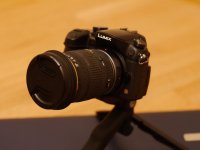
Stab - I have a Sigma 18-50 constant f2.8 for 4/3, with the Panasonic MA-1A adapter (about 100€). This combination works wonderfully with my GH3. Here is a picture of it on the GH3:

P1120072.jpg


Autofocus is a little slow by modern standards, but it is workable. Just did a side-by-side with the 12-35 and it competes very well. You can find these on eBay sometimes at good prices. Here is one in Duitsland via eBay NL for 379€.

No OIS, but you don't need it at the wide end.

Hope this is helpful,

Bill
 
You might be able to find a good 12-60 too! I use it on the E-System and love it, really good range... Will be compatible on micro 4/3 with the adapter.
 
You already own a set of decent primes so I would argue that buying a second body (probably a GH2) would be the better option. I can't imagine covering something like a wedding with one camera, that would scare the hell out of me.
 
You already own a set of decent primes so I would argue that buying a second body (probably a GH2) would be the better option. I can't imagine covering something like a wedding with one camera, that would scare the hell out of me.

I'm not a wedding shooter, but I shot one recently as a favor for a well known actor's sister in law. I used 5 cameras to cover the event. There is no way in hell I could have done it with a single camera, zoom or not!
 
I'm not a wedding shooter, but I shot one recently as a favor for a well known actor's sister in law. I used 5 cameras to cover the event. There is no way in hell I could have done it with a single camera, zoom or not!

Agree with this 100%

Like I said before what the OP wants just doesn't exist or isn't really intended to be used in the way he wants. Weddings are difficult enough to shoot without adding to the complexity. It is so easy to miss certain details that having a camera like a DSLR just enhances the possibility of missing even more. These are not controlled environments where you can tell people to wait. DSLR's can be amazing tools for weddings but you have to take in certain considerations to use them in those environments.

This is why I brought up getting a small low light sensitive video camera to use as a second camera. There are some amazing Panasonic video cameras for the price of the 14-140 zoom lens that spank that lens in low light shooting. They are have much better auto focus and power zoom. Just having a zoom lens doesn't always solve the situation. Manually zooming while shooting live can be a pain without a tripod to look decent. It can be done of course but it is much harder and takes more attention. Again a situation where you could potentially miss something. These small video cameras which are about the size of the 14-140 as well typically have a much broader zoom range as well which it virtually unheard of on a DSLR lens.

The fact is if you want a fast zoom you basically have two options each costing over $1,000.00. Even with those lenses you will have to swap lenses and can only zoom by twisting the zoom ring on the lens manually. Not exactly optimal for live shooting.

Can it be done? Of course but it takes a lot more effort with a lot more potential for error. This is where multiple cameras come in. A lot of amazing DSLR weddings are shot by more then one person with more then one camera. It tends to be the most and sometimes only practical way to get the job done. I'm sure there is somebody out there who does do it themselves with a single camera and that's great for them if they can handle the stress of doing it that way. In my experience a bride isn't going to give a darn about a bigger sensor if you miss the stuff important to her. It is the moments and guests important to her not depth of field and swapping lenses.

By adding a video camera you have a tool set with a wide range of practical uses. If you need to shoot a stage production you will be glad to have the power zoom with long reach. Need to shoot from the balcony at a church? The video camera will actually allow you to do that. No zoom lens is going to allow you to do this with stabilization, quick auto focus and power zooming. What you loose in depth of field control you make up for with sanity and happy brides.

Don't believe us talk to Jeff Harper at DVInfo. Long time GH1 and then GH2 user who shoots weddings. Finally bought a video camera to add to his five camera army of DSLR's he uses on every wedding by himself and he loves it. He bought a good 1/3" video camera which he says has been just as good in low light than all but his fastest primes. Jeff even considers f2.8 too dark for weddings so for him to be impressed with the low light on a video camera is saying something.
 
Thanks for the replies people. I forgot to mention that we will shoot the wedding with 2 people and that we are going to use 3 camera's (all DSLR'S).

I have done a lot of event shooting and even the 'party' of a wedding before with a 60D (no autofocus) so I know what I'm getting myself into and I know that I can pull it off. I'm not willing to sacrifice depth of field at the moment for an easier work flow, simple as that. I want it to look 'cinematic'.

Having said that, we will put up 1 of the camera's in deep focus at main positions during the day so we will capture everything for sure at least once. Then, me and the other guy will do some planned shots (visiting the location before) and do walking-around shots. The advantage of a DSLR is that we can also immediately take pictures when people ask for it.

Let's see how it goes and if I get back from this after :)
 
I had the Oly 14-54 you mentioned. Sold it because it was too noisy. When you focus or zoom there is a meter in the lens which clicks. If you have a mic mounted near the camera, it gets on the audio track nearly every time. I replaced it with the 14-50 that lpowel mentioned and I've been pleased with that lens though of course it's not perfect.
 
I'm not willing to sacrifice depth of field at the moment for an easier work flow, simple as that. I want it to look 'cinematic'.

OK great, but let me play devils advocate here.... You want shallow depth of field, You want it to look cinematic. Is that what the wedding couple wants? Remember you are not shooting a feature film. There are no second third or forth takes. If you miss a focus pull trying to be cinema movie guy you can't go back and do the wedding over. Let me also say that the majority of the paying wedding clients out there just want you to capture their wedding event and provide a professional product. The only people who care about all this shallow depth of field cine looking hogwash are the people who frequent these forums.

All the best!

Dave

Thanks Dave, you are right in most aspects. Customers don't want depth of field, they want beautiful images of all their important 'actions' that day.

Of course there is a difference between shooting F1.2 with a 5D and just minimal play with focus as we are planning to do. I'm not going to rack focus on the important parts so I might miss putting the ring on the finger.
In essence I agree with your points and I will be careful. I just try to find the balance between 'cinematic' and 'practical' :)
 
Thanks for the replies people. I forgot to mention that we will shoot the wedding with 2 people and that we are going to use 3 camera's (all DSLR'S).

I have done a lot of event shooting and even the 'party' of a wedding before with a 60D (no autofocus) so I know what I'm getting myself into and I know that I can pull it off. I'm not willing to sacrifice depth of field at the moment for an easier work flow, simple as that. I want it to look 'cinematic'.

Having said that, we will put up 1 of the camera's in deep focus at main positions during the day so we will capture everything for sure at least once. Then, me and the other guy will do some planned shots (visiting the location before) and do walking-around shots. The advantage of a DSLR is that we can also immediately take pictures when people ask for it.

Let's see how it goes and if I get back from this after :)

I do agree with you and completely see your point. My point however was not to replace using DSLR's but to enhance what you can do by adding one video camera into your toolset. Regardless if you use two or three DSLR's that are certain types of shots you just cannot get without moving around a lot. Many wedding venues will not let you move at all and will stick you in the back of the church. Swapping to a zoom lens is about as fast as grabbing a small video camera to get the shot. By all means use the DSLR's as much as humanly possible but having at least the option of moving to a video camera when it calls for it could not only make your life easier but make you stand out from wedding videographers who are not able to get those shots because they also insist on not using a video camera. Both cameras have their practical uses and it is important to learn when and where they should be used. Learning to embrace both will expand what you are able to cover and not limit what you can do creatively because you force yourself to only use one type of tool.

I would also argue that depth of field has little to do with cinematic and has become a crutch of creativity. Too many people feel their video is instantly cinematic just because of depth of field and that is not true at all. Yes having the option is important to tell a story but it should not be your only option.

Do you plan on zooming while shooting? This typically is a bit of a challenge with DSLR's. It can be done but it can also sometimes lead to jerky zooms which a lot of people don't like.

Not trying to sell you a video camera or anything. Just trying to point out that the best most practical and effective zoom lens for a DSLR is a video camera at your side. I used a hybrid shooting approach and recently sold my video camera which I now regret. I don't also do a lot of video work anymore that uses zooms but when I do need it I find myself really wishing I still had one to use when the situation calls for one. I realize there are some situations where you just cannot pound a nail into a piece of wood with a screwdriver.

Have you also considered using a slower lens like the 14-140 and using a video light on camera? I paid for college by shooting weddings and we always insisted on using an on camera light. Back then that required massive 18lb battery belts but no matter how good our 1/2" cameras were in low light we found it helped produce much more vibrant color and details. The competition always asked us why our stuff looked better and our single answer was lights. Of the 300+ weddings I shot back then we never had a single client complain about the lights. If you insist on only using DSLR's this is the next best thing I can think of without having to resort to swapping lenses all the time.
 
Again, really trying to consider your circumstances and budget, one thing that has killed me with two shooters is not having near-identical focal lengths. For example, during the ceremony, you will hate if the camera on the groom has a tight shot while the bride is somewhat wide. For example, what has been ideal for me is having the 14-140 on the groom
(light permitting, otherwise switch to 85mm f/1.2) while I cover the bride with the 35-100. Similar, but different. I like how the 14-140 can snag a wide angle shot and get more reach so my 2nd shooter can shoot more safely and surely. While I would be more aggressive if the 100mm was still too far. With the lenses you already have, that can get plenty done during the reception and "getting ready". It's the ceremony where I see the possible weakness. After reading everything, I'd suggest bring your primes, get a 50mm f/1.4, to match your 45mm somewhat which to me, is a workhorse focal length range, it can be tight of course, but love it anyway. I'd also suggest the Panasonic or Olympus 40-150. And perhaps the sigma 30mm f/2.8 (1st gen, $100) to somewhat compliment your 20mm. I think you'd still have some money left over for a first-gen 14-54+adapter. I think you have been getting a lot of great and humble advice from others here which is rare, but also consider, this is your 1st wedding and it could be somewhat foolish if you over-invest in something you may or may not continue. Let us know what you decide though and also how the shoot goes. All the best.
 
Back
Top