F5/F55 Sensor resolution and bayer pattern

I can confirm that both the F5 and F55 utilize traditional Bayer pattern CFAs and traditional Bayer pattern orientation.

Thanks, Mitch, for clearing that up. It seemed a bit confusing that Sony might advertise a 8.9MP 4k sensor to be anything but bayer CFA. Doesn't seem like there would be many other options as most alternative CFA patterns in use seem to require additional photosites to arrive at anything that might purport to be marketable as "4k".

And thanks for the great presentation on IR+NDs at the AbelCine EXPO last week.
 
Thanks, Mitch, for clearing that up. It seemed a bit confusing that Sony might advertise a 8.9MP 4k sensor to be anything but bayer CFA. Doesn't seem like there would be many other options as most alternative CFA patterns in use seem to require additional photosites to arrive at anything that might purport to be marketable as "4k".

Yes indeed. If the F65 uses 17.6 million photo sites in Q67 configuration for 4k, not sure why anyone would think the F55 could do it in 8.9 million. But I think when Sony says "effective" you could interpret that to mean many things but as someone pointed out, Sony would market the largest number possible not just the number that became effective after processing.

Anyway glad its all clear now.

It certainly makes me wonder what the heck it means when Sony says the F65 will have an 8K raw recording mode... they said that. right?
 
Thanks, Mitch, for clearing that up. It seemed a bit confusing that Sony might advertise a 8.9MP 4k sensor to be anything but bayer CFA. Doesn't seem like there would be many other options as most alternative CFA patterns in use seem to require additional photosites to arrive at anything that might purport to be marketable as "4k".

And thanks for the great presentation on IR+NDs at the AbelCine EXPO last week.

Yes indeed. If the F65 uses 17.6 million photo sites in Q67 configuration for 4k, not sure why anyone would think the F55 could do it in 8.9 million. But I think when Sony says "effective" you could interpret that to mean many things but as someone pointed out, Sony would market the largest number possible not just the number that became effective after processing.

Anyway glad its all clear now.

I was away on Thanksgiving, so sorry for the late reply.

But there is some semantic issues that we seem to be talking in circles for this thread.

The most apparent is the term "effective resolution". The effective resolution is the EFFECTIVE OUTPUT resolution you are going to get out of the camera. For the F5/F55 it will be 4096x2160=8.85MPs=4K. Sony is obviously advertising this as that is the resolution that is being outputed along with their new XAVC codec. The GROSS resolution (or total pixel resolution) of the sensor is 11.6MPs. The output resolution does not mean that the sensor is ONLY taking a 4096x2160 area of the sensor.

All too frequently, in marketing material as well as how product reviews and advertisements; gross pixel, active pixel, and effective pixel are confused and used interchangeability. This sort of technical semantics has never been a problem for dSLRs, as effective pixels always equalled active pixels which in turn always equalled output resolution. This is not the case with video cameras and most recently FOVEON sensors. For Sigma SD1 with the foveon sensor, the effective resolution of the camera is 14.7MPs, the active pixel area is thrice that (as it has three layers), which is around 44MPs (gross pixels is near 46MPs).

So for the F65, the gross pixel area is 20.4MP, the effective resolution is 17.6MP in F65RAW, its effective resolution is 4K when outputting in SR Codec. The active pixel area we should assume is near 20MPs. As the double-bayer "Q67" uses a combination of pixel-binning of adjacent photosites and interpolation, 4K does not necessarily need to be 17.6MPs, it just won't have 66.6% of RGB data. As evidence of this, The F65 can also output 6K/8K resolutions. The idea that double-bayer MUST be 17.6Mp for 4K resolution is wrong.


If the F5/F55 is bayer, and I would trust the words of Mitch Gross, then it should be as I said above where the camera should have an active pixel area near ~11.6MP even though its outputting an EFFECTIVE 8.85MPs; which should be around a 24% overscan to compensate for the debaying penalty. This is consistent with how the Sony F3 operates, and consistent given the fact that this is a four-figure camera.

Now, IF Sony is only capturing a 4096x2160 window out of a 11MP sensor it would mean this camera is HORRIBLY designed. Given these cameras should cost between a used and new compact car, and is not a dSLR, this sort of short cut is unacceptable, especially as the F55 is a custom-designed sensor (as the global-shutter requires pixel-level memory on each photosite). And again, as the F55 is a global shutter sensor, it should capture the entire frame, the sensor is clearly fast enough to do that. I don't think this to be the case given Sony is very competitive and ahead of the game in this field; I'll tell you that as an engineer that does this for a living.
 
So for the F65, the gross pixel area is 20.4MP, the effective resolution is 17.6MP in F65RAW, its effective resolution is 4K when outputting in SR Codec. The active pixel area we should assume is near 20MPs. As the double-bayer "Q67" uses a combination of pixel-binning of adjacent photosites and interpolation, 4K does not necessarily need to be 17.6MPs, it just won't have 66.6% of RGB data. As evidence of this, The F65 can also output 6K/8K resolutions. The idea that double-bayer MUST be 17.6Mp for 4K resolution is wrong.
The F65 doesn't quite fit 4K/6K/8K terms. Sony lists the effective resolution at 8192x2160. That's an aspect ratio of 3.9/1!

What they are doing is funny math with stair stepping. That's counting two vertical lines as though they were one. http://camerarentalz.com/sony-f65-6k-sensor/

Cheers.
 
The F65 doesn't quite fit 4K/6K/8K terms. Sony lists the effective resolution at 8192x2160. That's an aspect ratio of 3.9/1!

What they are doing is funny math with stair stepping. That's counting two vertical lines as though they were one. http://camerarentalz.com/sony-f65-6k-sensor/

Cheers.

It really doesn't fit in within normal bayer terms. Especially when you calculate it within ridiculous horizontal resolution terms.

The aspect ratio isn't really 3.9:1 as its rotated 45 degrees on the axis. It really doesn't fit in within the X & Y axis system of measurement. Even though Sony likes to officially call this a "double-bayer" it really doesn't function at all like a normal bayer filter in how it interpolates its photosites. Even while the camera can produce 6K/8K video via vertical interpolation, to Sony, the F65 is effectively a 4K camera.
 
I was away on Thanksgiving, so sorry for the late reply.

But there is some semantic issues that we seem to be talking in circles for this thread.

The most apparent is the term "effective resolution". The effective resolution is the EFFECTIVE OUTPUT resolution you are going to get out of the camera. For the F5/F55 it will be 4096x2160=8.85MPs=4K. Sony is obviously advertising this as that is the resolution that is being outputed along with their new XAVC codec. The GROSS resolution (or total pixel resolution) of the sensor is 11.6MPs. The output resolution does not mean that the sensor is ONLY taking a 4096x2160 area of the sensor.

...

If the F5/F55 is bayer, and I would trust the words of Mitch Gross, then it should be as I said above where the camera should have an active pixel area near ~11.6MP even though its outputting an EFFECTIVE 8.85MPs; which should be around a 24% overscan to compensate for the debaying penalty. This is consistent with how the Sony F3 operates, and consistent given the fact that this is a four-figure camera.

Now, IF Sony is only capturing a 4096x2160 window out of a 11MP sensor it would mean this camera is HORRIBLY designed. Given these cameras should cost between a used and new compact car, and is not a dSLR, this sort of short cut is unacceptable, especially as the F55 is a custom-designed sensor (as the global-shutter requires pixel-level memory on each photosite). And again, as the F55 is a global shutter sensor, it should capture the entire frame, the sensor is clearly fast enough to do that. I don't think this to be the case given Sony is very competitive and ahead of the game in this field; I'll tell you that as an engineer that does this for a living.

No, effective pixels pretty much always means its only originating from that many photosites. If you can find any case where that is not true in marketing or in spec sheets, I'd be interested to see it.

What's important is that its 8.9MP in an S35 DCI 1.9:1 sensor area, if there is additional sensor area that is unused outside that it doesn't matter to the end user. It's not horribly designed, many cameras do that. Perhaps it has lookaround or is designed to support other aspect ratios in the future.

I think you will be quite disappointed if you are expecting that Sony somehow managed to downsample 11.6MP RAW bayer data to a 8.9MP 4k RAW bayer recording...
 
I never heard that, but not to say Sony never said that.

Perhaps news outlets were misinformed, but I have seen mention of new firmwares enabling up to 8kx4k recording in the F65:

http://www.studiodaily.com/2012/10/sony-details-f65-roadmap-heading-into-2013/

Can't immediately find anything about it directly from Sony, though. Still wondering how they are getting that, maybe every other line gets counted both as a horizontal and vertical line. I understand that they are calling it 8k by pretending every two rows are one row since they are offset slightly by the stair-stepping orientation, but not sure where they'd also get a 4k image height unless they were doing the same with the columns. In either case, its still a ton of resolution, though I'd be interested to see more details about how they are packaging it in 4k and 8k RAW formats since most RAW formats are designed around standard bayer patterns.
 
I was at that briefing mentioned in the Studio Daily article and can confirm that is exactly what was stated.

Ned
 
So to summarize:

- Both the F5 and F55 use a traditional bayer pattern sensor and are 11.6MP (8.9MP effective) 4096x2160

- Their TRUE resolution is something less than the simple count of sensor photosites due to debayering process, and therefore they are not TRUE 4k.

- The F55 employs a color filter using the same color dyes as found on the F65 for an extended color gamut exceeding that of film.

- The F5 uses a color filter designed for the REC709 standard.

- The design of the Q67 sensor pattern (used in the F65) allows for a much higher pixel density within the same surface area. ie. 20 million photosites versus 11.6 million. The result allows FULL 4k resolution of the green channel and twice as much precision for blue and red. Sony claims this will deliver higher LP/mm or TVl/ph over traditional means.

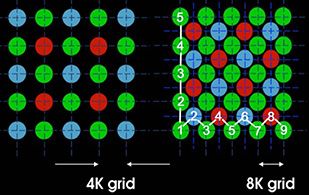
- From Sony's website, the term 8k comes from "an 8k grid" that is created when you look at the first two rows of horizontal photosites. The second row being offset slightly from the first row, also viewed as being 45 degrees off angle to the previous row's photosites.

Sony-F65-Sensor-650x419.jpg


- 8k RAW makes sense since there are more photosites of data to record, but don't confuse this with 8k resolution which at the same time Sony is saying the F65 will deliver true 4k resolution. 4k resolution with 8k RAW data from Q67 sensor, same as 3.2k'ish resolution with 4k RAW data from bayer sensor.
 
No, effective pixels pretty much always means its only originating from that many photosites. If you can find any case where that is not true in marketing or in spec sheets, I'd be interested to see it.

What's important is that its 8.9MP in an S35 DCI 1.9:1 sensor area, if there is additional sensor area that is unused outside that it doesn't matter to the end user. It's not horribly designed, many cameras do that. Perhaps it has lookaround or is designed to support other aspect ratios in the future.

I think you will be quite disappointed if you are expecting that Sony somehow managed to downsample 11.6MP RAW bayer data to a 8.9MP 4k RAW bayer recording...

"Effective" resolution is always the resolution you "effectively" get out of the camera. Its exactly as the word means. Here are some examples: Here is one example, here is another.

......but I'll do you one better.


I'll show you how inconsistent that "effective resolution" is relative to the topic at-hand. The Sony F65.


http://pro.sony.com/bbsccms/assets/files/cat/camcineprod/latest/Sony_SMPTE_NY_F65_March_20120314.pdf
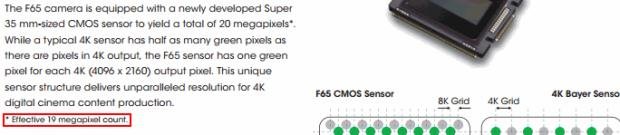
First we have a very detailed and technical Sony presentation claiming "effecitve pixels" is 20Mpixels.
F65_effective.png


http://pro.sony-asia.com/product/resources/en_BA/images/Brochure/BCAP/F65RS_brochure.pdf


Then we have another offficial Sony brochure saying that the effective pixel count is 19 megapixel

F65_effective2.jpg


http://pro.sony-asia.com/product/resources/en_BA/images/Brochure/BCAP/F65RS_brochure.pdf


Then we have yet another Sony hosted whitepaper saying that the effective resolution is 18.7MP

F65_effective3.png


http://pro.sony.com/bbsccms/assets/...FDTimes_F65_FS700_Report_4-2012-RGB_LoRez.pdf


F65_effective4.png


Yet again, we have 17.7MPs, which Sony never calls "effective", but has been been cited on this thread as well as ProVideoCoalition.
http://provideocoalition.com/index.php/awilt/story/quick_look_sony_f65_4k_digital_cine_camera/

http://image-sensors-world.blogspot.com/2010/12/sony-cinealta-moves-beyond-bayer.html


ALL from Sony. Different "effective resolutions" for the same camera. Mind you, this is not a camera that has a lot published on it.
 
Last edited:
So to summarize:

- Both the F5 and F55 use a traditional bayer pattern sensor and are 11.6MP (8.9MP effective) 4096x2160

- Their TRUE resolution is something less than the simple count of sensor photosites due to debayering process, and therefore they are not TRUE 4k.

- The F55 employs a color filter using the same color dyes as found on the F65 for an extended color gamut exceeding that of film.

- The F5 uses a color filter designed for the REC709 standard.

- The design of the Q67 sensor pattern (used in the F65) allows for a much higher pixel density within the same surface area. ie. 20 million photosites versus 11.6 million. The result allows FULL 4k resolution of the green channel and twice as much precision for blue and red. Sony claims this will deliver higher LP/mm or TVl/ph over traditional means.

- From Sony's website, the term 8k comes from "an 8k grid" that is created when you look at the first two rows of horizontal photosites. The second row being offset slightly from the first row, also viewed as being 45 degrees off angle to the previous row's photosites.

Sony-F65-Sensor-650x419.jpg


- 8k RAW makes sense since there are more photosites of data to record, but don't confuse this with 8k resolution which at the same time Sony is saying the F65 will deliver true 4k resolution. 4k resolution with 8k RAW data from Q67 sensor, same as 3.2k'ish resolution with 4k RAW data from bayer sensor.

Yes and no.

According to Sony, the F55 should not be "true" 4K. Sony's definition is that it gets RGB Q67->RGB Q100 via interpolation to result in a 4K 4:4:4 image.

The F65 will not get a 3.2K resolution, it should get 4K+ resolution in bayer terms. A 4K bayer gets ~3.2K resolution because bayer is by nature Q33(if you want to use Sony lingo). You pay a penalty from not having enough photosites (something that the F65 has in abundance).
 
Last edited:
"Effective" resolution is always the resolution you "effectively" get out of the camera. Its exactly as the word means. Here are some examples: Here is one example, here is another.

Maybe I am misunderstanding your original point, but aren't you now bringing up documents to support my point? All of those references you are citing use the "effective pixels" term to describe only originating photosites as I was saying, which supports the fact that in the F5/F55 Sony are using a 8.9MP effective area of a 11.6MP sensor.

I thought your argument was that "effective" pixels did NOT relate to the actual photosite count and only to codec delivery resolution...

As for the disparate numbers on the F65, I don't doubt that throughout the camera's development there may have been different numbers thrown around in technical documents occasionally citing the full sensor area while some eventually mentioned the effective/recorded sensor area.

Those numbers are not mutually exclusive. It is quite likely that the F65 has a 20MP sensor (recorded+lookaround+blackcalibration+unused), of which 19/18.7MP are used for imaging (recorded+lookaround), and 17.7MP of which are used for actual image recording in the most common recording mode. Some of those numbers have few significant figures, 19MP is probably just 18.7 rounded up for example...
 
Full "True" 4K = 4096 x 2160 x 3 = 26.5Mp

F65:

17.7/26.5 = .67 = Sony Q67

F5/F55:

8.8/25.5 = .33 = Sony Q33

Cheers.
 
Maybe I am misunderstanding your original point, but aren't you now bringing up documents to support my point? All of those references you are citing use the "effective pixels" term to describe only originating photosites as I was saying, which supports the fact that in the F5/F55 Sony are using a 8.9MP effective area of a 11.6MP sensor.

I thought your argument was that "effective" pixels did NOT relate to the actual photosite count and only to codec delivery resolution...

As for the disparate numbers on the F65, I don't doubt that throughout the camera's development there may have been different numbers thrown around in technical documents occasionally citing the full sensor area while some eventually mentioned the effective/recorded sensor area.

Those numbers are not mutually exclusive. It is quite likely that the F65 has a 20MP sensor (recorded+lookaround+blackcalibration+unused), of which 19/18.7MP are used for imaging (recorded+lookaround), and 17.7MP of which are used for actual image recording in the most common recording mode. Some of those numbers have few significant figures, 19MP is probably just 18.7 rounded up for example...

Please read my previous posts as I think I'm talking in circles at this point.

Effective resolution is exactly as the English language clearly communicates, its the 'effective' resolution you get from the camera. Its not necessarily referring to 'codec delivery resolution', its the effective resolution coming off the sensor that you get off the camera. In the case of F65RAW it would be 17.7MPs. If you can't get RAW then, yes, whatever codec delivery resolution is would be what you are effectively getting off the camera. Again, it is the resolution you effective get. Its very simple.

What you are describing as the the total number of photosites used to form an image is technically defined as ACTIVE PIXEL RESOLUTION.

As an example, here is the IMX021 sensor white paper (sensor used in the Nikon D90 etc), you can see that active pixel resolution, total pixel resolution, and effective pixel resolution are clearly defined and seperate specifications.
http://www.sony.net/SonyInfo/News/Press/200708/07-072E/index.html

Also, I showed the F65 'effective pixel' inconsistencies to show you how horribly defined that marketing and even technical documents are on this subject.

I'll quote myself from the previous post:

All too frequently, in marketing material as well as how product reviews and advertisements; gross pixel, active pixel, and effective pixel are confused and used interchangeability.

So to summarize my point, as you can see with the haphazard way that this term is used, even by Sony: because it says 'effective resolution' for the F5/F55 is 8.85MP it does NOT mean that the active pixel area is also 8.85MPs.


Full "True" 4K = 4096 x 2160 x 3 = 26.5Mp

F65:

17.7/26.5 = .67 = Sony Q67

F5/F55:

8.8/25.5 = .33 = Sony Q33

Cheers.

We've covered this earlier in the thread:

Sony's defintion of "true 4K" is 4:4:4 4K. To do this, they interpolate Q67->Q100. The logic is that 26.5MP makes photosites smaller harming DR, hence having zero interpolation on green pixels and interploation only on red/blue pixels resulting in f.6 of full RGB.

Also, F5/F55 would be based on 11.6MP, which would be closer to ~Q43. It would only Q33 like any other bayer sensor if its only using the exact 8.85MP area. Obviously Sony wants you to buy the F65 if you want what they consider to be "true 4K".
 
Last edited:
Full "True" 4K = 4096 x 2160 x 3 = 26.5Mp at 4.4.4

F65: 17.7/26.5 = .67 = Sony Q67 but at far greater pixel density than necessary for 4k, plus the Q67 reorientation gives twice the color resolution of a standard Bayer filter for much higher accuracy. Between the two you should have extremely close to 4.4.4 accuracy without the DR hit. I notice in the Sony white paper it seems to indicate that 1.3MP is being used for black balance, noise suppression, etc.

F5/F55: 8.8/25.5 = .33 = Sony Q33. This is where we know nothing for sure. What are the extra pixels going from 8.9 vs 11.6 being used for, oversampling? Color? Black balance? Or is really only 8.8MP being used for a 4.2.0 signal that's interpolated? Here the difference between effective (listed as 8.9 not 8.8) and actual pixes seems to be 2.7 Mp which as noted is room for a whole other 1080p image.
 
Last edited:
Yes and no.

According to Sony, the F55 should not be "true" 4K. Sony's definition is that it gets RGB Q67->RGB Q100 via interpolation to result in a 4K 4:4:4 image.

The F65 will not get a 3.2K resolution, it should get 4K+ resolution in bayer terms. A 4K bayer gets ~3.2K resolution because bayer is by nature Q33(if you want to use Sony lingo). You pay a penalty from not having enough photosites (something that the F65 has in abundance).

Actually, according to Sony no 4096x2160 bayer sensor pattern sensor can be true 4k, and the only TRUE thing about the F65 is that its GREEN is 4k, but not the RED or BLUE. So it neither is a true 4k camera - but it comes close because of supersampling it can use with so many extra photosites. Arguable it could be better than even if a sensor had dedicated photosites for each RGB...


Full "True" 4K = 4096 x 2160 x 3 = 26.5Mp

F65:

17.7/26.5 = .67 = Sony Q67

F5/F55:

8.8/25.5 = .33 = Sony Q33

Cheers.

^ This is 100% correct. And none of the F cameras are "true 4k" but the F65 does come closest.

My first post had said that neither the F5 or F55 are will resolve 4k of resolution, only approximately 3.2k and Sony themselves say that in their marketing information on the F65.

One things for sure, everyone seems to have their own idea of what 4k tends to mean.
 
Steve, at this point it is still not clear to me what you are saying, and it sounds like you may be further confusing yourself. What we care about is the number of photosites read-out to create the images that we record from the camera. There are many pixel counts, and the only one we care about is the one that is used for the recorded image area. It seems clear that in the F5/F55, that pixel count is 8.9MP, do you agree?

It sounds like you do understand that sensors often have more gross pixels which is a fairly irrelevant number for the end-user, and that specs are often given for numbers of pixels windows in that gross area that are used for imaging or and for recording. So where is the confusion? Why are you then surprised that Sony says a sensor has 11.6MP and is only using a 8.9MP portion of it to create recorded images? Clearly it is common for the area used for recording to be inside of the sensor, with outer area used for lookaround and for calibration area.

Are you talking about measured resolution or something? If so, measured how? MTF50? No manufacturer ever mentions measured resolution except RED who does not advertise it but sometimes tells people guidelines for it which often confuse people since there are many ways to measure resolution and most people have nothing to compare it to since no other manufacturer ever talks about measured resolution for good reason.
 
One sensor with only 8.9Mp can resolve over 2000 tvl/ph, but with heavy aliasing/moire artifacts.
Sensor with over 27Mp can resolve over 2000 tvl/ph with no aliasing/moire artifacts.
 
Back
Top