F5/F55 Sensor resolution and bayer pattern

Duke M.

Veteran
There has been some debate here about the ultimate resolution of the F5 and F55 along with the bayer pattern and its effects.

Alister Chapman is one of the guys who is generally in the know on Sony products and had this to say:

"The [F5] sensor size and pixel count matches that of the FS700′s sensor. It’s not entirely clear what the pattern on the F5 is, but is most likely bayer. The F55 is said to use the same pattern as the F65 which is Q67."

He also said:

"Both the F5 and F55 share the same body and I suspect most of the innards are the same (we do know the sensors are different)."


Per Abel Cine:

"Sony notes that the F55 sensor shares the same CFA as its big brother, the F65. Some people may confuse this to mean that the F55 shares the same sensor as the F65, but that is not the case." It shares the same color filter array. Both the F55 and F65 have a color gamut bigger than film.

"The sensor on the F55 is a CMOS Global Shutter, which requires a driver at every single photosite. The driver takes up some of the space that would be devoted to gathering light, lowering the Fill Factor so that the sensor is now rated at 1250 ISO." The F5 has a rolling CMOS shutter and is rated at 2000 ISO.
 
The released specs which say the pattern is bayer on both the F5 and F55 with a pixel resolution of 4096 x 2160, and effectively 8.9MP. What I had posted somewhere was that neither of these cameras will resolve 4000 lines of resolution and was challenged on that assessment.

In my other post I indicated that the RED EPIC and Scarlet both share the same 5120 x 2700 pixel bayer sensor which is 14MP total but the Scarlet can only shoot 24fps at 4k while the EPIC can shoot in 5k at 24fps or even higher frame rates. As a result the Scarlet resolves around 3200 lines of resolution while the EPIC is approximately 4000.

If the RED at 14MP is getting around 4000 lines of resolution (again a 5120 x 2700 pixel sensor) it becomes easier to see that the F5/F55 with 4096 x 2160 (only effective 8.9MP) is going to be hard pressed to deliver true 4k resolution and it will probably be closer along the lines of 3.2k.

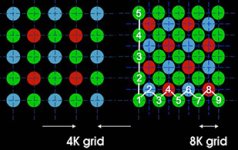
The F65 initially called an "8k sensor" was "sort-of" a lie. It did not have 8000 pixels in a direct horizontal path, they zig-zaged horizontally as photosites were placed off-horizontal path to pack more of them in a 35mm sized sensor. The pixel count on the F65 is 17.6MP but horizontally has around 6000 pixels and vertically 3000. If measured diagonally the sensor had 8000, but then you'd have to re-measure all other sensors and compare them this way by taking the square of each side, adding them together, then taking the square root of the result.

Sony-F65-Sensor-650x419.jpg

The new RED Dragon sensor will be around 6000 x 3160 (18.9MP) and marketed as a "6k" sensor but again, it does not mean it will deliver 6000 lines of resolution. It will however deliver 4000 lines really really well and likely exceed that to some degree.

By the way I'm not bashing the F cameras, I'm just saying that from all the "4k" cameras available only a select few like F65, EPIC 5k will deliver true 4k resolution. The terms 4k are used interchangebly between pixel count and resolution so I wanted to highlight the facts.
 
Last edited:
Dennis, I wasn't talking about the Epic or Scarlet and I do understand you're sold on the new Red cameras, but you're trying to compare apples to oranges.

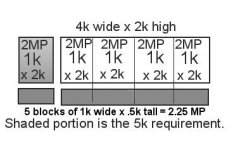
The Epic is 14 effective MP, but... MP contains height and width. Increasing the width from 4k to 5k doesn't just require 25% more pixels because of the height factor.

For example going from 2k to 4k doesn't double the number of pixels it more than quadruples it. Therefore, adding 25% more width to get 5k will require 25% + 25% + 12.5% more pixels. Comparison wise that puts the Epic equivalent 4.25 MP higher (about 9.75MP) to measure the same resolution because we're measuring lines not pixels.

5K-Pixels2.jpg

Then on top of that it's a non-debayered sensor so it needs ~20% more MP anyway. 9.75 x .8 = 7.8 MP equivalent Epic resolution. I don't doubt that someone has measured the Epic at near 4000 lines. (Although I have found Red Fanbois measurements questionable in the past just as Red's assessment of DR has included unusable DR.) That doesn't mean the F55 isn't in the same ball park.

Therefore, I think its far better to see some actual resolution results from the F55 before you try to convince everyone how much better the Epic is. The results may surprise you. (And the Scarlet isn't even worth comparing.)

And its really not a resolution contest. Resolution doesn't impart emotion or tell stories. That's what its all about isn't it, imparting emotion and telling stories, isn't it? Those require color, feel, depth, etc. That makes color gamut, organic rounding, etc more important.
 
Last edited:
Hopefully my post isn't misinterpreted. I am the first to discuss pros and cons of any camera, I am not a fan of RED any more or less than I am of Sony. (I can tell you what I think of BMCC however). I own the F3, bought a RED Scarlet recently and actually sold it before receiving it and will move over to either the F5, F55 or EPIC in the New Year.

I like to pixel-peek and analyze specs of different cameras but in the end I pick the tool that does the job for me. I could care less about resolution, but I speculated that neither F5/F55 will deliver 4000 lines of resolution and gave reasons why since somewhere someone made it sound like the RED Scarlet could "only" deliver 3.2k - but reality is that will be all we should expect from F5/F55 as well. The EPIC (5k camera) will deliver 4k and I brought it up as a point of reference to show how it delivers it through more horizontal and vertical pixels.

At the end of the day a sensor with only 4000 wide and 2000 pixels tall can not resolve lines equal to one of the sensors widths without serious aliasing issues. Sampling theories suggest having at least a 2.5 times sampling frequency rate so it would mean a lot of pixels to resolve a line afterwards... Another rule of thumb suggests to multiply the largest length in pixels by 0.83 to give you idea of actual sensor resolution.
 
Last edited:
The terms 4k are used interchangebly between pixel count and resolution so I wanted to highlight the facts.
Depending on where you're coming from, there is a very small difference there... For example, Phase One recently released v7 of their high-end raw converter and it's now capable of resolving details down to a pixel in width, even if you're not using their cameras. Video RAW conversion is astoundingly primitive from my point of view, when you consider what still cameras can do, there is not a single 4k or higher res frame that I've seen that had razor sharp details down to the pixel.

4K+ res is not going to be very useful until people figure out how to make the most out of the existing resolution, instead of cramming more pixels on the sensor.

At the end of the day a sensor with only 4000 wide and 2000 pixels tall can not resolve lines equal to one of the sensors widths without serious aliasing issues.
Considering that all video debayering software is garbage compared to Lightoom or CO7, I'm not surprised, but it's not a sensor problem, it's a software problem.
 
Considering that all video debayering software is garbage compared to Lightoom or CO7, I'm not surprised, but it's not a sensor problem, it's a software problem.

Exactly why RAW on the F's will be exciting because you will likely be de-bayering in post where you can balance/tweak between your own desired amount optimum "resolution" and aliasing for each clip or scene.

We will likely be able to achieve better/higher resolutions shooting RAW on the Sony F cams than the internal camera de-bayer processing and codecs will do.
 
Last edited:
Exactly why RAW on the F's will be exciting because you will likely be de-bayering in post where you can balance/tweak between your own desired amount optimum "resolution" and aliasing for each clip or scene.

We will likely be able to achieve better/higher resolutions shooting RAW on the Sony F cams than the internal camera de-bayer processing and codecs will do.

Are you saying you think this is different from shooting RAW with other cameras? Or do you just mean that that is a benefit of any RAW camera?

My understanding is while certain debayer algorithms will affect aliasing/sharpness to some degree, most of the resolution/aliasing tradeoff will be baked in through the manufacturer's choice of OLPF design. It can be useful to have control over debayer algorithms, but I think most proprietary RAW formats such as Sony's or RED's will likely take an extra step or two to get them into a workflow that will give you many debayer algorithms to choose from. Is there a particular software package you are thinking of that will give people choices of different debayer algorithms in post?
 
Some people love RAW, but I think for most low to middle end people it won't be used much. The extra steps and work flow necessary will seem excessive when most of the time you end up with the same result (unless the footage is pushed extremely far) will mitigate against that extra work. Even S-Log only provides a clear benefit in certain situations.
 
Are you saying you think this is different from shooting RAW with other cameras? Or do you just mean that that is a benefit of any RAW camera?

My understanding is while certain debayer algorithms will affect aliasing/sharpness to some degree, most of the resolution/aliasing tradeoff will be baked in through the manufacturer's choice of OLPF design. It can be useful to have control over debayer algorithms, but I think most proprietary RAW formats such as Sony's or RED's will likely take an extra step or two to get them into a workflow that will give you many debayer algorithms to choose from. Is there a particular software package you are thinking of that will give people choices of different debayer algorithms in post?

It shouldn't be any different from shooting RAW on any other camera (with OLPF) but of course further "tweaking" will depend on what kind of tools are made available by whom, and what can be done in them, and whether they are hardware or software based.

For example the Red Rocket card does realtime 4k debayering but I don't believe allows you to chose a debayering interpolation method or algorithm, nor allow any selectable OLPF compensation or noise reduction in the process. Whereas if you drop a RED Raw clip into Adobe Premiere you can go into the source settings for the clip and adjust some small level of debayering detail, chorma denoiser, and OLPF compensation.

You are right however most of the resolution/aliasing tradeoff happens with the OLPF but the thought of having some control over the complexity level of the interpolation algorithm based on your computing power will give you some power to further tweak your image. But these tweaks are minor and may only come in useful on a handful of clips.

Interestingly enough the BMCC doesn't use a OLPF at all.
 
Resolution doesn't matter, its the quality of the sensor and the feel of the image. Arri Alexa = 2.8K resolution in Arri RAW mode. And its also the most used and wanted camera in the market by far.

4K is the file size, they are still right, regardless of what it resolves. You forget that you need Glass in front of that sensor that can actually resolve a full 4K too, which dispite all the BS you read, is actually quite hard.

Your limiting factor will always be lenses, The sensor is more than enough to handle what it needs to do. I dont think anyone needs any more than 3K to make a movie look beautiful. 4K is nice to have the extra play room and little extra resolution to bounce back down to 2K. A 4K DCP would be nice to do too for theaters that project 4K, but im pretty sure the apparent resolution wouldn't translate to much more unless the screen was LARGER than the equivalent 2K projected screen.

4K still is the standard and the F5/55 is doing a good thing by staying with the times.
 
The released specs which say the pattern is bayer on both the F5 and F55 with a pixel resolution of 4096 x 2160, and effectively 8.9MP. What I had posted somewhere was that neither of these cameras will resolve 4000 lines of resolution and was challenged on that assessment.

In my other post I indicated that the RED EPIC and Scarlet both share the same 5120 x 2700 pixel bayer sensor which is 14MP total but the Scarlet can only shoot 24fps at 4k while the EPIC can shoot in 5k at 24fps or even higher frame rates. As a result the Scarlet resolves around 3200 lines of resolution while the EPIC is approximately 4000.

If the RED at 14MP is getting around 4000 lines of resolution (again a 5120 x 2700 pixel sensor) it becomes easier to see that the F5/F55 with 4096 x 2160 (only effective 8.9MP) is going to be hard pressed to deliver true 4k resolution and it will probably be closer along the lines of 3.2k.

The F65 initially called an "8k sensor" was "sort-of" a lie. It did not have 8000 pixels in a direct horizontal path, they zig-zaged horizontally as photosites were placed off-horizontal path to pack more of them in a 35mm sized sensor. The pixel count on the F65 is 17.6MP but horizontally has around 6000 pixels and vertically 3000. If measured diagonally the sensor had 8000, but then you'd have to re-measure all other sensors and compare them this way by taking the square of each side, adding them together, then taking the square root of the result.

View attachment 62734

The new RED Dragon sensor will be around 6000 x 3160 (18.9MP) and marketed as a "6k" sensor but again, it does not mean it will deliver 6000 lines of resolution. It will however deliver 4000 lines really really well and likely exceed that to some degree.

By the way I'm not bashing the F cameras, I'm just saying that from all the "4k" cameras available only a select few like F65, EPIC 5k will deliver true 4k resolution. The terms 4k are used interchangebly between pixel count and resolution so I wanted to highlight the facts.

Sorry, tardy reply to the other thread.

If Alister Chapman is correct, and this is a Q67 sensor, we should NOT be comparing it to any other bayer CFA sensor camera (like any of the REDs).

The F65 is a 8K sensor in that it does have 8K in the horizontal path (8192x2160). While the sensor pattern may be a normal bayer rotated to 45 degrees, the big difference is that it does not do debayering. Again, while this Q67 pattern is called 'double bayer' it does not function like a regular bayer sensor.

So a 17.6MP sensor only makes a 8.8MP image, the reason is that each photosite is divided to make a single panchromatic pixel (diagram below). So none of the color information is gathered from interpolation but rather the actual signal from each photodiode.

Meaning that for a 17.6MP sensor only makes a 4K image. You sacrifice significant resolution from the actual pixel count of the sensor. For the F65 (with the firmware update), it takes a 6K and 8K image via vertical interpolation.

The F5/F55 actually has a 11.6MP sensor which has an effective pixel of 4K(8.8MP). Usually, for a normal bayer, a certain amount of pixels are reserved for calibration and other purposes. However, ~3MP is excessive, which is why I questioned in the other thread if this was not a Q67 like the F65. This means that it does not inflate resolution like a normal bayer sensor does.

Q67 Pattern
Q67_Thumb_2.jpg
Each Pixel (no interpolation of color data from adjacent pixels):
Q67_Thumb_2sd.jpg
 
Sorry, tardy reply to the other thread.

If Alister Chapman is correct, and this is a Q67 sensor, we should NOT be comparing it to any other bayer CFA sensor camera (like any of the REDs).

The F65 is a 8K sensor in that it does have 8K in the horizontal path (8192x2160). While the sensor pattern may be a normal bayer rotated to 45 degrees, the big difference is that it does not do debayering. Again, while this Q67 pattern is called 'double bayer' it does not function like a regular bayer sensor.

So a 17.6MP sensor only makes a 8.8MP image, the reason is that each photosite is divided to make a single panchromatic pixel (diagram below). So none of the color information is gathered from interpolation but rather the actual signal from each photodiode.

Meaning that for a 17.6MP sensor only makes a 4K image. You sacrifice significant resolution from the actual pixel count of the sensor. For the F65 (with the firmware update), it takes a 6K and 8K image via vertical interpolation.

The F5/F55 actually has a 11.6MP sensor which has an effective pixel of 4K(8.8MP). Usually, for a normal bayer, a certain amount of pixels are reserved for calibration and other purposes. However, ~3MP is excessive, which is why I questioned in the other thread if this was not a Q67 like the F65. This means that it does not inflate resolution like a normal bayer sensor does.

Q67 Pattern
View attachment 62785
Each Pixel (no interpolation of color data from adjacent pixels):
View attachment 62786

I think Q67 sensor also needs debayer, for it doesn't have enough pixels for red/blue channel. A true 4k image needs 8.9Mp of each color, though F65's Q67 sensor has only 4.5Mp of red/blue color.
 
I think Q67 sensor also needs debayer, for it doesn't have enough pixels for red/blue channel. A true 4k image needs 8.9Mp of each color, though F65's Q67 sensor has only 4.5Mp of red/blue color.

As the name suggests, Q67 has 67% of RGB data per pixel (as its missing a third of the red/blue pixels as you say), a normal bayer battern however is 33% (the F35 is true 100% 4:4:4). But let's also keep in mind, that F55 isn't 67% like the F65 for 4K with just a 11.6MP sensor (closer to Q43).

And no, it does not need debayering in the classical sense. The raw output of the sensor isn't separate red, green, blue pixels that require debayering to make it a recognizable image. Each pixel is panchromatic in the sense that it has all RGB color data in each pixel. Keep in mind, the F65 has 20.4MP sensor that produces 4K (8.8MP) RAW files. Digital processing is used to makeup the rest, but not debayering.
 
As the name suggests, Q67 has 67% of RGB data per pixel (as its missing a third of the red/blue pixels as you say), a normal bayer battern however is 33% (the F35 is true 100% 4:4:4). But let's also keep in mind, that F55 isn't 67% like the F65 for 4K with just a 11.6MP sensor (closer to Q43).

And no, it does not need debayering in the classical sense. The raw output of the sensor isn't separate red, green, blue pixels that require debayering to make it a recognizable image. Each pixel is panchromatic in the sense that it has all RGB color data in each pixel. Keep in mind, the F65 has 20.4MP sensor that produces 4K (8.8MP) RAW files. Digital processing is used to makeup the rest, but not debayering.

Well if it doesn't need debayering, it will lose some resolution due to lacking of red/blue pixels. So F65 will resolve aroud 1800TVL/ph, a bit lower than 2100 TVL/ph(True 4k).
 
Well if it doesn't need debayering, it will lose some resolution due to lacking of red/blue pixels. So F65 will resolve aroud 1800TVL/ph, a bit lower than 2100 TVL/ph(True 4k).

Debayering as the name suggests is when you translate a bayered array into panchromatic cell. For this Q67 the pixel itself is not a 1:1 correlation with the actual photosite, as we do with a normal bayer , its as (the picture I've shown above), each pixel is a virtual pixel that is a combination of different photosites. So interpolation does happen, but not 'debayering' like a normal bayer filter. What comes off the sensor itself is fully formed panchromatic pixel. You're getting a straight sample on green, and some simple interpolation for red and blue. This is why the raw file is very different from what we usually get from normal bayer sensors.

Let's also keep in mind, what we mean by 'off the sensor' varies widely. For older CCD sensors, A/D conversion was done off sensor, what is off the sensor is actually an analog signal. You also cannot predict accurately colorspace in terms of resolution. Its a mistake to think of this sensor in the same paradigm as classical bayer sensors.
 
Last edited:
This discussion is on the resolution of these sensors, so what is the general consensus so far?

If the F55 uses the same Q67 pattern layout as the F65 (a 17.6MP sensor delivering approx ~4000 lines of resolution) what will the F55 with its 8.9MP Q67 sensor deliver?

Steve you had said that the Q67 17.6MP sensor will deliver a 8.9MP image, so since the F55 is only 11.6MP/8.9MP what do you reckon it will deliver?

By the way the F35 was mentioned somewhere but note the F35 uses vertical strips of RGB filters so although it is a 12MP sensor compared to a bayer pattern sensor with approximately the same MP it delivers significantly less resolution. ie. the F35 delivers approx 1.9k lines of resolution while the original RED ONE with its 9.5MP bayer pattern sensor delivered approximately 3.2k lines - a whopping 1.3k difference.
 
Resolution doesn't matter, its the quality of the sensor and the feel of the image. Arri Alexa = 2.8K resolution in Arri RAW mode. And its also the most used and wanted camera in the market by far.

4K is the file size, they are still right, regardless of what it resolves. You forget that you need Glass in front of that sensor that can actually resolve a full 4K too, which dispite all the BS you read, is actually quite hard.

...

Actually, modern lenses of decent quality can certainly resolve above 4K. Don't take my word for it, here are some emperical proofs:

1. Lenses have not proved to be a limiting factor with the many still cameras that have higher than 4K resolutions.

2. Resolution tests between the Alexa and the Red cameras clearly show a resolution advantage in favor of the Reds.

3. Most lenses perform best at about f5.6 or f8. So while you may see poor performance wide open, even a $200 kit lens should be able to easily resolve over 4K when stopped down a bit.
 
Last edited:
... Sampling theories suggest having at least a 2.5 times sampling frequency rate so it would mean a lot of pixels to resolve a line afterwards... Another rule of thumb suggests to multiply the largest length in pixels by 0.83 to give you idea of actual sensor resolution.

These two statements contradict each other. As the first says horizontal pixel count * 0.4 = actual resolution. The second says that horizontal pixel count * 0.83 = actual resolution.

The first statement is probably derived from Nyquist theory which states that you need to have a sampling rate = to at least twice the maximum frequency to be measured. But what do "sampling rate" and "frequency" mean in the context of digital imaging? The long and the short of it is that these terms are somewhat misused. So in fact a 4K sensor could certainly resolve 4K of resolution (but of course not more than 4K).

But how is this possible, as Red is saying you need a 5K Epic to resolve 4K? That's b/c the Epic's sensor uses a Bayer mask, which reduces resolution. The rule of thumb is that using a Bayer pattern reduces resolution by ~ 0.8. This is also why the Monochrome Epic has significantly higher resolution, as it has no Bayer mask.
 
Last edited:
If the F55 uses the same Q67 pattern layout as the F65 (a 17.6MP sensor delivering approx ~4000 lines of resolution) what will the F55 with its 8.9MP Q67 sensor deliver?

Steve you had said that the Q67 17.6MP sensor will deliver a 8.9MP image, so since the F55 is only 11.6MP/8.9MP what do you reckon it will deliver?

You still have a few errors in those statements. The F65 is a 17.6MP sensor to produce an 8k wide image in the future. Yes it produces 4000 lines of resolutoin now, but 17.6 MP isn't required for 4k resolution.

The total MP is only a rough estimate of resolution. OPLF, CFA, photosite pattern, photosite size all have an impact. Even alignment of the camera can have an impact if the photosites are in a straight grid.
 
Back
Top