F5: F5 and Atomos Shogun Flame...the good, the bad, and the ugly

They have clear specifications, they stick to this specifications. Do you know what a technical specification is? If you do not understand what that means - also in legal terms - then really your issue only. And for sure they never lied to you. Also it has been explained to you here. And then you say you do not beliefe it!?!

Fine. I am out from such a senseless discussion. All the best.
 
Last edited:
There's SO many convoluted nuances involved in this video business, I would hesitate to broadly complain a company lied. Over the years, I've seen so-called professional apps not even know the difference, for example, between Studio and Computer levels. I was, once, flatly told there's no need for video levels because everything is digital, not analog. LOL...ignorance abounds. What is truth to one person, is a lie to another. So much of all this technology is confusing, and many OEM's use that confusion to be deceptive, if not just plain ignorant. Caveat Emptor never applied so well as it does in the video hardware and software regime. When a company as reputable as Sony neglects to post a particular specification, is it ignorance, oversight, or deception? My own opinion is that it's deceptive practices 95% of the time.
End of Rant.
 
No, Atomos does not have a clear specification. All they state for the Inferno is HDMI 2.0, but they don't mention anything about DCI 4K on HDMI, only on RAW and 12G SDI.

I know very well what a technical specification is. Before my retirement, I was the Senior Technical Writer for General DataComm Industries up til 1984. My work involved network data communications equipment, and knowing what a specification is was tantamount to my job. In fact, much of my career was in electronics before the digital video era hit. After I retired, I served as a contract engineer for many of the radio stations in the Northeast US. So I have a deeper understanding than most folks about the underlying electronics in most systems.

A spec is a spec, but some companies employ ambiguous language and omit information, leaving you to guess and make assumptions about compatibility with your application.
 
No, Atomos does not have a clear specification. All they state for the Inferno is HDMI 2.0, but they don't mention anything about DCI 4K on HDMI, only on RAW and 12G SDI.
If you are a techical writter then you should know: what you will not find in a technical specification is not specified at all. You will only get what is specified. In other words: since they do not say anything abo DCI4K on HDMI, you should know that the product will not serve DCI 4K on HDMI. It is so simple. They specify 2160p for HDMI only, and that is an alternative name for 4K UHD or 3840x2160.

So either you are not familiar with what a specifiction is, or you have not read them or you are not familiar with what the HD-standards at all. And therefore you ask for stupid things and state that they lied to you (what nobody beliefes who knows the industry). Learn the basics, everything one need to know is written in the Atomos specificatons.
 
I think you want the Shogun Inferno, not the flame. It is due out soon.
Or get the Odyssey 7Q+. It's amazing and does so much more than any device I know of.
And they will offer DNxHD sometime down the line which will make me even happier with my 7Q+'than I am now--and I'm pretty damn happy now!
 
If you are a techical writter then you should know: what you will not find in a technical specification is not specified at all. You will only get what is specified. In other words: since they do not say anything abo DCI4K on HDMI, you should know that the product will not serve DCI 4K on HDMI. It is so simple. They specify 2160p for HDMI only, and that is an alternative name for 4K UHD or 3840x2160.

So either you are not familiar with what a specifiction is, or you have not read them or you are not familiar with what the HD-standards at all. And therefore you ask for stupid things and state that they lied to you (what nobody beliefes who knows the industry). Learn the basics, everything one need to know is written in the Atomos specificatons.


Obviously you don't understand the difference between a technical specification and marketing literature. Atomos publishes marketing literature. They omit the technical specs for the HDMI for what reason, one can only guess. A technical specification is an internal document with detailed information that is too deep for marketing folks to deal with. What you see on the marketing page is only the highlights. And omission of information does not imply that zero capabilities exist for that HDMI port. Any reasonable person, knowing that HDMI 2.0 has been in circulation for a few years, would not reasonably expect an obsolete implementation of HDMI 1.3b on a current product.

I can only conclude that you are a paid shill for Atomos. The Atomos forum (now shut down) was full of them. I will not give you the entertainment of further responses on this matter.
 
Or get the Odyssey 7Q+. It's amazing and does so much more than any device I know of.
And they will offer DNxHD sometime down the line which will make me even happier with my 7Q+'than I am now--and I'm pretty damn happy now!
I wonder if that is true really.

There are some points that I see for the Qdyssey 7Q+ in there specifications too. Lets start here:
- HDMI interface is 1.4a only. Means the 7Q+ will support up to 4K UHD 30p only with HDMI. Similar to most Atomo products, worser then the Shogun inferno what will have HDM 2.0 and will allow 4K UHD up to 60p (but be aware: the FS7 delivers here 8bit 420 only!)
- The display has an OLED 1280x720 matrix only. So only the small HD resolution. Even the first Shogun had 1920x1080.
- The display is no HDR display - here the Shogun Inferno will be better with 1200 nits
- SSD media - now the 7Q+ allows to use Samsung SSDs. Great. There are a lot more SSD brands specified for the Atomos recorders
- raw for the FS7 - here the 7Q+ has the clear advantage that it allows to capture Sony raw as CDNG up to 4K DCI with 60p, while the Shogun 1 and Shogun inferno seems to be limited to CDNG with 4K DCI 30p (I still do not understand that limitation of the Shogun Inferno).
- the conversion of raw to 4K DCI ProRes up to 60p is possible for both the 7Q+ and the Shogun Inferno
- the 4K raw burst mode with 120 fps to CDNG is supported by the 7Q+ only
- the 2K raw burst mode with up to 240 fps to CDNG is supported by the 7Q+, the Shogun Inferno only up to 120 fps
- the 2K raw high speed to ProRes burst mode is supported by both the 7Q+ and the Shogun Inferno.


So in reality the 7Q+ has a weaker display (720p and no HDR) and an older HDMI 1.4a Interface compared to both the Shogun 1 and the Shogun Inferno. The raw modes are superior compared to the Shogun Inferno. Beside that the Shogun Inferno is upcoming only. Atomos has a poor track record how long it took them to come up with CDNG for the Shogun 1 (public beta only now available), and some users here seems to lack trust in this company and their products. But in reality the product are very similar.
 
Obviously you don't understand the difference between a technical specification and marketing literature. Atomos publishes marketing literature. They omit the technical specs for the HDMI for what reason, one can only guess. A technical specification is an internal document with detailed information that is too deep for marketing folks to deal with. What you see on the marketing page is only the highlights. And omission of information does not imply that zero capabilities exist for that HDMI port. Any reasonable person, knowing that HDMI 2.0 has been in circulation for a few years, would not reasonably expect an obsolete implementation of HDMI 1.3b on a current product.

I can only conclude that you are a paid shill for Atomos. The Atomos forum (now shut down) was full of them. I will not give you the entertainment of further responses on this matter.

No friend, I do not work for Atomos. I only use a Shogun 1 since the very beginning and I know what the unit can and what not.

To state that the specifications are not public is a lie. It can be read on atomos.com, similar to the specs of the 7Q+ on the convergent design homepage. And both companies publish on an "appropriate" level for the user, allowing the user to know what he can expect from the product. We are not talking about construction details, nobody will publish that. But what both companies publish is enough to assess their products.

But users like you seems to be not willing or not able to read/understand even that summary of specifications and discredit it as "marketing". The best examle: it is clear written that he Shogun1 has an HDMI 1.4b what is the same as the 7Q+ has, by the way. And the upcoming Inferno will have 2.0. But you believe that they have HDMI1.3b. LOL.
 
Just to add, having had a Shogun and a 7Q side by side, there's 1920 x 1080, and there's 1920 x 1080. The 7Q is an excellent quality monitor and certainly looked better than the original Shogun. Can't comment on the newer versions of it.
 
OK, I've purposefully stayed out of this conversation until now. I will dip my toe in only to set the record straight about some specs and the nature of specs in general.

- Over HDMI, the Odyssey7Q+ will accept DCI 4K at 23.98p/24p, UHD up to 30p, 1080 up to 60p, as well as 1080 60i and 720 60p.

- The Odyssey7Q+ uses an HDMI 1.4a input. Not all HDMI 1.4a inputs are created equal. For example there are certain chips that were made that would truncate a DCI 4K 24p 10-bit signal to 8-bit. The Odyssey7Q+ HDMI 1.4a input will fully accept a 10-bit signal with no truncation at all of the resolutions and frame rates noted above.

- The Odyssey7Q+ can also accept DCI 4K / UHD up to 30p over single-link 6G-SDI (such as on Blackmagic Design cameras) or Dual-Link 3G-SDI (F5/F55, IO4K).

- The Odyssey7Q+ can accept DCI 4K / UHD up to 60p over Quad-Link 3G-SDI (F5/F55, IO4K). I believe that only the Convergent Design Odyssey7Q, Odyssey7Q+, Apollo and the AJA Ki Pro Ultra Studio Deck can record DCI 4K 60p over Quad-Link 3G-SDI. (Someone please correct me if I am wrong.)

- While the image resolution is lower on the Odyssey7Q+ and it is not and HDR panel, it is a self-illuminating OLED with deeper blacks, extremely accurate colors and a wider gamut. In fact the Odyssey7Q+ OLED is capable of displaying P3 color space, which is far beyond the limitations of a REC709 LCD with a fluorescent backlight.

- The Odyssey7Q+ supports five models of Samsung SSDs. Samsung SSDs are readily available worldwide and highly competitive prices. Samsung is in fact the single largest manufacturer of SSDs in the world. Currently a 1TB 850 EVO 2.5" SSD is available in the US for just over $300.

- Capturing from the Sony FS5/FS7/FS700 from the RAW data output, the Odyssey7Q+ can capture in CinemaDNG DCI 4K up to 60p continuous, DCI 4K 100p & 120p burst and DCI 2K up to 240p continuous. All of those same frame rates & resolutions are also available as Apple ProRes in HQ, 422, or LT compression. Additionally, in Apple ProRes recording, any of the DCI 4K frame rates can be captured in UHD or SuperSampled to DCI 2K or 1080 HD. The high speed DCI 2K can also be captured as 1080p HD Apple ProRes. Please note that the DCI 4K 100p & 120p burst mode is available on the FS5 and FS700 cameras but not on the FS7. Also note that DCI 2K up to 240p is a continuous frame rate, not a burst mode.

- Recording in CinemaDNG at 4K5 50p/60p or 2K 200p/240p requires two SATA buses and therefore two SSDs. It is too much data to put through a single SATA bus onto a single SSD. The Odyssey7Q+ has two SSD slots with separate SATA buses, so it can therefore record high speed CinemaDNG files. All other recorders offer only a single SSD for recording, so cannot accomplish this recording.

- Please also note the differences in the monitoring tools available on the Odyssey7Q+ compared to other manufacturers. I will not comment on the implementation of tools on competitors' offerings, other than to say that we believe that our tools are the most thought out, most functional, and most user-adjustable and friendly of any available. The Odyssey7Q+ has a Vectorscope with 15x magnification, An L/R/G/B waveform that reads accurately in all resolutions, a multi-target spot meter with comparison tool, L/R/G/B Histogram, programmable color zebras, programmable false color mode, L/R/G/B monochrome display, a Pixel Zoom with up to 12x magnification, up to five programmable color frame guides, and a 3D-LUT routing system that includes 17 presets, room for up to 140 custom LUTs, and the ability to control where the LUT is ascribed (to the multiple outputs individually, to the OLED, and to the monitoring tools).

- In DCI 4K and DCI 2K, the Odyssey7Q+ allows monitoring of either a 16x9 center cut or a letterbox view of the full 17x9 frame. The Odyssey7Q+ is the ONLY device that will show the full 17x9 frame unless the camera outputs a monitoring view of this frame (for instance the Canon C300-2 and C500 offer this on the HD monitoring output). On the FS5 camera, the Odyssey7Q+ offers the ONLY way to monitor the full 17x9 frame as even the camera's LCD screen and viewfinder do not offer the full view. This 17x9 letterbox is also output over the HDMI and SDI outputs for other monitors to display the full field of view.

- The Odyssey7Q+ also offers anamorphic desqueeze with multiple ratios as well as magnifications to view the deceased image at the screen ratios that are most popular. The Odyssey7Q+ will also output these disquieted images over HDMI and SDI for other monitors to display. It is the only device in the industry to output disquieted images to other monitors. Unlike other devices, when anamorphic desqueeze in in use, all of the other monitoring functions such as LUTs, Pixel Zoom, Waveform, etc. are also available.

- There are numerous other functions and features available on the Odyssey7Q+, such as DCI 2K & HD recording in 12-bit and 10-bit 4:4:4 in DPX, Apple ProRes 4444XQ and Apple ProRes 4444. The Odyssey7Q+ can also record in RAW from the Canon C300-2 , C500, ARRI Alexa Classic, IO4K, IO2K, Indycam GS2K and soon the VariCam LT. There is also the Apollo Option available for the Odyssey7Q+, allowing it to record up to four cameras at once as well as function as a switcher and record that switched output as a fifth recording simultaneously. Apollo offers a lot more than that and I will not go into that here, but suffice to say that there is a lot more that is possible with the Odyssey7Q+.

- There are also a few other factors that one may wish to consider, such as the Odyssey7Q+ locking connectors (including on the SSD), the magnesium casing which needs no rubber protective bumper, and radiant cooling that requires no open vents or fans that can be fouled by moisture. If one is going to compare specifications, it is worthwhile to compare all specifications.


Finally, on the topic of specifications, it is important to note that printed specs can be written in such a way as to educate or obfuscate. For instance, it is not necessarily a fair criticism to note that a spec "clearly states 2160p" because 2160p is not legally or technically binding as an indicator of 3840x2160 or 4096x2160 resolution. Likewise it is not fair to complain that a manufacturer "claims 4K" when asked a question when the question is not framed in the parlance of DCI 4K, UHD QFHD or anything more specific than merely "4K". Stating or asking something in a limited, most broadly-defined fashion is bound to limit clarity. Also, please note that specs change. That is why specification pages clearly state "Subject to change without notice". As the guy who writes some of this stuff, I can assure you that it is not because we are trying to hide something, but in reality we are redefining as we go forward. The best intentions are always there.


I wonder if that is true really.

There are some points that I see for the Qdyssey 7Q+ in there specifications too. Lets start here:
- HDMI interface is 1.4a only. Means the 7Q+ will support up to 4K UHD 30p only with HDMI. Similar to most Atomo products, worser then the Shogun inferno what will have HDM 2.0 and will allow 4K UHD up to 60p (but be aware: the FS7 delivers here 8bit 420 only!)
- The display has an OLED 1280x720 matrix only. So only the small HD resolution. Even the first Shogun had 1920x1080.
- The display is no HDR display - here the Shogun Inferno will be better with 1200 nits
- SSD media - now the 7Q+ allows to use Samsung SSDs. Great. There are a lot more SSD brands specified for the Atomos recorders
- raw for the FS7 - here the 7Q+ has the clear advantage that it allows to capture Sony raw as CDNG up to 4K DCI with 60p, while the Shogun 1 and Shogun inferno seems to be limited to CDNG with 4K DCI 30p (I still do not understand that limitation of the Shogun Inferno).
- the conversion of raw to 4K DCI ProRes up to 60p is possible for both the 7Q+ and the Shogun Inferno
- the 4K raw burst mode with 120 fps to CDNG is supported by the 7Q+ only
- the 2K raw burst mode with up to 240 fps to CDNG is supported by the 7Q+, the Shogun Inferno only up to 120 fps
- the 2K raw high speed to ProRes burst mode is supported by both the 7Q+ and the Shogun Inferno.


So in reality the 7Q+ has a weaker display (720p and no HDR) and an older HDMI 1.4a Interface compared to both the Shogun 1 and the Shogun Inferno. The raw modes are superior compared to the Shogun Inferno. Beside that the Shogun Inferno is upcoming only. Atomos has a poor track record how long it took them to come up with CDNG for the Shogun 1 (public beta only now available), and some users here seems to lack trust in this company and their products. But in reality the product are very similar.
 
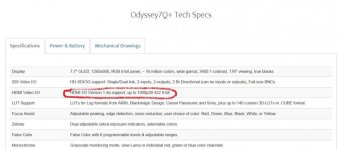
Mitch, my assessment was done by studing your homepage only. And even before your clearification it was clear to me that some points seems to be outdated. For example, it is quite clear that even the HDMI 1.4b will support 10bit but not only 8bit as written there. Or there is the Info there that UHD 30p is supported over HDMI, but no info that 4K DCI is suported.

To state that 2160p can be DCI 2160p or UHD 2160p - well in the public sources like the LOL wikipedia you find that 2160p stands for UHD 2160p only. This confusion is the result that the industry all together tells the consumer "it is all 4K". But here are professionals who have to know exactly what a unit is able to do and what not.

I would recommend to update the specs both to you but also Atomos. And for sure that is a question of fairness because I as user want to know what I purchase. And I have the right to know that. But it is also a question of competitiveness. Because if I compare products like I did based on outdated specs I may get the wrong impression. And the outcome of outdated specs can be seen in this discussion.
 
I will look into the info as posted on our website. Specs for our products are available for download on our site. If there is any issue I will address them.

I will ill note to some of the earlier comments on this thread, over time the wording of the specs on both the Convergent Design and Atomos websites has changed. On our part (and I know because I'm the guy who made the changes), this was done in part to improve clarity on some of the misunderstandings noted here. I can't speak for another company but I wouldn't be surprised to hear of similar reasons.
 
Well, I have not even seen where to download the specs, because they are written down.

But I am talking about outdates infos like those as in the snapshoot.
 

Attachments

  • Spec 7Q+.jpg
    Spec 7Q+.jpg
    51 KB · Views: 0
And so we find that published specs do not always relate to the product being sold. A marketing item is not necessarily a specification, and a manufacturer may not be using a device to the full extent of its specification.
 
I just received a Customer Support response to my inquiry, from Atomos. I am informed that the F5 is not capable of 4K...???. Apparently, Atomos knows little about camera integration. So, as I said, the whole digital imaging paradigm is too complicated, even for OEM's.
 
To be fair to "the other guys", the F5 cannot output 4K without an optional upgrade, and that upgrade was not available until several years after the camera first shipped.

I find myself having to let our engineers know about developments at other companies all the time. They have their own stuff to take care of. It's not easy to stay on top of everything.
 
Back
Top