
Navigation
Install the app
How to install the app on iOS
Follow along with the video below to see how to install our site as a web app on your home screen.
Note: This feature may not be available in some browsers.
More options
You are using an out of date browser. It may not display this or other websites correctly.
You should upgrade or use an alternative browser.
You should upgrade or use an alternative browser.
F23: Just Got A New Camera - Sony F23
- Thread starter Viddovation
- Start date
Mitch Gross
Veteran
What about Speed Racer? Atrocious movie, but it certainly showed what the camera could deliver.
Harry Lime
Well-known member
That's the exact trailer I saw last night...
Probably the two best cinematic examples shot on f23 with trailers available might be Benjamin Button and Avatar.
Wasn't Buttons shot on the Viper?
Piszkos Fred
Active member
As I recall only the hospital scenes were shot on the F23.

Run&Gun
Veteran
On a somewhat related point of Sony CineAlta 2/3" cameras: I noticed Sony F900 are going for only US$1.5K on ebay
Insane... When I was shooting with that camera on a regular basis, it was a $100K+ for the body only. And just as crazy to look at F35's and F23's now, too.
And it depresses me to see the current used market value on my VariCam's...
For $1500, I'd almost get one for the sentimental value. I loved the picture. And I still have a few boxes of HDCAM tapes in the office. Too bad there wasn't an SDI out on the original version to use a Nano Flash or other recorder, only analog component unless you had something like a Miranda to come out of the multi-pin on the rear.
Last edited:
GordanWillis
Carbonite Member
You can use an analog to SDI converter into like the PIX240 as well - or nanoflash - or who knows what other recorders can capture SD. I just bought a dvx100b (my first camera) to use with the pix240 - something about that CCD image that feels like 16mm. I'm not joking really. I just watched "Ultimate Christian Wrestling" and man it got me repumped for the little dvx100.

stefanhuberfilms
Veteran
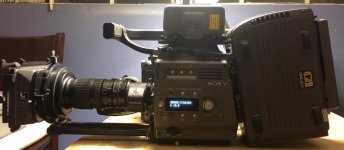
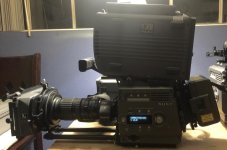
Looks pretty bulky! Wast's the weight? Managable on the shoulder? Nice setup!


Mitch Gross
Veteran
Might want to consider replacing Igor's hump with an Odyssey7Q+.
I did not buy the deck, it was a trade with another F35 user. Yes I have a 7Q, and with 12-bit 4444 now, it completes the F35/23 as a modern camera.
I want to try some speed ramping, I want all the buttons and menus to work on the F23. If I strike the parts, I'd like to get the fiber IF box and connection which only works with this original deck.
It's incredibly bulky and very heavy. I will probably use the 7Q on all most gigs with my F35/23.
I want to try some speed ramping, I want all the buttons and menus to work on the F23. If I strike the parts, I'd like to get the fiber IF box and connection which only works with this original deck.
It's incredibly bulky and very heavy. I will probably use the 7Q on all most gigs with my F35/23.
Harry Lime
Well-known member
I just watched this little behind the scenes piece about Tarantino's upcoming Hateful Eight that was shot on 65mm and how Panavision went into their storage vault and hauled out these cameras and lenses that are decades old for this new production. it got me thinking about how much things have changed in just a very short time.
If I remember correctly the F23/35 were $180-250k and now you can pick one up for the cost of a pro DSLR.
Film cameras have faired as bad and worse. I've seen Arri 535 packages go for $10-15k with mags etc. That was a +$200k camera just 10 years ago that could last you a lifetime.
I paid $15k for my F3 just three years ago and now I would consider myself lucky to get $2500 for it.
Unfortunately cameras have become disposable like all electronics and have a limited shelf life in the eyes of the market place. Cameras like the F35 will continue on for a good while, but sooner or later the electronics will fail and without replacement parts it will be game over. You can't just make a run of new sensors or IC's once that production line is gone. And that's a shame, because these are cameras capable of beautiful and unique results.
The first camera I bought was a Mitchell NC-R that was made in 1936. By the time it came into my possession it had been retired for about 15 years, but after getting it overhauled I shot a few projects with it. And yes, I still have it and it runs perfectly. The great thing about a film camera is that the IQ is directly related to the film stock aka 'sensor' and lenses. If I shot Vision3 with modern glass on that Mitchell it would look no different than something shot on a 'modern' film camera. That is sort of ironic when you think about it. In some ways film cameras are considered archaic, but at the same time they are timeless, because unlike a digital camera their sensor is not fixed and frozen at a particular point in time. Theoretically you could keep that Mitchell running and current for as long as they make film and there are lathes and mills to make parts. Unfortunately digital cameras will not share the same fate.
If I remember correctly the F23/35 were $180-250k and now you can pick one up for the cost of a pro DSLR.
Film cameras have faired as bad and worse. I've seen Arri 535 packages go for $10-15k with mags etc. That was a +$200k camera just 10 years ago that could last you a lifetime.
I paid $15k for my F3 just three years ago and now I would consider myself lucky to get $2500 for it.
Unfortunately cameras have become disposable like all electronics and have a limited shelf life in the eyes of the market place. Cameras like the F35 will continue on for a good while, but sooner or later the electronics will fail and without replacement parts it will be game over. You can't just make a run of new sensors or IC's once that production line is gone. And that's a shame, because these are cameras capable of beautiful and unique results.
The first camera I bought was a Mitchell NC-R that was made in 1936. By the time it came into my possession it had been retired for about 15 years, but after getting it overhauled I shot a few projects with it. And yes, I still have it and it runs perfectly. The great thing about a film camera is that the IQ is directly related to the film stock aka 'sensor' and lenses. If I shot Vision3 with modern glass on that Mitchell it would look no different than something shot on a 'modern' film camera. That is sort of ironic when you think about it. In some ways film cameras are considered archaic, but at the same time they are timeless, because unlike a digital camera their sensor is not fixed and frozen at a particular point in time. Theoretically you could keep that Mitchell running and current for as long as they make film and there are lathes and mills to make parts. Unfortunately digital cameras will not share the same fate.

JMtheDP
Veteran
Anyone thinking film cameras are perfect/indestructible/go on forever is welcome to buy any one of my enormous stack of failed accessories and parts for ARRIs and Moviecams. They are still great things, but there are a lot, particularly those from the late 80s/early 90s which have suffered from the electronics of the time. The older cameras have other issues like belts and seals perishing - and it's not always easy to get spares.
Harry Lime
Well-known member
Anyone thinking film cameras are perfect/indestructible/go on forever is welcome to buy any one of my enormous stack of failed accessories and parts for ARRIs and Moviecams. They are still great things, but there are a lot, particularly those from the late 80s/early 90s which have suffered from the electronics of the time. The older cameras have other issues like belts and seals perishing - and it's not always easy to get spares.
Obviously. Nothing lasts forever.
But it is interesting that you can pull a decades old film camera out of storage and still shoot a movie with it and get perfectly acceptable results.
Try that with an Alexa in 40 years.
Mitch Gross
Veteran
I can tell you that the days of the $150K top tier production camera are pretty much done, never to return. Now only extreme specialist cameras such as top of the line Phantom or the Alexa 65 could command such prices (and the Alexa 65 doesn't do this, instead existing as a rentals-only camera). There was a time when all production at a certain level depended on such high spec camera systems, but now major productions are routinely produced on camera systems available from $25K-$100K. These systems have descended to a commodity level, so that it no longer requires that individual, hand-built special tool to make pro level results.
Sony pissed off more than a few clients when it pushed cameras like the F23 and the F35, only to follow them up a few years later with F65 and then pul the rug out under the market with the much lower cost F55 camera system. Of course there was competition that Sony needs to take into account, but surely the model for camera systems such as the F65 had already expired well before the camera debuted. The problem was that it takes years to develop the cameras, and Sony wanted to extend that business model for as long as it could. Unfortunately you can't have your cake and eat it too.
Sony pissed off more than a few clients when it pushed cameras like the F23 and the F35, only to follow them up a few years later with F65 and then pul the rug out under the market with the much lower cost F55 camera system. Of course there was competition that Sony needs to take into account, but surely the model for camera systems such as the F65 had already expired well before the camera debuted. The problem was that it takes years to develop the cameras, and Sony wanted to extend that business model for as long as it could. Unfortunately you can't have your cake and eat it too.
Harry Lime
Well-known member
I can tell you that the days of the $150K top tier production camera are pretty much done, never to return. Now only extreme specialist cameras such as top of the line Phantom or the Alexa 65 could command such prices (and the Alexa 65 doesn't do this, instead existing as a rentals-only camera). There was a time when all production at a certain level depended on such high spec camera systems, but now major productions are routinely produced on camera systems available from $25K-$100K. These systems have descended to a commodity level, so that it no longer requires that individual, hand-built special tool to make pro level results.
Sony pissed off more than a few clients when it pushed cameras like the F23 and the F35, only to follow them up a few years later with F65 and then pul the rug out under the market with the much lower cost F55 camera system. Of course there was competition that Sony needs to take into account, but surely the model for camera systems such as the F65 had already expired well before the camera debuted. The problem was that it takes years to develop the cameras, and Sony wanted to extend that business model for as long as it could. Unfortunately you can't have your cake and eat it too.
I agree. I would even go as far as saying that the days of the $60-100k cameras are numbered. The trickle down nature of technology is relentless and we are already seeing enormous bang for your buck on the sub $20k level. I can't even imagine what the market will look like 10 years from now.