GH4 External Microphone Solutions for the GH4 (avoiding the buzz)

jcs

Veteran
I tested a few mics with the GH4 to get an understanding of the buzz issue. At 0dB in-camera gain, the buzz is heard on headphones and is also recorded. The buzz starts as soon as any TRS or TRRS connector is inserted into the mic port, including open-contact adapters with no mic plugged in. The GH4 preamps appear to be pretty decent with respect to noise- the NTG2 with battery usually needs a bit of gain, however on the GH4 it is well amplified with relatively low white noise. The buzz is far louder than the noise floor, however. Since the Panasonic mics don't have the buzz issue, it would appear the solution may require an adapter that acts like the Panasonic microphones (with resistors + caps or just TRRS wired differently to TRS?).

Interestingly, when using a Sennheiser G3 wireless receiver as a preamp and setting GH4 mic gain to -12dB, there is no audible buzz (and the SNR in Audition shows a pretty much flat line in silent sections). At -12dB, the GH4 is more sensitive than the 5D3 at 1-click-above-zero: I had to turn down the G3 receiver output. The GH4 shouldn't need a preamp for mics such as the NTG2 (on battery), as the mic pres sound pretty quiet (vs. other DSLRs such as the 5D3). However until the buzz issue is solved (with some kind of adapter?), going back to the old DSLR preamp workaround sounds excellent with the GH4.

A low-cost work-around for mics like the NTG2 is $33 (which sounds better using phantom power vs. battery):
http://www.amazon.com/IK-Multimedia-iPhone-Android-Devices/dp/B007534LFK/
+ $13 (there are lower cost options)
http://www.amazon.com/Headset-Buddy-Adapter-Smartphone-01-PH35-PC35/dp/B00332DPDG/
= $46

Example audio: http://www.dslrfilmnoob.com/2012/11/16/irig-pre-xlr-audio-interface-dslr-impressions/

If you're handy with a soldering iron, you can save ~$13 and modify the iRig Pre: http://www.dslrfilmnoob.com/2012/11/25/irig-pre-hack-cheap-xlr-phantom-power-preamp-dslr/

It could be that the GH4 is usable without a preamp once an adapter for the GH4 is available (or discovered), as the preamps appear reasonably quiet (minus the buzz). If you need phantom power and just one channel, the iRig Pre looks like a decent solution. As noted in the link above, if two channels are needed, glue or otherwise attach two iRig Pres together and use a dual mono to stereo Y cable. Traditional DSLR preamps are larger, more complex, and much more expensive (especially if you only need one channel with phantom power).

The Panasonic DMW-MS2 would be another option at $229, however reviews appear to show the mic isn't very good, especially for the price. Mid+Side shotgun mics are pretty cool in allowing post processing between shotgun and a wide stereo field, however the MS2 performs decoding only at the mic level (I use an Audio Technica BP4029 with the FS700 which sounds great).
 
Others have claimed too that in -12 buzz is not audible. So I think it is not a big problem then because -12 db is standard for audio recording. At least here. Ive worked with both Tascam and Zoom external recorders and always set em up on -12.
 
The buzz is far louder than the noise floor, however.

I haven't found an audio clip that demos this issue. So far all of the audio clips I've looked at, the "buzz" sound appears to be the actual audio noise-floor being modulated by the camera electronics.

For example, when the GH4 audio setting is -12 dB, you have approximately 63 dB of clean/clear uncompressed audio to work with. ( the camera noise-floor is just below -63 dB )

At higher camera settings, the noise-floor rises so that you no longer have the 63 dB of clean dynamic range to work with. I haven't spent any time determining the actual noise-floor at different camera settings, but if Panasonic's "dB audio level setting" represents actual dB levels, then setting the camera to a 0 dB audio setting would give you a noise-floor of -51 dB, which is pretty loud for noise. ( noise louder than -60 dB is too loud for me )

It could be that the GH4 is usable without a preamp once an adapter for the GH4 is available (or discovered)

I would love to have a GH4 recording made with the Panasonic mic wrapped in enough sound-deadening material, that I could then measure the recorded noise-floor and see if this actually is a real solution to the modulated noise-floor problem. I have a sneaking suspicion that the self-noise ( or noise-floor ) of the Panasonic mic is greater than -63 dB, which would mask out the GH4 modulated noise-floor issue, so you would end up replacing the GH4 modulated noise-floor with a louder "hiss" from the Panasonic mic. ( so the "buzz" sound gets masked by the louder mic "hiss" )

It would be great if this Panasonic mic can actually demo a real solution, but I won't believe it until I can test it for myself.
 
Others have claimed too that in -12 buzz is not audible

The GH4 "buzz" sound sits just below -63 dB when you have the camera's audio level set to -12 dB, which makes the "buzz" sound inaudible if you don't boost the audio levels in post.

A -62.5 dB noise-gate filter will completely remove the noise-floor of the GH4 recording ( including the nasty "buzz" sound ) if you do need to boost your audio levels, but this -62.5 dB filter only works for audio recorded with the GH4 audio recording level set to -12 dB. ( other camera audio levels require different noise-gate filters )

I agree that this "buzz" issue should have never been there in the first place, but I also understand that these things happen when new technology is released to the market, so you may have to learn to work around them. ( dual audio is probably the best solution for any paid video work )
 
Others have claimed too that in -12 buzz is not audible. So I think it is not a big problem then because -12 db is standard for audio recording. At least here. Ive worked with both Tascam and Zoom external recorders and always set em up on -12.

I agree it's not a problem if using an external preamp, however it would be nice to be able to use something like an NTG-2 with battery or VMP etc. for quick run & gun shoots.
The -12dB I was referring to is the mic gain level setting for the GH4 mic (lowest level). This is different from hitting/averaging -12dB during recording as a 'safe/standard' level for recording (this simply means recording at 1/4 the max signal amplitude possible with the device (20*log(.25) = -12dB)).
 
The GH4 "buzz" sound sits just below -63 dB when you have the camera's audio level set to -12 dB, which makes the "buzz" sound inaudible if you don't boost the audio levels in post.

A -62.5 dB noise-gate filter will completely remove the noise-floor of the GH4 recording ( including the nasty "buzz" sound ) if you do need to boost your audio levels, but this -62.5 dB filter only works for audio recorded with the GH4 audio recording level set to -12 dB. ( other camera audio levels require different noise-gate filters )

I agree that this "buzz" issue should have never been there in the first place, but I also understand that these things happen when new technology is released to the market, so you may have to learn to work around them. ( dual audio is probably the best solution for any paid video work )

Since there is a solution when using -12dB mic level, I didn't spend any time for further analysis. Listening to room tone (near silence) normalized to 100% in post did not bring up the buzz- just white noise and room tone. I didn't perform an FFT or spectral analysis on the buzz, however to my ears the spectral energy of the buzz is higher than the white noise. The buzz acts like a fundamental and of course colors the sound (white noise (vs. pink etc.) from an AD system is practically color free). When nothing is plugged into the external jack and the mic gain is set to +6dB (2x amplitude boost), the same white noise can be heard with no buzz (and it's actually not that loud in terms of SNR- pretty good for a $1700 DSLR). So the issue appears to be with the external mic circuit, not the AD system per se.

The last Panasonic camera I purchased, the TM700 also had audio issues: fan noise. Kind of ironic, Pana-sonic :huh:. Panasonic mentioned it could be a grounding issue- perhaps folks familiar with mic circuits will wire something up to test using TRRS and TRS parts etc. (and/or use a multimeter on a TRRS Panasonic mic to see what's going on with the TRRS connector).
 
however to my ears the spectral energy of the buzz is higher than the white noise

Using the Sony dB peak indicators built into Sony Vegas Pro and Sony Sound Forge, they show no recorded sound louder than -63 dB when you record "silence" with the GH4 set to it's "-12 dB" audio setting.

This is why you can completely remove the noise-floor with a -62.5 dB noise-gate filter and then boost the audio levels by 50 dB and you will hear absolutely nothing, and the dB peak meters show the SAME thing.

I am absolutely convinced that the "buzz" we are listening to is the modulated -63 dB camera noise-floor ( -63 dB at the "-12 dB" camera audio setting ), and it has no influence on the clean audio dynamic range between 0 dB to -63 dB.

If we think about Fourier Synthesis, we see that sound can be broken down into a fundamental and partials, which can then be added back together to create the original sound. The buzz sounds like a square or triangle wave, and provides the fundamental tone, as we might expect from a digital system. If we removed the white noise, we'd be left with the buzz, likely a square/triangle or compound of partials. The amplitude of the buzz sounds higher than the amplitude of the white noise. When both signals are added together, we get the buzz+white-noise sound of the GH4. Again, I wasn't able to bring up the buzz after normalizing 'room tone' (not really silence)- the room tone was much louder than the captured white-noise+buzz tone. I didn't need to use a noise gate or similar dynamics- it was clean enough to use as is: the signal was much higher than all forms of noise coming from the GH4. In terms of the math, the GH4 noise is from the white noise of the AD system along with the buzz square/triangle wave added to the signal (modulation = addition, thus increasing the amplitude of the combined waveform).

In the waveform shown, we can see the buzz amplitude is higher than the white noise: http://eriknaso.com/2014/05/23/gh4-external-mic-audio-issues-and-work-around/
Perceived loudness isn't necessarily the same as spectral energy, however this test when the buzz gets constant sounds louder than the white noise to my ears: https://www.youtube.com/watch?v=P_gFYvKG074

Hopefully Panasonic will provide a solution to allow using the apparently decent preamps in the GH4 above -12dB mic gain when not wanting to use an external preamp (NTG2, VMP, etc.).

[edit]: turned mic gain to +6dB and covered L+R mics on camera with fingers: can hear high frequency sounds (autofocus?) and stabilizer (12-35 2.8 lens), white noise, but no buzz. At -12dB with G3 turned off- can hear buzz, but when turned on and with sufficient gain- no buzz. So the buzz is only on external mic, but is always there even at -12dB. However, as I adjusted the G3 gain, it sounded almost like the GH4 was doing some kind of auto-level and once the gain was high enough, the buzz went away faster than it seemed it should relative to the gain increase.

Also interesting: http://eriknaso.com/2014/05/23/gh4-external-mic-audio-issues-and-work-around/ (Sounds like Panasonic is sending Dave Dougdale an adapter to try).

This guy states buzz is always there: http://suggestionofmotion.com/blog/panasonic-gh4-audio-buzz/ , including for internal recording. While I can clearly hear the buzz with an external mic, so far it's quiet with the internal mics, even with +6 mic +15 headphones, and covering the mics (can then hear lens noises, but no buzz on my camera).
 
Last edited:
The amplitude of the buzz sounds higher than the amplitude of the white noise. When both signals are added together, we get the buzz+white-noise sound of the GH4.

Based upon past experience working with GH2 and GH3 audio, the GH4 appears to be recording audio in essentially the same manner, other than the "white noise" floor being modulated with the GH4. The dynamic range measured in dB RMS is essentially the SAME for the GH2, GH3, and GH4 cameras.

Using a noise-gate to remove all audio that is slightly louder than the noise-floor measured in dB RMS will completely eliminate the noise-floor and the "buzz" sound, to the point where you can amplify the remaining audio information by 50 dB and not hear either the noise-floor or the "buzz" sound. If you used the same noise-gate with the GH2 or GH3, you would achieve the same result, with the removal of the "white" noise from the recorded audio.

I wasn't able to bring up the buzz after normalizing 'room tone' (not really silence)- the room tone was much louder than the captured white-noise+buzz tone.

Most likely the noise-floor and the "buzz" were still in your recorded audio, they were just masked by the ambient room tone of your recording. You could probably retrieve the noise-floor and the "buzz" by using a noise gate to eliminate all audio louder than -62.5 dB ( assuming the GH4 audio control was set to "-12 dB" ), and then amplify this by 20+ dB to make it obvious.

I strongly suspect the same thing is happening with the Panasonic mic that supposedly doesn't have the "buzz" issue, where the camera's noise-floor and the "buzz" sound are being masked by self-noise of the microphone. ( i.e. the "buzz" is still there, but you won't hear it unless you eliminate the louder audio that is masking it's presence )

In the waveform shown, we can see the buzz amplitude is higher than the white noise

This is the noise-floor being modulated by electronic signals from the other camera circuits. It is possible that the GH4 could have a much lower noise-floor than the GH2/GH3 cameras if the audio circuitry had better shielding, but as stands right now, when measured on the RMS dB scale the GH4 shows the same clean 63 dB dynamic range as the GH2/GH3 cameras, you just have a noise-floor that is being modulated to create the "buzz", but this still resides below -63 dB RMS just like the noise-floor of the GH2/GH3 cameras.

Hopefully Panasonic will provide a solution to allow using the apparently decent preamps in the GH4 above -12dB mic gain when not wanting to use an external preamp (NTG2, VMP, etc.)

If it's a hardware shielding issue, then Panasonic might revert the preamp gain back to GH3 levels to eliminate the perceived "buzz" sound, and then we would have to feed the GH4 the same -20 to -30 dB signal that the GH3 wants for optimal audio recording. ( instead of the -40 to -50 dB signal that the GH4 currently works well with ) This gets rid of the buzz and we have to go back to using external preamps just like the GH3.

I can't imagine Panasonic ever doing a recall over this issue, though they might fix it at the manufacturing level so that new cameras won't have this audio flaw.

This guy states buzz is always there

I would agree with this assessment, but you won't hear the "buzz" if it's being masked by ambient room-tone or the self-noise of the mics you are using.


As things stand at the moment, I think the simplest solutions are to...

- Mask the "buzz" with ambient room-tone or self-noise from your mics ( assuming the mics are noisy enough )

- Use a noise-gate to remove the noise-floor and the "buzz" sound from your recording ( there is no usable audio in this range, so it won't harm anything you record )

- Use a dual-system audio set-up
 
I'm not hearing or seeing any evidence that the buzz is happening on the internal circuit. Both internal mics covered, +6dB mic gain, picking up lens noises etc., but no buzz. After normalizing and doing a spectral plot on a section without lens noises etc.:
IntMics.jpg
We should be able to see any repeating patterns (the buzz) regardless of relative gains vs. white noise (might not be audible, but should still show up in plot). I'm not hearing or seeing it with the internal circuit.

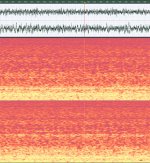
External circuit with a mic plugged in but turned off (noise is clearly audible with mic turned on, however white noise is higher (does not mask buzz)):
ExternalMic.jpg

In both the waveform and spectral plot, we can see the repeating noise pattern of the buzz (and of course is clearly audible), which has significantly higher amplitude than the noise floor. If someone has a waveform+spectral plot of the buzz with the internal mics, it would be nice to see it.

you just have a noise-floor that is being modulated to create the "buzz"

Which translates to a significant square wave being added to the noise floor (white noise) on the external circuit :). There might be some AGC going on as well, so when mic noise (or room/env tone) is higher, AGC is lower and the motorboat buzz has less amplitude.
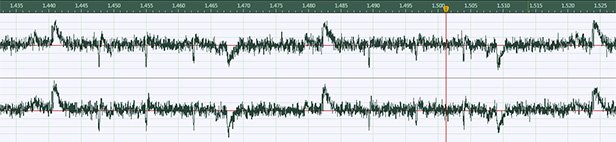
[edit]: after zooming in, the buzz is a triangle, not a square wave (much higher in amplitude than the noise floor):
TriangleBuzz.jpg
 
Last edited:
I picked up the iRig Pre last year. It appears to be a relatively good way to add gain compared to using any DSLR's built-in preamps. In fact, it was rated favorably in comparison to the preamps in other audio recorders.

Soldering the connections is the cleaner route, but the necessary audio adapter could cost less than a dollar (via eBay), or ~$5 on Amazon if you can't wait a week or so for delivery from China.
 
Does this mean, the audio problem can be bypassed by using an external pre-amp like the JuicedLink riggy micro?
 
Does this mean, the audio problem can be bypassed by using an external pre-amp like the JuicedLink riggy micro?

Yes, shooting with the GH4's mic gain at -12db and feeding it a strong signal was always the best workaround for this issue. The buzz is still there, but it's buried enough that it's not an issue as long as you don't have to do extensive post processing. So in an ideal world, where everything goes exactly as planned, you should not suffer much from the buzz. That said, the buzz can introduce problems when shooting in less than ideal situations, where you need to record and control levels directly in-camera. It's not the end of the world, but it sure makes you question why they gave you the ability to control audio levels in the GH4 if the -12db setting is the only usable one.
 
I use a rode videomic and filmed a quick a little interview with the mic plugged straight into the camera. I heard the buzz from my headphones but the buzz was not recorded. I unplugged the headphones before recording if that helps.
 
Others have claimed too that in -12 buzz is not audible. So I think it is not a big problem then because -12 db is standard for audio recording. At least here. Ive worked with both Tascam and Zoom external recorders and always set em up on -12.

The -12dB standard for digital audio recording refers to maintaining levels about twelve decibels below clipping which is zero. In other words "-12" means we have twelve decibels of headroom. Zero is where you are clipping the signal as in there can be no more information processed just like when your exposure is too high and you clip the highlights.
In this case the input meter is an arbitrary scale. The level control on the GH4 (and some other cameras I have owned) should be thought of as more of a fader with "0" being the nominal position. We really have no way of knowing what the actual analog voltage in to the A/D is.
My guess is the mic preamp on this camera is fixed at something like 60dB and the level we are attempting to adjust is downstream of that. Possibly even after the A/D conversion. It's only a convenient way for us to level things out in general. There is no physical room in that camera for analog potentiometers or digitally controlled filters.
In a nutshell - the level control does not actually adjust mic preamp gain.
I'm afraid we are stuck with what we got. The only fix is a hardware modification be it new preamps or better shielding. Firmware ain't gonna do that.
I want less gain at the head amp as it's better to boost that outside the camera. Rode's +20dB boost or a strong output from an external mixer does that.
 
I had no luck with a TRS to TRRS adapter I purchased from Amazon. I went ahead and ordered the same adapter from Rode just to check it out. I unfortunately had to buy it. :laugh: unlike Dave who got one for free from Rode. It will be delivered today.

I doubt the cable will be different than the version I bought previously.

As mentioned before I've been getting very good quality direct recordings from the Rode Lavalier with the GH4 set to -12db. It sounds great. The Rode levels are perfect at -12db. Even the VideoMic Pro set to -0 and the GH4 set to -12db is good.

I shot this last week in 4K using the Rode Lavalier.

 
Last edited:
http://vimeo.com/groups/gh4/videos/96841041

This video made me want to get the Panasonics DMW-MS2 own mic. The ability to have both Stereo and Shotgun in one is the selling point for me. Plus do I understand correctly that the buzz is not an issue with it? Anybody can confirm?
If it is then probably gonna go for Zoom H4n.
I feel the opposite. The Panasonic just sounds thin and has a hiss noise to it.
 
Last edited:
Back
Top