Exposure with Dark Scenes

iamlance

Well-known member
This may be obvious to many others, but I've never come across a clear answer in any of my readings. When exposing for a moody shot, how do you keep correct exposure while keeping things dark? Let's say I'm shooting a night bedroom scene, or a dark hallway villain scene. I cannot put too much light onto the scene, but the levels (waveform, histogram) are low otherwise. Does SOMETHING in the scene have to be exposed correctly, and the rest can be dark? Or am I going at this completely wrong and exposure is all relative to what you want?

Another problem I've run into is if we go the above route and keep certain parts lit and the rest dark, those dark areas will be noisy (with low iso, so noise is from underexposure), and only improved with adding too much light for our vision. Camera is GH4 or t3i.
 
It's all up to you. Sounds like you might be lighting a little too "by the book," overly concerned with appropriate readings. Your instruments are guides to help you get the look you want; they shouldn't dictate it.

Anyway, personally I prefer night shoots to have a lot of contrast with strong backlight, underexpose the rest. But there are some people that light nightscenes with a big, soft source from the front and underexpose it. Or there are people who do something different entirely. All valid options.

If you're overly concerned with noise in the shadow areas... er, shoot at a lower iso? Or you could consider crushing the darks down in post.
 
If you are going the realist / minimalist way, then imagine what it would be like if the scene was grabbed from daily life.... maybe the source is a hard light street lamp.... backlighting like Sonos says, and then use fill where possible to bounce it back like it would in real life from fx. a building or the surface of a car or a window etc. Sure, you can augment light, but it could also cause you to run into trouble of overlighting the shot / scene.
Either way, there's no wrong way to do it, but finding out what you like first might be an easy step onwards.
 
This may be obvious to many others, but I've never come across a clear answer in any of my readings. When exposing for a moody shot, how do you keep correct exposure while keeping things dark? Let's say I'm shooting a night bedroom scene, or a dark hallway villain scene. I cannot put too much light onto the scene, but the levels (waveform, histogram) are low otherwise. Does SOMETHING in the scene have to be exposed correctly, and the rest can be dark? Or am I going at this completely wrong and exposure is all relative to what you want?

Another problem I've run into is if we go the above route and keep certain parts lit and the rest dark, those dark areas will be noisy (with low iso, so noise is from underexposure), and only improved with adding too much light for our vision. Camera is GH4 or t3i.

The biggest problem with actual 'low light' shooting is the noise in the 'blank black' areas. For example, night outdoors will have large areas of 'blank black'... so, often even in Real(tm) productions, one will see 'smoke' or something to break up backgrounds.

Small interiors also have the blank black problem, but then putting a light into the room... and one has the problem of too much light where one doesn't want it...

As for 'exposing' correctly... the light on the subject should be such that 'noise' is not an issue... At night one expects 'darker than in broad daylight', but one needs to avoid noise, so light the subjects to a 'dark level' that doesn't have noise... control light in the background to give the impression of 'night'...
 
I feared I was depending on the meters too much. The director was very worried about noise (we did a test and had bad noise with the gh4 at the lowest iso; we had lit the scene the way we wanted to, slightly dark and underexposed. We then heard that the GH4 is better a little overexposed than underexposed), so we shot at higher levels against my artistic desire.

I constantly hear when people ask for criticism on their work that they are underexposing the shots. If adding more light causes the scene to be too bright, and the lowest iso is already being used, are the only options to get a better camera or to crush the blacks/denoise in post? The GH4 is a very nice camera, so I can't see that being the issue.
 
I sometimes use some really big bounce or diffusion sources and raise the overall level a half stop or so... mainly get the shadows where there aren't 100% deep blacks, and keep the mids and high intensity I want for the key details - so it can look a little flat in camera. It's a simple matter to just bring the shadows up in post, which kicks the contrast back up and really pops the stuff you wanted to keep.

This can boost saturation in the lower mids if you're not careful, but it's effective if you're worried about noise in a really low key scene.

I generally use the large scrim jim frames (about 5' square) or hang some diffusion or bounce. Doesn't take much.

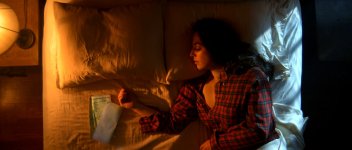
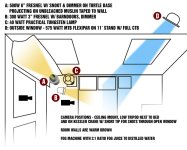
This scene was a really tossed together last-minute, last shot of the nigh kind of thing, but didn't take much to light:

DSC_8276.jpg DSC_8259.jpg

Was lit like this and then crushed a bit in post...

CHART.jpg
 
This may be obvious to many others, but I've never come across a clear answer in any of my readings. When exposing for a moody shot, how do you keep correct exposure while keeping things dark? Let's say I'm shooting a night bedroom scene, or a dark hallway villain scene. I cannot put too much light onto the scene, but the levels (waveform, histogram) are low otherwise. Does SOMETHING in the scene have to be exposed correctly, and the rest can be dark? Or am I going at this completely wrong and exposure is all relative to what you want?

Another problem I've run into is if we go the above route and keep certain parts lit and the rest dark, those dark areas will be noisy (with low iso, so noise is from underexposure), and only improved with adding too much light for our vision. Camera is GH4 or t3i.
My IMO

Firstly you need to define - are you shooting in a dark place (eg a night ext) or just want a dark look (in a controlled environment)

Simply for either case you want to shoot with an expectation of lowering the toe in post - aka crush the blacks - this is your key to noise free footage.

There is no reason for a moody scene to have any more noise than any other scene.. if you have enough control.


So shooting in a controlled place you can light up so your darkest scene elements are 10 or 20% - pretty much make it normal on the monitor and just darken in post.

Now with actual dark places you cant light (like a wide night ext) you just want to get as much light as you can.. fast glass, highest ISO you dare.

And "'does something' have to be exposed correctly"

No it does not - but actually it is often artistically good to have something bright in a scene - typically a hair-light on the talent or a sweep across their face (semi backlight)

Ive done a bunch of night shots recently on the 'insensitive' Black Magic, and didn't struggle but did use a lot of LED backlight (and board to subtly fill)..

EDIT.
Michael has a good one above..

S
 
I haven't had too much experience, so it is difficult for me to imagine the changes in post. I'll try to shoot some sample or test footage and play around with it in post.

Morgan Moore,
What I was imagining was similar to what Michael showed, contrast and light wise. Thanks for clearing up the exposure question. It's all coming together in my head now. What would you say correct exposure should be, as a percentage? In the past, I've stayed near 20% on the dark areas (when I purposely underexpose), when I can, during moody scenes.

Michael,
When I have a big area that needs a general level lift or for the shadows, I shine a light (usually a 1k baby scrimmed) at the ceiling. I probably add too much light though. For the walls in your diagram, you used bleached muslin. Is that because the walls were brown rather than white, or does bleached muslin change the light differently than a ceiling or bounce board does? And you mentioned using the scrim jim; is that what you used instead of the ceiling, for more focused area lighting?

I couldn't help but notice the amount of light and types you have going on in that scene. I need to pick up some smaller lights. My bigger ones always seem to live with a dimmer or scrim on them.

I love the diagrams and pictures! Thank you! Is the catcheye from the practical or fresnel?

My productions usually do not allow for much setup time (12-20 minutes per shot), which is difficult for a beginner as myself. I'll play around with different lighting setups and see how the light changes.
 
The changes in post..

Well I guess you need to set up a scene - maybe like Michaels (which I currently think is a bit light for 'dark' but that is personal) and do a bunch of bracket tests and see where you can go in post.

Nothing is rocket science - just practice testing and experience.

If you have a fancy camera or monitor you could create a 'dark' LUT - that replicates what the post look will do - but if you dont have fancy camera you will have to just shoot light, watch the director freak and then please them in post!

S
 
Does SOMETHING in the scene have to be exposed correctly, and the rest can be dark?

No, the entire scene has to be lit and exposed correctly so that you can get the effect you want. Noisy shadows come from a light starved sensor. Just because you want a dark result doesn't mean you shoot in the dark!

The key to a good dark result is a properly exposed capture followed by good color grading. Yes, really.

To clarify my answer to align with the comment above I meant it doesn't have to be properly exposed after grading, but often looks good if there are a few highlights that are quite bright..
 
yeah, if you are afraid of noise use a lower ISO and don't be afraid to pull it down in post. Expose faces where they work. If you check any BTS from something like Prisoners, it is often surprising how much light there is in a "dark" scene. Just check your ratios expose for where the light is, and if it looks too bright, it's easy and worth it noise-wise to pull it down later. Somtimes I'll futz with my aperture to see how it will look in the monitor when I pull it way down later.

The main thing I do in "dark" scenes is to make sure I flag the light from the areas I don't want to see it by flagging or skirting, doors or black wrap. That's the best bet.
 
I don't have many fancy tools yet. Very basic setup without light meters, jim scrims, flags. I make use of similar items, like diffusion paper, thick white cloth, black blankets, but it isn't as easy. Know how I could check ratios without a light meter? Would the spot meter tool within the camera work? The iso is usually on 200 already, the lowest iso available. But your comment gives me hope. I'm curious to see if the scene will look dark like I wanted after the editor gets to color grading. I'll give him a call.

What would you consider "exposed correctly"? Anything above 50%? 80%?

I'll try the aperture thing next time!
 
Night scene and moody scene are not exactly the same,yet they share same principle - a lot of underexposed areas (dark) and usually high contrast.
One thing that causes confusion is the term underexposure. Underexposure of negative as a whole vs underexposure of areas of the negative. Take a look how day for night scenes are shot - underexpose daylight a stop or 2 and you get this dusky/moonlighty feel - whole picture is uniformly underexposed. Same work in reverse (David Mullen ASC posted pictures,can't find link atm) if you take a long exposure of real moonlight it looks like midday.

Now take a look at a brilliant scene from Big Combo,which has extreme mood,but underexposing parts of an image,rather than negative as a whole. She is exposed "correctly" her skin is definitely not underexposed. The bad guys skin is hot from 3/4 key and rim on the right guy too is pretty hot. However the rest goes to black (atlest in this crappy quality screenshot),with 0 fill levels. So the majority of the frame is almost pure black. This creates incredible contrast and "mood".

http://aworldoffilm.files.wordpress.com/2014/03/big-combo-cinematography.png

The easiest way to get mood is using hard light and no or severely underexposed fill. If you want a night/dusk/shade feeling,you then can underexpose key light to taste.
Darkness/moodiness does not depend on light levels. It doesn't matter if you have a 200w key and 50w fill or 2000w key and 500w fill the ratio=contrast stays the same.
Use your eye to judge contrast.
 
I don't have many fancy tools yet. Very basic setup without light meters, jim scrims, flags. I make use of similar items, like diffusion paper, thick white cloth, black blankets, but it isn't as easy. Know how I could check ratios without a light meter? Would the spot meter tool within the camera work? The iso is usually on 200 already, the lowest iso available. But your comment gives me hope. I'm curious to see if the scene will look dark like I wanted after the editor gets to color grading. I'll give him a call

Using a combination of your eyes and the histogram (and a bit of common sense) should allow you to figure out proper light levels and exposure for the main parts of your image (most often the talent's face).
I never willingly underexpose an entire shot and there's never any need to unless you plan on skipping post production. I have had directors force me to underexpose because they (or someone sitting next to them,, Yeah I'm talking to you Tina in Makeup! ) wanted the image on the monitor to be as close to the final image as possible (Makes you love digital), and this is where you really do need a light meter to expose just right. The image always degrades when the sensor is starved of light which makes underexposing in camera a less than ideal idea most of the time. I always try to expose where the focus is to get the best possible image quality where the audience will be looking. Of course it all comes down to artistic preferences in the end.

There are also a lot of different ways to shoot "dark". I once did three projects in a row where the directors had completely different ideas of what "I want it to feel dark!" would get them. One wanted the outside to be bright as if lit up by the moon, to create contrast between the pitch black indoors where the character would move in silhouette across the properly exposed windows. Another wanted a perfectly even look, as if there was no source of light at all, anywhere. It was all just even and "dark".. Which meant we wanted to light the entire frame so that it could later be darkened in post. The last one wanted spots of light; Didnt matter where they came from as long as they were spotted to only light up specific elements and pieces of the scene.

Speaking of shooting dark,
I remember Barry talks about this in the Lighting For Film & Television dvd (mainly thanks to the Buffy reference).
http://dvxuser.com/articles/dvxshop/LightDVD/
Honestly, if you're new to lighting this is the best purchase you'll ever make (Aside from a toolbelt.. And protective gloves.. And Xanax)
 
Last edited:
Very interesting. It seems people have different ideas on how to do this, just as you said, Tolin. I'll go the light-with-post-in-mind way and see if it gets me what I want.

I have already watched the Lighting DVD, which was extremely informative. I'll go back and rewatch parts of the DVD, as they must have not stuck with me.
 
Get yourself a lightmeter. If you want to learn and understand more about how light and exposure affect your image, it really is a necessary.

Exposure is always a choice (well assuming you're not trying to shoot night exteriors without any lights). What effects the image is HOW you choose to exposure the different elements of your frame. For a low key scene, if you want to see expressions clearly, you'd probably want to keep to a stop underexposed on faces, if you want things to feel really dark, go two stops underexposed on faces, want to see just the tiniest bit of detail on a face amongst the darkness? Go three stops underexposed.
 
often looks good if there are a few highlights that are quite bright..

Morgan Moore has got it. If you look at most good-looking dark scenes, most of the area is dark, but there are one or two spots that fall at normal exposure or even highlights.

Or think about it this way. A normal scene has parts that span the whole range, from black to white. A dark scene should also span the whole range. It's just that there are fewer above 50%. But if it were a dark scene that was low-contrast, where everything is below 50%, it would just look muddy.
 
Back
Top