FS7: EI. mode question

Nice Ben.

Personally I bought the camera when I tried Slog3 and made pretty pictures instantly (after months of getting bum results with F3-Slog) - I would be interested in any thoughts from the field about why Slog2 might be better. For example one curve might be better in the studio where one has more control, the other better when run-gunning in wider DR and changing environments?
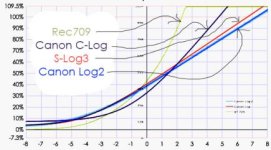
 
Someone just sent me a link to a puff-piece video on the Canon C300mkii. It included a brief frame of a chart comparing Canon Log2 and Canon C-Log. As there aren't any available technical documents about Log2 yet, I took a frame grab, built an S-Log3 vs C-Log chart in LUTCalc, scaled both on top of each other in Photoshop and ta-daa:
Canon-Log2.jpg
The thing that stands out to me is that it follows the lead of S-Log3, Arri LogC and Panasonic V-Log in general response. They had to make a change as the original C-Log taps out at 5 1/3 stops above mid gray in extended range and the claimed dynamic range is 15 stops, but they could have ended up with something more like S-Log2.

What they appear to have is something harmonised to EI shifts in post and the workflows of other manufacturers' cameras. Good for mixing and matching cameras, less good for people who have rolled-their-own with C-Log.

Again, absolutely nothing wrong with S-Log2, particularly if you are both shooting and handling the post workflow, but there is some good (and clearly pretty well agreed) logic behind S-Log3,

Ben
 
As someone who comes from linear raw stills Clog2 and Slog3 both look effectively linear in everything but the deep shadows and therefore.. perfect. Toe? Knee? shoulder? 1990s hell-o-vision.
 
Hi Sam,

that X-axis is logarithmic, ie in stops. That's why the line goes straight on the y-axis. A linear response would shoot up even more than the Rec709 line on this chart. You probably know that already as you are talking about the knee which, you're right isn't there in log (high ISO Arri LogC notwithstanding), so pushing and pulling things around creatively is relatively easy, but the biggest consequence is that exposure adjustment in linear is a matter of gain, whereas in log it is more closely related to offset ( log(ab) == log(a) + log(b) ).

If you need to do ISO shifts in post and the software doesn't have a built-in tool or do it automatically from metadata, either play with gain after linearisation, or for more accuracy and simplicity you can use a log exposure adjustment LUT. That was the original reason for me developing a webapp called LUTCalc.
 
I stand by my own assessment that S-LOG2 is better. Yes, I said better. But I will try to preface such statements in the future by adding "in my opinion" if that helps other people sleep better at night. The nice thing about these cameras is that you can use whatever you prefer, regardless of what someone else says. But of course, that is just my opinion.
 
I stand by my own assessment that S-LOG2 is better. Yes, I said better. But I will try to preface such statements in the future by adding "in my opinion" if that helps other people sleep better at night. The nice thing about these cameras is that you can use whatever you prefer, regardless of what someone else says. But of course, that is just my opinion.

It may well be better, or certainly more suitable for certain projects.

It would be good, and constructive, to know why you think this.

It would seem to me that having a steeper curve one gets potentially less DR but in exchange more bits per tone.. which could indeed be a good thing as bits per tone translates to rich gradable images.
 
Sam, my #1 reason is that S-LOG3 clips highlights at 93%. In a controlled lighting situation that might not be an issue, but I find that limitation to be a constant problem with a lot of what I shoot outdoors. Second, I find S-LOG2 much easier to grade in Resolve. Of course, that is just my opinion.
 
Sorry Doug, I don't get what effect the white clip has on outdoor filming? 93% is 6 and a bit stops above mid gray in S-Log3 just as 109% is six stops above mid gray in S-Log2. The actual dynamic range / latitude is identical.

If it's because it's harder to see S-Log3 in the viewfinder in bright light, why are you looking at log at all instead of an MLUT?

The contrast is so low on both that a well chosen, more contrasty LUT will be much easier to expose to whether by zebras or waveform and if you want an idea of true clip, the much-spoken-of LC looks cover the camera's entire range. I personally see very little need to ever actually work straight off log, but I'd genuinely be really interested to hear your reasoning,

Ben
 
Ben, I'm not talking about anything having to with monitoring. I am talking about the actual S-LOG3 signal flat lining at 93%. Even when exposing S-LOG3 perfectly according to the recommendations, there are plenty of instances with specular hightlights, backlit hair, etc. where that clipping is just plain ugly and unfixable in post. S-LOG2 handles it better. I shoot backlit as much as possible and there is clearly a difference between graded S-LOG3 and graded S-LOG2. And even when lighting conditions are not that extreme, the way S-LOG2 handles the upper end of the exposure simply looks much nicer to my eyes. Of course, that is just my opinion.

Frankly, I'm shocked that you don't understand what effect a 93% clip would have on outdoor filming. Are you sure you meant to say that?

You are welcome to quote all the technical specifications you want but that means absolutely nothing to me. My opinions are based on real world experiences. And as I said before, it is easy for anyone with a RAW recorder to process the the exact same footage as S-LOG2 or S-LOG3 in post and come to their own conclusions. That is the best way to really find out which one works better for someone's shooting style and their expectations of what the video should look like.

Everyone is free to have their own favorite, but even the insider people at Sony will tell you that S-LOG2 is technically superior to S-LOG3.
 
I agree 90clip feels intuitively wrong.

But as Ben says it is the actual amount of stops recorded that counts, just the two ask for different exposure choices (aka stop down to protect the highs)

But the bigger question is which records those stops well.. Im on the fence.

My FS100 clips at 109 but clearly Im getting a lower DR and less pleasing image than the FS7

If Slog2 makes pretty pictures for you that is great. Frankly Im only interested in pretty pictures and moving from that to good story.

S
 
Doug,

93% on S-Log3 is sensor clip. 109% on S-Log2 is sensor clip. In the brightest few stops below clip both logs are extremely close to the limiting response of log, ie an even increase in data value per stop. I don't really understand what precisely about that shocks you.

I shoot backlit loads of the time, let's face it everyone does. If highlights are close to clip - so at native 6 stops above 18% gray, CineEId down a stop then 5 stops above, CineEId down two stops then 4 stops above and looking ugly under the monitor LUT then I'll tend to use experience to work around it; whether just a Pola, a bit of bounce or just taking the CineEI back the other way a bit.

In my job I hand over rushes and either the editor or a colourist will buff things up. It's not up to me what happens then, but the bulk of my work is still shot WYSISYG, even if going to a grade, but depending upon whether production want a log workflow. I take on board every bit of feedback I can get from post. Personally I prefer S-Log3, but I'm not going to kick up a fuss if production insist on S-Log2 and am happy to go with their preference on WYSIWYG or Log. In my spare time I have spent a lot of time augementing testing and shooting experience with reading and mathematics.

I say all this because I know that the roll off of highlights on a finished grade need bear no relationship to the underlying log and should look just as dandy with S-Log2 as wih S-Log3, provided they are treated appropriately. One person's post approach may suit a particular log curve, but I still don't see why sensor clip at 93% should be so troublesome compared to sensor clip at 109%, ut I'm probably just being thick.
 
"Sony takes the 'purist' approach. The full dynamic range is captured, with identical basic data stored regardless of the ISO. Then an item of metadata tells post software what the CineiEI ISO rating was and is expected to perform the correction on the fly. Great if it works, bouncing exposures with CineEI shifts if the metadata is ignored."

I'd be interested in knowing the workflow others are using, especially if editing in Premiere. I'm two days away from beginning a feature and really want to make sure my workflow is not going to ignore the metadata. I'm shooting in 4K , transcoding to 2K daily, probably in Catalyst but open to suggestions.
 
Ben, we'll just have to agree to disagree on this. Fortunately we have cameras that allow us to choose the path that we each think is best. But if S-LOG3 and S-LOG2 are essentially the same, why have both of them? If they can both look equally dandy, why have two? And why do the experts at Sony's Digital Cinema Production Center, who work on big-budget feature films and episodic television shows, say that S-LOG2 is technically superior? Why do two experienced colorists in LA that I am freiends with say they prefer S-LOG2 when they get to choose or when they are working with RAW? I came to the conclusion that S-LOG2 is better on my own, but it is nice to know I am in good company with people who's work I've seen and are in a position to know. Whether other people choose to agree with me does not matter, I only have to answer to myself and my clients. Of course, all of this is only my opinion.
 
Fair enough Doug,

I should point out that I have at no point stated that one or other is superior, but you have. It's just the IRE of sensor clip is a bit of a thin test of superiority. I'll give you a couple of reasons:
1.) The thick shadows of S-Log2 look rather closer to the shadows of a linearised or gammad image. What makes it marginally less tuned to high ISO also means that it looks better 'out of the tin'. That can make life easier for a colourist, but then if a look established between the DoP and post is being applied that's hardly a deal breaker. Anyway, I'd feel much more comfortable having clients look at a LUTted image than any flavour of log.
2.) At native or when CineEIing to a low ISO, the data spread is greater above 18% gray for S-Log2 than S-Log3. Above 18%, considering the lower level of the shadows and the fact that it goes to 109% IRE, S-log2 has more data per stop. Polishing a t*rd that could come in handy to a colourist working with 10-bit material, but if your exposure is reasonably good to start with, the advantage is minimal. A colourist may very well appreciate that, but I'd be surprised if they expressed a particularly strong opinion either way.

What I'm saying is that alternatives exist because people have differing tastes. Yes, there are technical reasons for S-Log2 having a nose's advantage in some circumstances (low ISO) and S-Log3 tipping the scales in others (high ISO), but frankly the basic difference is more gut feeling and personal taste in the workflow approach - particularly when you put things like ACES in the mix - than a slam-dunk 'thou shalt shoot S-Log2 as it is the tops and S-Log3 is a big pile of p**'.

I am just a cameraman, not a colourist, but I do make a point of checking up whether anyone has issues and preferences for my material in post. I also talk with DoPs and lighting cameramen on private forums and have yet to hear of any apocalyptic disgust over use of S-Log3 in post. Ditto S-Log2. Each to their own and don't worry which you prefer.

I must update my website - just notices it has been a echoing wasteland for a couple of years now. Not good. Loved the subtle nudge though! ;-)

Ben
 
Ben, I am happy to let you have the last word on this so I won't stir it up again by pointing out some stuff I don't quite agree with. After all, you are right, it is not apocalyptic either way and the differences can be subtle.
Did I nudge you to update your website? I have never looked at your website so I hope I didn't give the impression that I had.
Of course, all of this is just my opinion.
 
Sorry Doug, you mentioned trusting the opinion of people who's work you are familiar with. I'm a nobody cameraman from the UK you have zero reason to be familiar with with a website I haven't got around to updating for years so even if you did look, it ain't impressive!

I spend a great deal of my time wrong, and I'm always seeking to correct that. I really do read and digest what you and others say, and then try to consider what that means in the context of my current understanding. Please, please set me straight, it's just, pain in the b*m that I am, I always like reasons to understand as well as statements to remember.

I didn't mean to stir up trouble and I may very well have spouted some total guff (I hope nothing substantial! :-) ), but you do seem to have strong opinions - truth be told rather stronger than mine - which of course is great but as a teacher what you say has great weight and I just thought it's a shame if people don't consider S-Log3 because it's not your cup of tea,

chastened,

Ben
 
And likewise I would hate to have someone discount the use of S-LOG2 just because it is a lower number than S-LOG3, it's older, and you can't just throw the LC709TypeA LUT on it and walk away. I don't mean to tell other people what to do, but rather to open their mind to other possibilities and pass along my hands-on experience and information I've gotten from people they may not have access to. A lot of the time I have strong opinions is because I have already had the debates, heard the arguments, felt the resistance to change, and seen the prejudices some people harbor. So instead of starting slowly I jump right to 110% mode. Guilty. :-)

I like these discussion too and I have learned things from you, but that doesn't mean the new information goes far enough to change my mind. Ultimately, real world experience always trumps.
 
Fair enough Doug,
<stuff removed>
I am just a cameraman, not a colourist, but I do make a point of checking up whether anyone has issues and preferences for my material in post. I also talk with DoPs and lighting cameramen on private forums and have yet to hear of any apocalyptic disgust over use of S-Log3 in post. Ditto S-Log2. Each to their own and don't worry which you prefer.

You seem intelligent, bet you could do your own slog3 correction in Resolve with the LC709A lut & some tweaking.

What about the color differences Art Adams wrote about? That would be the influence of sgamut, right?
As I recall, in the FS7 if we want Slog2, we get sgamut.

Enjoying the discussion,
Robert
 
Doug, I wholeheartedly, 100% - no 110% - agree! And truthfully, this whole thread has made an afternoon (in the UK) that otherwise had the potential to be a long wait for a CEO to show up much more entertaining. Canon C-Log with a production company's own camera, where did I go wrong? :-)

Friends?

infohou - if you mean the presentation and article where he applied the LC looks to S-Log2 and S-Log3, I seem to remember that he was applying the S-Log3/S-Gamut3.cine look to both sources, to see what happened creatively. Sony has released S-Log2/S-Gamut LC looks on their forums in the past, which should be a closer match to the S-Log3/S-Gamut3.cine looks.

I wrote a web app called 'LUTCalc', which lets you mix and match and do basic customisations on various colour spaces. You can use that to produce S-Log2/S-Gamut versions, but I'd seek out the Sony releases first.

Ben
 
Back
Top