C200: Dynamic range offset versus iso

Yes, this has been the case with the Canon cinema line from the start. I will often take the camera as low as possible when I'm in a high ambient/low light environment. Basically keep your highlights in check as the lower the ISO the quicker the highlights clip on the waveform. Aside from that the shadows become incredibly clean at those lower ISO's.

You can use it for effect. Here's a C500 shot, we have a 750 leko punched into the ceiling, but I ISO'ed down to 320 for a "lights out" effect.


REEL_2016.00_01_51_22.Still048.jpg

REEL_2016.00_03_40_18.Still041.jpg

I push the cameras the other direction too. I just shot a C200 test, pushing up to 12800 ISO in ambient daylight with perfectly usable image.
 

Attachments

  • HA_colortest04.jpg
    HA_colortest04.jpg
    13.4 KB · Views: 0
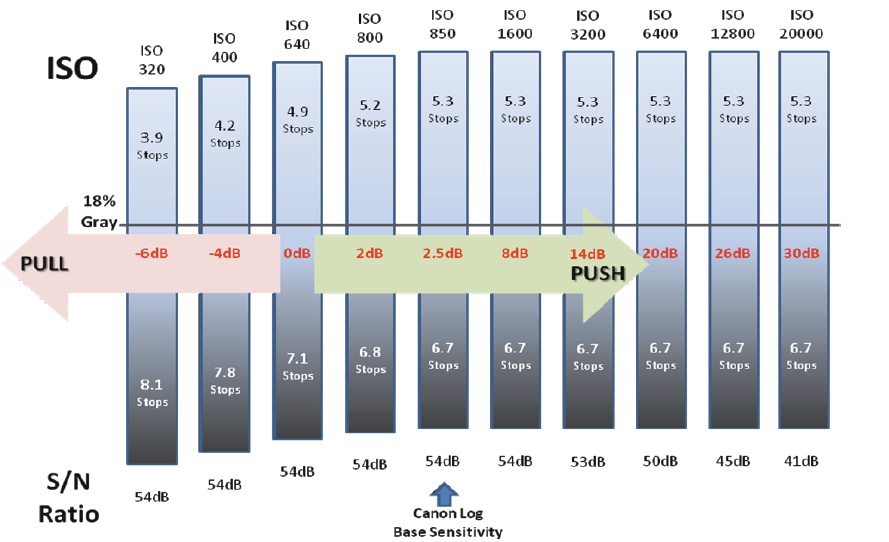
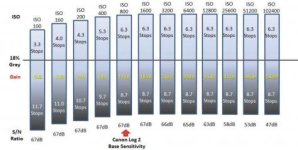
This is Canon Log 1's dynamic range chart for the C300 Mark I. I have not seen a chart for the Mark II or C200, but I'd imagine it would be similarly spaced out as far as what ISO's it changes at, just with more dynamic range.

John, considering this chart shows no dynamic range increase in the highlights after 850, why would you push to 12,800 ISO in daylight? Did you find with the C200 that the dynamic range did increase in the highlights at that higher ISO compared to 850, or were you just seeing if you could get a clean image at that ISO in general?

ISOrange.jpg
 
I pushed it up to 12800 as a test. But I did shoot a short on the C700 recently and I found I actually really like the look of ISO3200. The roll off into the shadows just looked nicer than the 800. It's a per project/scene choice.


Screen Shot 2017-12-03 at 8.33.42 PM.jpg
 
At around 2:59 he says it makes more sense to shoot at ISO200 in low light.
Interesting.

There should be no surprises here. Let's break it down a wee bit.

Lower ISO means less image noise. As a consequence, if you want as little noise as possible—shoot at the lowest ISO. This "makes sense".

But.... you still want to achieve correct exposure, right? It won't help to drop ISO to 200 if your image turns out black. We can't just change our ISO around without also compensating with f-stop and or shutter. Not if we want to maintain the exposure value.

Traditionally, users only started to increase ISO when the limits of aperture and shutter were already met. But with todays flexible cameras ISO is increasingly used as a means to control dynamic range distribution relative to middle gray. The chart posted above shows how available DR shifts around. All this to say that if you can shoot at ISO 200 your scene probably isn't that "low light" to begin with.

Any scene that just contains reflected light—like a studio interview setup—can probably be shot at very low ISO. If you have a light source in frame (or a window) that you need to control, you might want a higher ISO to give more headroom above middle gray.
 
Back
Top