
Navigation
Install the app
How to install the app on iOS
Follow along with the video below to see how to install our site as a web app on your home screen.
Note: This feature may not be available in some browsers.
More options
You are using an out of date browser. It may not display this or other websites correctly.
You should upgrade or use an alternative browser.
You should upgrade or use an alternative browser.
Does everyone shoot shoulder mount?
- Thread starter Rick Burnett
- Start date


Darren Levine
Veteran
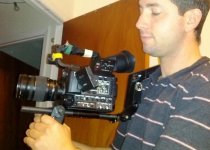
this is this cavision kit which includes those handles mentioned before, and i like the kit very much, its very solid and low profile
http://www.bhphotovideo.com/c/product/531905-REG/Cavision_RS1580D_SPE_RS1580D_SPE_Shoulder_Pad_System.html
can't beat it for 200 bucks, all told.
the shoulder mount has two joints and two connection points on each side and can also be flipped, so you can position it below the rails, on level with the rails, or like in the photo, much higher above the rails, which i think will help your tallness issue. i drilled a 1/4" thread tap in the back to add weights

CPM Camera Rigs
DVXuser Sponsor
Im also 6'4" and understand exactly. Our bulldog and dslr shooter rigs are low chassis shoulder rigs specifically for the reasons you mentioned, get the camera closer to how it might be flown or tripod mounted. They can also be swapped around to "rails on the bottom" and "camera above the shoulder". We suggest that everyone try the low mode before re-configuring the rigs, just to see. Its a little unconventional so most people want to configure it like a standard rig. But once they try it a lot keep it that way. DSLR shooter has fixed handles, not as adjustable, $530. The Bulldog has more adjustment in the handle area, $650. Also we still have the 10% coupon code for DVX User. Just type in DVXUser.com on check out. We also have military and education discounts of 25%. Email me for more details on those; steven@cpmcamerarigs.com
http://www.cpmcamerarigs.com/DSLR_Shoulder_Rig_p/041_shoot_dslr_shldr.htm
http://www.cpmcamerarigs.com/DSLR_Shoulder_Rig_p/095_shoot_bldg_shldr.htm
DSLR Shooter;
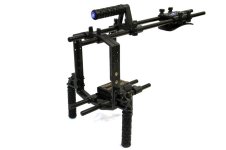
Bulldog;
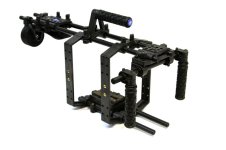
http://www.cpmcamerarigs.com/DSLR_Shoulder_Rig_p/041_shoot_dslr_shldr.htm
http://www.cpmcamerarigs.com/DSLR_Shoulder_Rig_p/095_shoot_bldg_shldr.htm
DSLR Shooter;
Bulldog;

Rick Burnett
Section Moderator
The CPM rigs are great, given I have one, I know!  The problem I have is with the FS100. It's a really long camera and I'm finding that a bit of a challenge at the moment in terms of moving it from on top of the shoulder to in front of me. I think underslinging the camera is a good way to go. What I need to do is order some extenders for the C clamps because the C is just not tall enough in my setup right now.
Rick Burnett
Section Moderator
I spent a lot of time researching every angle on what I wanted to do for this series of shoots I have coming up over the next month and a half. From a shoulder rig perspective, I don't have all the parts I need to test out how to undersling the camera. With the parts I do have I tried a few difference scenarios, but I'd really need to try something like the DSLR shooter above, and even then, I want to think about that more. The CPM rig works AMAZING with my 7D. Where I am having the trouble is in the length of the FS100 and the distribution of weight. It's so long, it really puts it away from your body, and then, it just gets strange. Given I've frankensteined three sets of rails together to make a test shoulder rig, it's just not stable because I am using parts in ways they were not designed for.
A lot of the shots I do are action shots, and I need to move around pretty quickly. I've used a bunch of Berkey parts to place handles at different locations on my camera. What I found was, if I got the center of gravity below the handles where the camera is in the position that I want to shoot, it's really stable on 30mm and wider lenses. With the handles, I can really shoot a lot of different angles since they articulate in a bunch of different ways. The Berkey parts (including the FS100 plate) and the DP6 I use do add weight to the camera, but it's actually just enough to make it stable to hold.
After making a trip to CMR (They make the Blackbird Stabilizer) I decided to go with a steadicam pilot arm with the blackbird for the more difficult shots. After about four hours of adjustments on both the BlackBird and the vest, I am REALLY happy with the performance. I'm still tweaking the setup as I am new to vests, but, I've floated the blackbird for quite awhile now (albiet with a smaller camera before).
Here is the shot CMR took of me that they used at IBC last year, so if you stopped by their both and saw this, yeah, that's me!
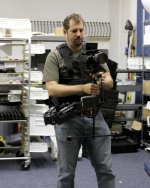
Where I think the shoulder rig will have the biggest use in the future for me is when we are shooting long segments of dialog shots. After I am done with this shoot and have more time, I want to build up a new shoulder rig to try out with some different parts from CPM that help with a 7D.
This picture does not show the Berkey stuff attached to my setup which I've pretty much made it that I can reconfigure the camera in less than a few minutes between stabilizer, hand held, monopod with LCD, slider (Igus for now) and tripod. (Because I use all Manfrotto plates on EVERYTHING).
As for the Turtle-XS system, I wrote the company and got no response at all. I wanted to know about using the FS100 on it. I've heard good reviews from some people and mediocre reviews from others. The one thing all agreed is it works well to remove weight and if you shoot all day, it can make a huge difference. But, it does not help with stability in moving shots. I starting thinking about making an adapter to attach the BlackBird to it and then I just realized, duh, steadicam arm.
We'll see how this weekend goes. I am sure there is something I didn't think of
A lot of the shots I do are action shots, and I need to move around pretty quickly. I've used a bunch of Berkey parts to place handles at different locations on my camera. What I found was, if I got the center of gravity below the handles where the camera is in the position that I want to shoot, it's really stable on 30mm and wider lenses. With the handles, I can really shoot a lot of different angles since they articulate in a bunch of different ways. The Berkey parts (including the FS100 plate) and the DP6 I use do add weight to the camera, but it's actually just enough to make it stable to hold.
After making a trip to CMR (They make the Blackbird Stabilizer) I decided to go with a steadicam pilot arm with the blackbird for the more difficult shots. After about four hours of adjustments on both the BlackBird and the vest, I am REALLY happy with the performance. I'm still tweaking the setup as I am new to vests, but, I've floated the blackbird for quite awhile now (albiet with a smaller camera before).
Here is the shot CMR took of me that they used at IBC last year, so if you stopped by their both and saw this, yeah, that's me!
Where I think the shoulder rig will have the biggest use in the future for me is when we are shooting long segments of dialog shots. After I am done with this shoot and have more time, I want to build up a new shoulder rig to try out with some different parts from CPM that help with a 7D.
This picture does not show the Berkey stuff attached to my setup which I've pretty much made it that I can reconfigure the camera in less than a few minutes between stabilizer, hand held, monopod with LCD, slider (Igus for now) and tripod. (Because I use all Manfrotto plates on EVERYTHING).
As for the Turtle-XS system, I wrote the company and got no response at all. I wanted to know about using the FS100 on it. I've heard good reviews from some people and mediocre reviews from others. The one thing all agreed is it works well to remove weight and if you shoot all day, it can make a huge difference. But, it does not help with stability in moving shots. I starting thinking about making an adapter to attach the BlackBird to it and then I just realized, duh, steadicam arm.
We'll see how this weekend goes. I am sure there is something I didn't think of
morgan_moore
Major Contributor
I used to have my 7d in the underslung configuration - I would agree that the FS100 is too long for this if you are shooting for any duration because it will stress the arms or require a huge counterweight
I suggest you have a careful look at my rig.. (http://dslr4real.tv/index.php?option=com_zoo&task=item&item_id=98&Itemid=1)
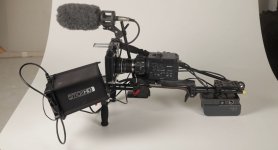
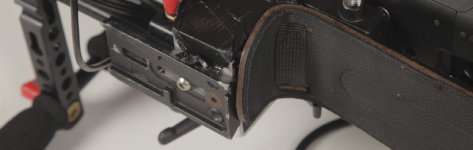
You see that by having no rods under the camera I have absolutely made the camera sit as low to my shoulder as practically possible
The Frotto 501/577 combo is 19mm thick and my rig is 6mm thick
Now you are going to use a removable plate for convenience I guess so that 19mm is unavoidable
Your Berkely sytems plate is I guess 60mm (or more) thick before adding a camera plate - thats 60mm of rig with the Berkely vs 6mm with my rig
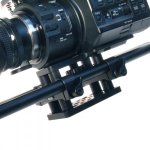
So thats 6mm vs 60mm (or more)
I can tell you lowering the camera/lens by 54mm (or more) makes a huge difference to eyeline and stability - everyone laughs at my scruffy rig .. until they put it on
I am sure that it is the best compromise between lens height and weight distribution - I played for months to get it in this config !
-----
Another thing that I am going to be playing with is the use of a shift lens !
I have a nikkor 28PC that I use so much on my steadicam pilot - the drop you can create is awesome
While that is a wide on my 5d Pilot combo it seems that 28mm is a great interview lens with the S35 chip
If you don't like nikons (due to focus direction) maybe canon FD have an equivalent
Happy rigging
SamMM
I suggest you have a careful look at my rig.. (http://dslr4real.tv/index.php?option=com_zoo&task=item&item_id=98&Itemid=1)
You see that by having no rods under the camera I have absolutely made the camera sit as low to my shoulder as practically possible
The Frotto 501/577 combo is 19mm thick and my rig is 6mm thick
Now you are going to use a removable plate for convenience I guess so that 19mm is unavoidable
Your Berkely sytems plate is I guess 60mm (or more) thick before adding a camera plate - thats 60mm of rig with the Berkely vs 6mm with my rig
So thats 6mm vs 60mm (or more)
I can tell you lowering the camera/lens by 54mm (or more) makes a huge difference to eyeline and stability - everyone laughs at my scruffy rig .. until they put it on
I am sure that it is the best compromise between lens height and weight distribution - I played for months to get it in this config !
-----
Another thing that I am going to be playing with is the use of a shift lens !
I have a nikkor 28PC that I use so much on my steadicam pilot - the drop you can create is awesome
While that is a wide on my 5d Pilot combo it seems that 28mm is a great interview lens with the S35 chip
If you don't like nikons (due to focus direction) maybe canon FD have an equivalent
Happy rigging
SamMM
morgan_moore
Major Contributor
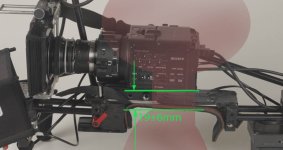
I tried to illustrate it here.. but the operator looks like ET
Rick Burnett
Section Moderator
Haha, that does look like ET! I actually use the Berkey top plate, not the bottom plate, as seen here:
http://www.berkeysystem.com/store/s...-nex-fs-100-top-mount-accessory-cheese-plate/
The problem is, at 6'4", even if the camera is resting on my shoulder with NOTHING inbetween it and my shoulder, it's too high. The majority of people I shoot are always quite a bit shorter than me, therefore, my only option is to squat down to get the right angle I need. With the CPM Film Rig offset Z connector I can get the camera even a little lower and it's still not enough. On the couple shoots I've had this setup, I was always having to squat down a bit for over the shoulder shots. Then when I was going a two-shot, it was even worse.
I spent an entire night going through my DVD collection watching a ton of movies I'd seen a million times (so I would not be distracted by the story) to see where the camera sits in relation to the shot tightness to the talent, and the angle to the eyes. It was VERY clear in narrative work, I have to get my camera lower more often than not.
I actually use the Berkey top plate, not the bottom plate, as seen here:http://www.berkeysystem.com/store/s...-nex-fs-100-top-mount-accessory-cheese-plate/
The problem is, at 6'4", even if the camera is resting on my shoulder with NOTHING inbetween it and my shoulder, it's too high. The majority of people I shoot are always quite a bit shorter than me, therefore, my only option is to squat down to get the right angle I need. With the CPM Film Rig offset Z connector I can get the camera even a little lower and it's still not enough. On the couple shoots I've had this setup, I was always having to squat down a bit for over the shoulder shots. Then when I was going a two-shot, it was even worse.
I spent an entire night going through my DVD collection watching a ton of movies I'd seen a million times (so I would not be distracted by the story) to see where the camera sits in relation to the shot tightness to the talent, and the angle to the eyes. It was VERY clear in narrative work, I have to get my camera lower more often than not.
http://www.bhphotovideo.com/c/product/388836-REG/PAG_2002_2002_Orbiter.html -- I'm messing with one right now. I am 6' 3"
Using it without the silly beam, it's pretty damned solid. You can lock all the axis.
Other than that, honestly, an Easy-Rig would be the way to go.
And tripods are for baby men. >:]
Using it without the silly beam, it's pretty damned solid. You can lock all the axis.
Other than that, honestly, an Easy-Rig would be the way to go.
And tripods are for baby men. >:]
morgan_moore
Major Contributor
The problem is, at 6'4", even if the camera is resting on my shoulder with NOTHING inbetween it and my shoulder, it's too high. The majority of people I shoot are always quite a bit shorter than me, therefore, my only option is to squat down to get the right angle I need.
You are correct camera height is critical
Any shoulder camera will present this problem, even operators with Alexas or Epics will be struggling with this (and more mass)
You really should play with a shift lens - also stepping back with a longer lens helps eyeline as as the camera to subject distance increases the angular variance decreases
On those DVDs - I guess they were funded movies with crew - the talent may be on apple boxes or the operator is legs apart bent knee maybe with an AC hugging him or at least grabbing the camera between shots
Also there is a world (for static shots) of pillars to lean on, walls to lean on - shootings sticks - I also have badass kneepads
The handle on my rig allows for various waist high grips - thats why I have a monitor so I don't have to have the camera to my eye
Ulitimately I think when Tom Cruise calls we over six footers may need to turn him away..
Have fun
Samm
Kholi, what's the weight like without the "gut-stick" ?
One of the main reasons I've always liked the Zacuto shoulder mounts is that they have enough counter-balance weight that the camera can pretty much float without tiring out your arms when shooting all day.
You can use it without the stick thingy and just the straps, which provide tension. Plenty enough to float the camera when not in use.
Konstantinos Tyrintzis
New member
01-18-2012 02:40 AM

Woah, just stumbled over this here:
Never heard of that company .
The website is a bit errr... quite though.
http://www.aeoncine.com/
The best information I found is this: http://cinescopophilia.com/a-sneak-p...-shoulder-rig/
Frank
Hello. the Titan Rig has not been released yet. The reason is that Aeon does not rush to bring things on the market, before serious testing and after listening to different feedback.
they have launced NAB 2012 and now they are almost ready to release the very much modified production Rigs, there are previously 4 different combinations o the Titan staring with the Spartan config at around 2700 $.
the rigs are made in an aerospace CNC facility that makes parts for Rolls Royce and helicopter parts. The materials are 7075 t5 aluminum hard anodised.
the new production rigs are going to be shown at the end of September , early October, and many will be given for testing to various popular ops.
The rigs are designed around Red Epic and Scarlet, so they can be used directly with out any riser plates. However the 3 first priced rigs can be used with all kind of cameras from Alexa, C300-500, ETC adding only a simple riser plate for the correct lens center distance.
Coming soon some more simplified and cheaper version for DSLR will complete the Titan range.
There is no cheap tubing, bent metals and cheap processes techniques in these production rigs, and everything is made in high accurate CNC 5 axis milling making sure that all standards are kept with precission
The Arri standard dovetail design is used at all dovetail brackets, and you can easilly take this from shoulder to Sticks in seconds with a snap of the cam locks, using your element technica , Arri , or other compatable plates.
The rossetes are Arri standard too.
The best thing about this rigs is that are fully upgradable to the higher models, and they can balance correctly the camera above your shoulder with out having to play with front heavy configurations that 99% of the proffessionals hate to use as they make operating painfull after a few minutes of continues shooting.
They are very modular and rapid in configurations from sticks to shoulder and back with out having to have hand grips hanging out front of the camera when in tripod mode.
They give the operators many different choices using always the best logical princibles of operating , coming out of years of experience in the film business.
many clever features as the smallest Quick release ever made, 20 degrees of roll possitioning angle for the shoulder pad fully adjustable for any kind of body structure having always a horizontial placement of your camera sitting on your shoulder.
Everything is click on with safety spring locks and a few seconds away of any configuration you might choose.
last 15mm standards and studio lightweight are also available.
you can actually view the new production rigs on their webstore.
But soon you will be get to know the real Titan rigs from close.
Cheers hope that helps.

Bern Caughey
Veteran
The Aoen gear is very interesting. Love the low profile nature, & all the quick build/reconfigure options. Wish I could check it out locally.
http://vimeo.com/35094202
http://vimeo.com/40633768
What I don't love about most shoulder rigs in their inflexibility, & bulk. Too often they're setup only for shoulder shots, & can't be reconfigured quickly for low shots, or if you need to squeeze up against a wall, or hop in a car. Even when crewed up properely, waiting on camera rigging can get bothersome, especially with certain Directors, Actors, & such.
I know this is an old thread, but I'll chime in on the EasyRig anyways.
I bought, & eventually returned, the Turtle-X Strong primarily due to the zippers malfunctioning on a job, & making it impossible to remove the backpack. I bought mine from the US distributor, & during the demo one of their reps broke a zipper too.
The Turtle-X has been discontinued, & there's a new budget line called the "Mini". I bought the Mini Strong for my roughly 10lbs camera setup, & with the disclaimer that I haven't used it that much, so far so good.
While an EasyRig is not a substitute for Steadicam, it can greatly reduce fatigue, particularly waist level shots or such, & as a friend describes, "takes the nervousness out of handheld".
Last edited:

RyanT
Veteran
Another trick I like to use for static handheld shots is sticking a small bouncy ball in the Mitchell plate, or the bowl of the tripod. This way the operator can rest the camera on something, but give the shot that handheld feel. I also like to do this with dolly moves that I want a little loose. This way you don't feel the obvious steps of the operator, but still get a good push in or pull out.
There was a website a while ago about the operators and grips on the wire, I think it was. They had developed a soccer ball with a lockable cage around it, that had a quick release plate on top. Cameras would be handheld all the time, but they would always stay on the dolly and could be locked off when not in use.
There was a website a while ago about the operators and grips on the wire, I think it was. They had developed a soccer ball with a lockable cage around it, that had a quick release plate on top. Cameras would be handheld all the time, but they would always stay on the dolly and could be locked off when not in use.

Drew Ott
Wish I were banned.
While a monopod would be my last pick for shooting narrative, it's one of my firsts for shooting events. I'm not sure why more people don't use them. They are incredibly easy to operate for everything but long tracking shots. You can do little crane and dolly type moves by tipping the whole stick over then operating the head to keep your subject in frame. High and low shots are a breeze, etc, etc. Give it a shot.
Another thing you can do with a monopod is to make it as short as it can go, then rest the bottom of it on your thigh. Next take the arm, lock it as tight as it will go, and position that so it rests on your shoulder. It works like a perfect shoulder rig.
Steadicams are another great all-around tool, but take a while to learn how to use. I have a Merlin and can operate that all day with no fatigue since I'm using mostly a GH2 at the moment. I used to have a Canon A1 and could only operate that maybe an hour, but I was also weaker so it's a tough comparison. If you are strong enough, I think the best all-around tool is a Glidecam. The Merlin is better, imo, for tracking shots, but the Glidecam's advantage for event shooting is that it is long enough to rest on your thigh for stable static shots.
Grahamrobbins5
Active member
90% of the photos I see on here are people shooting shoulder mount. I thought, okay, I've not really shot a lot of shoulder mount so let me try it. I've been through 2 iterations of shoulder mount setup and the honest truth is I just don't like it. Given I am 6'4" most people are shorter than me. This means for almost every shot, the camera is pointing down a bit. If I get down on a knee or knees, then I am stuck in that one position.
When I see a lot of film set shots, I see the camera either on a tripod, or, they've got it on a crane/dolly system that is typically pretty crazy.
When I used to shoot with my 7D, I used a blackbird stabilizer. I have to tell you, this combination was absolutely amazing. EVERY person who I've taught to use the setup has just been amazed at the freedom in shooting so they get more dynamic shots. Because the camera is right in front of me, my arms work raising and lowering, and I can track and rotate very well with the system.
Then I bought the FS100 (and before that the AF100).
These cameras are just a bit too heavy to hold out in front of you all day long. (The AF100 more so) and because both camera are longer, the weight distribution at the top isn't as good to me with the Blackbird.
I've spent DAYS thinking about this. I know when we shot with the HVX200 that we'd use the top handle for lower shots, and cradle the camera for midlevel shots. And of course, hand held for higher shots.
With the FS100 and AF100, I don't know why, but handheld with the built-in/attachable grips just feel off. The weight is all wrong on the FS100. On the AF100, the lack of articulation in the grip prevents me from using it at different camera heights.
I've been thinking of using my Berkey pieces (with some additional ones) to build a bunch of different grip points around the camera to help with holding it. Making it so I can change the grip location based on center of gravity AND the grip orientation to deal with the axis of rotation relative to my movements.
Some people have used a camera strap to help stabilize when running with the camera lower. I also considered if a chest pad in the back would help.
Has ANYONE gone down this path? If you need to shoot a mid level (think camera at stomach) shot where you need to move around, what do you do? Any ideas would be GREATLY appreciated.
Hahah this made me laugh, I shoot a lot of commercial and in the commercial world at least I have literally NEVER worked with a director who wanted a handheld look. I work with steadicam, cranes, dollys, sliders, crane cars, ect to do really smooth compound moves. I always find it funny how crazy packed the online community is with ENG style shooters who do lots of handheld. I wish I could do it more It just not the style of the directors I work with. People on forums are always talking about and comparing each others handheld rigs, If I was to own a camera I dont even think I would bother with a shoulder mount hahah.
Cheers,
Graham Robbins
Bern Caughey
Veteran
Another trick I like to use for static handheld shots is sticking a small bouncy ball in the Mitchell plate, or the bowl of the tripod. This way the operator can rest the camera on something, but give the shot that handheld feel. I also like to do this with dolly moves that I want a little loose. This way you don't feel the obvious steps of the operator, but still get a good push in or pull out.
There was a website a while ago about the operators and grips on the wire, I think it was. They had developed a soccer ball with a lockable cage around it, that had a quick release plate on top. Cameras would be handheld all the time, but they would always stay on the dolly and could be locked off when not in use.
I've seen a softball used in a similar way. It had a bolt screwed into it with the head cut off. The bolt would get threaded into the ARRI, & the ball would go into the tripod bowl.
We always carry SteadyBags, & often just slap them on top of a tripod, or dolly, but a friend in the ASC has repeadly asked I design a fluid ballhead, however that's outside my skill set.
Here's a customish thing I bodged together from a few inches worth of 2"-side aluminum and a single Cinevate rail block (plus random other small bits) to alleviate the AF100's relative out-of-the-box unwieldiness:
http://www.dvxuser.com/V6/showthrea...p-ultralight-ENG-Doc-rig&highlight=ultracheap
Obviously I wouldn't say I go off sticks often because I'm lazy: more than anything, simple economics. For example, this is the kind of small-scale shoot which serves as my bread-and-butter:
http://www.yellowpages.com/nationwide/mip/holistic-pest-solutions-444198
Specs are to go on location, meet, review, and shoot the most-always un-media-savvy talent/talent's workplace in under 90 minutes, with whatever light is available (usually around noon - blech), and deliver an edit essentially same-day. They're not high budget. Usually, the only locked-off shots are the interview/sales blurb, maybe some signage b-roll, perhaps a few closeup details. Going hand-held and putting something approaching angle variety and movement is excellent... although it helps to be able to hold the thing steadily.
Other shoots are usually documentary... and working in DC often, there are many locations where use of tripods, monopods, or even steady bags is illegal.
Lastly, I'm somewhat of an indecisive semi-perfectionist, and regardless of where I put a tripod, I'm always convinced I'd have been better off putting it someplace else.
The cheap design linked above was a result of building something to fit my accidental/necessary "style." The handle is in the right forward position to easily balance and change to a comfortable angle when shooting from the shoulder, hip, or cradled. It can sit on the shoulder and still use the camera's EVF, or sit a bit back and use the LCD as EVF, or (heck) just use an EVF/monitor. It balances on the shoulder easily because the shoulder support is above the COG. It can be balanced easily single-handed while the second hand manipulates the lens. It sits balanced and level on the ground. Only the shoulder support (one single 15mm rail loosened) need be removed to fit into a carryon-approved camera bag (with lens, mic, wireless receiver, and monitor attached). It adds nearly no additional weight to the shoot-ready AF100 and fits easily through small doorways, in crowds, etc. It's light and easy to handhold for hours on end.
Anwyay, it works for me. Maybe it could work for someone else with similar needs.

legrevedotcom
Veteran
Ulitimately I think when Tom Cruise calls we over six footers may need to turn him away..
Have fun
Samm
...or you stick to DP'ing and call in a 5' 8" like me for the camera work
