DIY Led Panel

Siccdragon

Active member
My Goal was to create a durable, portable and rechargeable Light kit. I chose LEDs cause of the low power consumption. In the excitement of what i have made so far I decided to share with you guys and see what you think and what input you have. Having very little sleep for numerous reasons I will probably edit this once I have recharged.

Pictures and crappy Iphone video just to show what i have to far. need to add more bars and a battery pack but this is just the beginning powered with a 12v power suply.
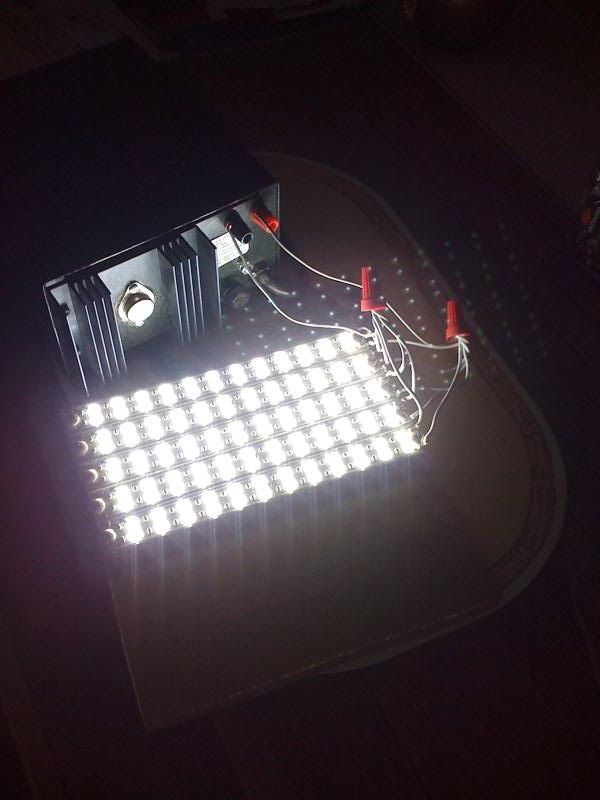
IMG_0108-1.jpg


IMG_0107-1.jpg


http://vimeo.com/2374916

When finished It will be a 3 point light kit that can run four hours on decently small (very relative term) battery power
 
It looks pretty good, but I would caution anyone against sinking a bunch of money into LED's, especially the cheapo ones you generally find on ebay. I discovered myself, after spending a lot of money, that the cheap ones have a major flaw that ended up being a deal-breaker for me-

Low CRI- Color Redering Index. The leds I found all had a very low CRI and made everything look grey, color rendition was horrible, and that combined with their very low light output, (until you've spent 1000's on crappy LEDs), makes for a light that is well below the quality of what you get for a $30 Eiko flourescent and a chinaball.

I did, however, find some battery powered worklight "sticks" that come in handy for small things.

There's a reason why commercial LED lights are so expensive, just want to keep others from making the same mistakes I did.
 
Thanks for the input. I'll definitely keep that in mind and was what I was worried about. What going to try some gels to see if i could get the color right. But yeah if the color isn't in the light a filter won't fix that. My hope is that the led cluster's I bought are extra's from some random high bulk order.

If I do get this to work cool, if not a wasted some money and have some nice long lasting work lights ;)

I have ran the 5 bars for 10+ hours from a cheapo HVX ebay battery so there is some hope there. I ordered a few more to do a complete test and I'll get back to you all when I'm finished.Which will hopefully be in the next week.

But yeah I'll take the hit before anyone else tries this
 
Last edited:
lights.jpg


I'm no huge color and lighting expert but this is the video scopes from final cut with just the light on, on a white surface. Since they'll all even is the CRI correct? are there other tests to tell? Will be finishing up the whole kit this weekend to set up a mock interview to fully test them. Would like some good info on CRI testing tho. Thanks for all of the input :)
:dankk2:
 
I have noticed that most of the DIY led emitters that one first uses is them small and lots of them, cheap dime a dozen types. Sure they are cheap and plentiful, but for serious lighting requires the good stuff. Using 100, 200 or more of them really is NOT the way to go. First, the color temperature is usually on the blue (5000K or more) side.Second, and most importantly is the beam angle spread,they are way too narrow, and third, they occupy a lot of space to get a good bright light. Above all, how efficient are they or how much lumens per watt do they shell out? Now, you might say "put a warming filter and a diffuser in front of them" to get the color and beam spread right." Yeah, right ! you also will DROP the output by more than 40% by doing that. I laugh every time I see a led unit that you must gell it and diffuse it to get what you really need. If the lamp is natively say 4500K and the spread is natively 90degrees or more,
wouldn't that be the way to go ? As leds go, the key ingredient is a DRIVER to control the current flow. When one intends to design a lamp, care in choosing the right driver along with the leds and mounting options with particular attention to heat. There is a tradeoff between power consumed and lumens out. The best and most efficient ones have 85% and more efficacy of the driver. Drivers come in many flavors and types, common ones are the Buck types that will lower the input supply voltage to match the current limits of the led. Just keep in mind that leds are measured in lumens output at a given amperage and a fixed distance of 3 ft. from a white surface. Also helpful is to know that a typical incandescent household bulb of 100 watts is roughly 1700 lumens. That 100 watt rating is really the POWER consumed from your electrical company and NOT a measure of brightness. Some led lamp makers are reluctant to post the true lumen output of their units and spread angle. In most cases a 35 watt led on the spec is really a 35watt incandescent equivalent and NOT the power consumed by the led. If a led light would really consume 35 watts, that would mean a really bright light if the efficacy is near 100 lumens per watt (3500 lumens WOW). Led technology is improving by the month, and already out there are leds that offer well in excess of 120 lumens per watt @350ma efficacy. Choose your leds and drivers wisely.
 
today you can find dozen of led light for video (or not for video) so the DYI spirit is not really necessary except if you target some very special design.
(ringlight for example, or putting some leds into a sunshade).
Good leds with lots of power are required and they cost the hell, so the DYI lamp often ends up by costing the same price of a good lamp.
I made already tons of led lamps and frankly , each time you got light, that is not so difficult, but having lot of light , or the correct color, or in a compact and clean design is not so easy or cheap.
If you are serious in getting a quick and cheap led lighting, you better would purchase something like the comer 1800.
 
Back
Top