
Navigation
Install the app
How to install the app on iOS
Follow along with the video below to see how to install our site as a web app on your home screen.
Note: This feature may not be available in some browsers.
More options
You are using an out of date browser. It may not display this or other websites correctly.
You should upgrade or use an alternative browser.
You should upgrade or use an alternative browser.
DIY Fluorescent Lighting
- Thread starter Cool Lights
- Start date

Cool Lights
DVXuser Sponsor
Kplo,
Thats strange, its working for me. This is the direct link to the Cool Lights Video Magazine Universal Yoke Adapter video.
http://www.coollights.biz/wordpress/archives/22#more-22
What browswer are you using and what version? I'm testing under Internet Explorer 6 and Mozilla 2 (latest). Works fine under both. Its Windows Media too. I have to admit I haven't tested under a Mac (don't have one).
a little something i'm working on
a little something i'm working on
Interesting thread. I am pretty impressed with some of this sheet metal work. I don't understand what the purpose of the hood is though. If you need to soften the light why not just put some paper in front?
Also I am curious about the CRI of the compact fluorescents used. So far I have only been able find 90+ CRI lamps in T-8, T-12 and PL-L sizes (as pictured below), and only from Philips. The compact fluorescents all seem to be around 82 CRI, which is not good enough for my purposes. Am I missing something here? Are high CRI compact fluorescents available? Who makes them?
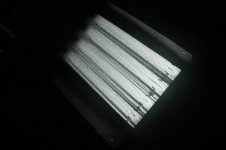
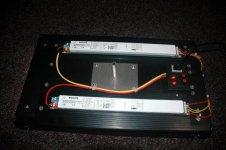
I found myself in the situation of needing to build my own lights as well. So I made the light pictured here. Runs on 240 VAC, 4x55w PL-L tubes 5000K, 91 CRI, fully dimmable. The honeycomb is also home made. Construction is mainly PVC with some polycarbonate. Heaviest part is the ballast. I also constructed a two tube version (not pictured).
I'm working on a new design that will no longer be a patent violation, and will offer additional features at lighter weight. I wonder what you guys think. Kino sells the Diva Lite 400 for about $1000. Are there people out there interested in something along these lines at half the price?
My next design will be lighter weight, and dmx controlled. Any other features people would be interested in? Just to be clear, although I built these at home, some of the materials and fasteners are not the kind of thing you'd find at your local hardware store. So I wouldn't say the plans would be of much use to anyone.
Attachments
Last edited:
Cool Lights
DVXuser Sponsor
The left picture isn't very clear. What did you use for the housing or how did you make it? What country are you in--if you're using 220v that usually indicates somewhere other than USA...
As for the original bulbs I used, they were GE 3500K I believe with CRI 82 which was fine for my purposes. 82 CRI is only 18% off of 100. Most people won't see this difference especially if you are using a light like this to light a backdrop like a green screen which is primarily what I used my original 6x55's for.
When you do the research into what it takes to make a CRI 90 bulb, how really difficult it is to make something like that and even higher, you realize that you are negating many of the reasons people go to fluorescent in the first place--namely energy efficiency. The higher the CRI, the less light comes out of the tube. There is a balance to be struck between energy efficiency and good color rendering. I wrote about it here:
http://www.coollights.biz/wordpress/archives/13
and here:
http://www.coollights.biz/wordpress/archives/14
Both articles talking about all the issues in fluorescent tube production, why there is a green spike, how Color Temperature and CRI are measured and why its so tough to find higher CRI bulbs in 3200K and 5600K. In a nutshell though, we are really a small minority and are competing with the rest of the world which doesn't really care about CRI or Color temp and thus most of the tubes produced are mostly meant for grocery stores and warehouses. They mainly care about energy efficiency and tube life.
As for the hood its a long story and you had to be there. It was just an extra experiment that I tried when I realized how extremely bright a 6x55 was. It also related to how expensive dimming ballasts are--I was trying other tricks to see how more diffusion could play a role in a poor man's dimmer. I also tried polystyrene diffusion material too.
I did show how to add dimming ballasts and dimmers in my video though for those really interested in it and not afraid of the extra costs but a dimming 55w ballast costs at least $120 in the USA unless you are lucky enough to find a deal where someone is liquidating some. And that doesn't include the costs for adding DMX or any special 10v dimming manual controllers.
As for higher CRI bulbs, I am selling CRI >87 on my site now in 3200K and 5600K color temps. CRI 90 and higher are available but (for sure) a bit tougher to find and for sure more expensive.
There are definitely people out there interested in dimmable 4x55 units. I'll have dimmable models for sale on my site to go with our non-dimmable units and it will be priced under $500 to go along with our committment to bringing the price down and making energy efficient lighting affordable. As I mentioned earlier, the price of dimming ballasts makes this a tougher, but not impossible issue to solve.
Park Edwards
Veteran
Richard,
Is it possible to purchase just the halogen to cfl conversion in a .mov or .avi? I'd really like to purchase the whole dvd, but i'm only going to be using the one tutorial?
all the best,
-Rh
Is it possible to purchase just the halogen to cfl conversion in a .mov or .avi? I'd really like to purchase the whole dvd, but i'm only going to be using the one tutorial?
all the best,
-Rh
Cool Lights
DVXuser Sponsor
Hi Car30, I haven't broken it out before and hadn't thought to do that at least at this time.

JohnMC
Member
I'm working on a new design that will no longer be a patent violation, and will offer additional features at lighter weight. I wonder what you guys think. Kino sells the Diva Lite 400 for about $1000. Are there people out there interested in something along these lines at half the price?
My next design will be lighter weight, and dmx controlled. Any other features people would be interested in? Just to be clear, although I built these at home, some of the materials and fasteners are not the kind of thing you'd find at your local hardware store. So I wouldn't say the plans would be of much use to anyone.
What patent is he talking about? I'm currently working on some lights for myself, but some other people I know would also like to buy a couple. I just want to make sure I am not stealing any property.
Thanks,
John
KROOKEDKROWN
Well-known member
Do you have any plans for any of these so I could take a wack at a couple of these my self

Cool Lights
DVXuser Sponsor
They do all look wonderful. But what I'm really wondering about is flicker. Flicker is the achilles heel of the flourescent world right?
So....
Do you have any?
If not, HOW did you avoid that problem????
-edg
Flicker is one of the least problems today when you use an electronic ballast. Advance, Fulham, Universal, Sylvania all have reasonably priced non-dimming ballasts which yield great results and no flicker at any shutter and/or frame rate. We sell Sylvania ballasts on my site and they are well liked by everyone that uses them.

erniediaz
Well-known member
Hello, Richard Andrewski - Cool Lights USA
I'm in a project and have to make my own equipement, because:
1.- here in my country is very espensive to rent cine equipement, and
2.- we need to carry (several weeks) the equipement to the jungle in order to make a feature (independent) movie.
I have constructed my ligths, (as well as a crane, a dolly, a kind of steady cam wich I call "Dove Cam", among other devices) but have not been able to make the barndoors's hinges in a usefull way.
So can you help me giving me some advice?
thanks in advance.

Jim Brennan
VHS Member Old Skool
You can make to doors out of aluminum. Attach 2 "L" brackets to the barn door so that the holes in the part of the bracket on the adjacent side (the side not on the barn door) face each other, Do the same thing on the body of the light so that brackets on the light and the barn door line up with each other. Put a small nut bolt with a lock washer of some type through the holes and tighten.
Here's a pic of a Smith Victor light with a similar design, except it uses a single "U" shaped bracket on each part instead of 2 "L" brackets, but it's the same idea.
Here's a pic of a Smith Victor light with a similar design, except it uses a single "U" shaped bracket on each part instead of 2 "L" brackets, but it's the same idea.
Cool Lights
DVXuser Sponsor
Hi Ernesto,
Did you ever see my video on the subject of how to add barndoors to a light?
http://www.coollights.biz/wordpress/archives/21
Try that and see if it makes things clearer.
Other methods for creating barndoors will be quite a bit more complicated than this method and not DIY friendly.
Did you ever see my video on the subject of how to add barndoors to a light?
http://www.coollights.biz/wordpress/archives/21
Try that and see if it makes things clearer.
Other methods for creating barndoors will be quite a bit more complicated than this method and not DIY friendly.