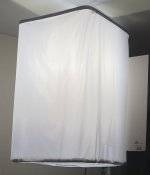
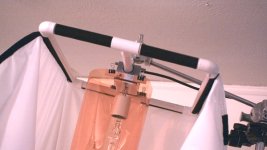
DIY DAYLIGHT 150 HMI $150... (OK, it's HID)

Hey Michael,

You've sold me on considering making one or two of these since I'm moving away from 3200K lighting.

Questions: I know these bulbs you're using draw less power than the original bulb, but a.) Do they last longer?
B.) Do they really emit less heat? I see they are spec'd at about 150W, but in your configuration, do they maintain that sort of heat output after being in use a while?

Thanks mate.
 
Last edited:
I have three source four PARs fitted with 150W ceramic metal halide. They are very serviceable.

The life of ceramic metal halide is usually quoted based on the time it'll run before decaying to some hopelessly low level of output, or before the colour drifts so far it's barely recognisable. Mine usually use the Philips CDM-T 150/942 G12 1CT, which is specified to 10% failures at 10,000 hours, and 50% failures at 12,000 hours, but Philips' definition of "failure" in this context is likely to be rather less demanding than ours. Lighting of the type we're discussing here is specified for use in retail premises and architectural installations, an application with a rather wider tolerance than we have. Still, we can derate them by an extremely conservative 75% and end up with a life in the 2500-hour range, which is entirely reasonable for an under-$20 device.

It's still important to be aware that neither HMI (nor MSR, CSR, or other equivalents) or CMH is likely to match new-for-old or even across batches, so carry some eighth-strength colour correction filters for trimming.

Assuming the datasheets are accurate, 150 watts of energy are going into the bulb and 150 must therefore come out. I reckon mine are getting on for as powerful light-wise as the 575 HPL often used in S4 PARs, which is a reasonable efficiency claim for metal halide over tungsten, so quite a lot more of it is coming out as light than heat. People put 750W tungsten in these things. I'm not worried about 150.

P
 
Hey Michael,

You've sold me on considering making one or two of these since I'm moving away from 3200K lighting.

Questions: I know these bulbs you're using draw less power than the original bulb, but a.) Do they last longer?
B.) Do they really emit less heat? I see they are spec'd at about 150W, but in your configuration, do they maintain that sort of heat output after being in use a while?

Thanks mate.

Hey DP - my understanding is that heat at a given wattage is going to be about the same. Richard at Cool Lights verified this discussing his globe.

So sticking a 150 HID in a 650 fixture (or even a 300) should be fine.
 
Michael, I am planning on making the 150W light. thank you for sharing your knowledge. why don't I see these DIY projects producing high quality 1000W video lights for low dollars? Is DIY low dollar limited to 150W HID? I looked at coolights, and when they get to 1200W it is $3600+/- What am I missing? Even a referaence article that would help me understand would be wonderful.

Thanks, Mike.

There are some guys on this forum trying to do 575s and so on. The main problem is getting a ballast that works for video - low noise and high hz. There's a german ballast out there, but you have to buy them in bulk and create an enclosure for them. I was surprised to find a workable 150 ballast for $50 - Cool Lights sells theirs for $400!

It seems like right now, people are focused on LEDs, which have come a long way but I'm still not a huge fan of and are still primarily soft sources - and trying to do a point source LED at decent brightness is still very very pricey. There's a retrofit LED bulb for 1k fresnels out there - it's $800 though. For the bulb replacement, you supply the fixture. But they say it's 1k of daylight and pulls less than 2 amps. Maybe their prices will drop. At $500 it could be attractive.

People that want to own a bright hard light are generally getting used 575 HMIs or pars - even a 1.2k HMI is common and will run on most household circuits. The chinese knockoffs seem to do OK for some people as well, and their 575 HMIs are down to $700 or so. And there are lots of used HMIs out there, especially if you don't mind a magnetic ballast. Check Pyramid Films and their eBay listings.

I have one of those auto-show HMI source four par conversions, they can be found for under $300 (mine was $175). They're pretty good lights, but 6500k so need gels (the 5200k globe is $200-$250). They have loud fans so they need head extension which are easy to make though. The source four par is a crazy efficient fixture so they really kick out some light.

I totally believe a modern 575 could be done for under a grand and be profitable. Don't know why nobody's doing it. Well, the Chinese are, but early units had QC issues with no stateside service.

But - the little 150 is a pretty nice little light to replace a 650 fresnel… that's a start. And I have been using 400 watt mogul grow lights and ballasts in Photoflex Starlites which are pretty damn bright and work with all the existing Starlite softboxes. Getting powerful, bright, clean daylight for soft light isn't such a challenge anymore. Throw a couple biax quads or newer style LEDs behind a scrim. Getting a really pretty fresnel or par look is tougher. Seems like there's a market though.
 
Excellent answer Michael. So the issue is noise and hz. Good to know. I just got my lighting technicians book, and will be reading it asap, so I can cut my learning curve.
Questions:
Who is the German ballast maker?
What is head extension?
Is the Mogul setup the same type of light as your 150 or a 575HMI, just in 400watts? Thus about 2000 watts of tungsten?
It was your find of the inexpensive ballast that convinced me to make the 150. I found your commentary on the Ballast Amazon Review, assuming there is only one Michael Carter who made a video light with one :)

Thank you again Michael!
 
Last edited:
Excellent answer Michael. So the issue is noise and hz.

And availability/affordability. You need a ballast that will strike an available bulb, that will fit in an available fixture, and preferably everything is affordable.

Also, when you get above 500 watts or so, the pulse that's used to first light the globe (which is a big blast of power) is too big to run through the ballast cable, so the ignitor has to be part of the fixture and very close to the bulb. So, another component that has to match everything.


Who is the German ballast maker?
What is head extension?

Can't recall the ballast info - DVX member Phil Rhodes has been playing with this stuff.

The head cable is the cable that runs from the ballast to the head - a head extension is a male/female cable that extends this, depending upon how much length at what gauge cable will work.

What is head extension?
Is the Mogul setup the same type of light as your 150 or a 575HMI, just in 400watts?

Nope, if you dig through my 2 threads on that light, they're based on 2 different bulbs that both work with that ballast, one a G12 bipost and one a gx9 (tiny) globe.

Mogul bulbs are like an edison-screw base but bigger, and they're long a sort of tubular. HID mogul bulbs have a UV glass layer so they can be used without a lens, like in a softbox.

The Photoflex Starlight uses Mogul tungsten bulbs in a fixture that has a built-in speedring, that works with their range of softboxes for high-heat, and they take 500w and 1k tungsten globes.

But I came across a Mogul HID bulb listed as 6500k and high CRI, so I got a 400w aquarium ballast and tried it in the Starlite - works fine and needs 1/2 CTO - I also made a space light with it. Lately I've seen 5200k moguls HIDs to try.

BUT… the HID moguls only fit 2 of the 3 starlites I have - something's odd about the thread and it's slightly different for HID vs. Tungsten. Not sure why.

400 Mogul HID space light:

spacelight.jpgDSC_5598.jpg
 
[German ballasts]


Here's the saga to date:

The company is Schiederwerk and the product is the EVG-5. This is, as far as I can find out, exactly the unit that's in Michael's 575W Enliten PAR. They require forced-air cooling. They didn't want to supply less than three on some ludicrous multi-month preorder at extortionate cost, so I overlooked them entirely.

Power to Light in the UK wouldn't even return my calls.

Taiwanese company Jenbo also advertises a potentially suitable 575W ballast module. When I asked a few weeks ago, they were unable to supply due to a parts shortage, which may translate to they couldn't be bothered to make a single unit, which is probably fair enough.

I tried a Lumatek 600W HID ballast intended for the - ahem - "hydroponics" market. These are high frequency ballasts and they will light HMIs, but not very satisfactorily - there's a pronounced flicker. The high frequency output causes the medium-arc-length lamp to act a little like a plasma globe. The wandering arc causes visible flicker and it's no good. They're also only about a third cheaper than the cheapest real HMI ballasts, so it really isn't worth it.

There was a company that made, or at least sold, low-frequency square wave ballasts for - ahem - "hydroponics". I have no idea why they did this, as the frequency is presumably irrelevant if you're just driving plants, and the lower frequency would have increased the unit cost. Still, they might have worked well for medium-arc lamps like HMIs. They've been out of manufacture for some time and I couldn't find one. I suspect it was just a case of a western distributor getting a good deal on some older tech and selling it. It's gone.

In light of this, however, I contacted several hydroponics suppliers to see if anyone still made low-frequency HID ballasts. Nobody does, as far as I can tell, but a company called Harvest Tech were - surprise surprise - anxious to supply me with a true HMI ballast, the TMA-575-110C which arrived with PCB markings suggesting that the OEM is an outfit called Shenzhen TechOne Tech Co. Ltd.

It wasn't particularly cheap - it's actually the self same device GAM sell with their 575W HMI source fours, and it has a rather noisy fan (which I have replaced with a much quieter one branded Noctua). Nonetheless it will properly light and, with the associated ignitor, hot restart 575-watt HMIs.
Subsequent tests reveal that, no, the GX9.5 MSR bulbs and bases will definitely not tolerate being hot started.

So that's what I did. The ballast was reasonably expensive, and I bought a proper G22-base, hot-startable Osram HMI bulb for it, and the associated lampholder. All of these things are expensive, and the G22 base doesn't fit in the "deep" back caps on the 575-watt MSR source four clones, an engineering problem I'm still in the process of solving. It will, barely, fit in the device, with a bit of minor filing, but the centre of the arc wouldn't be properly located in the reflector so I'm going to have to make it a new back end. Take heart, however; you can do this mod to any source four par, not just the rarer-on-ebay MSR type. Edit: There's a need to be cautious about how resistant to dangerous UV the lenses are. The MSR ones should be OK, but it's worth having them tested. The others certainly may not be, and people have had problems in the past (I won't say who, but people have definitely developed ultraviolet keratitis (arceye) or sunburn after being exposed - it is a real thing and has happened). It is possible to buy HMIs with UV coating, now, and I did, but I view it as a secondary level of protection and the lenses must be right.

The resulting device is not very much cheaper than the very cheapest Chinese ebay HMI fresnels, but it is a true hot-startable 575W HMI PAR and I'm happy with it on the basis that I like source four PARs.

P
 
Last edited:
Great, thanks for chiming in Phil! I was looking for your posts and am not to savy at navigating the forum yet, so it was a pleasant surprise to see this. Thanks Michael Carter and Phil! Answered all my questions on the issue. I need to do a bunch more reading on ballasts and bulbs so I can distinguish the differences. Most helpful!
 
Regarding lens safety - how does one test for UV output?

(I've been reading up on this, since I also have a darkroom and want to do multi-color gum printing, but with an enlarger… so I need to come up with a "UV enlarger", something many have failed at).

But anyway - short of lab testing gear, would those "sunburn exposure cards" be a crude way to tell if an HMI is a UV death-cannon or puts out safe levels? They are treated plastic cards that turn purple to warn you when you've been in the sun too long… beyond that, how does one test for UV? Point it at your cat and see if they bump into walls the next day? (Owww, kidding!!!)
 
In my view, one doesn't, one asks a professionally equipped lab to do it and one pays the fee they require. Here in the UK it was about £600 (US$1000) last time I asked.

I hate to be difficult about it, but this is a health and safety (OSHA, Americans) issue. We're talking about causing workplace injuries. In absolutely the worst possible case, we're talking about blinding people. The room for assumption here is absolutely microscopic.

There are many things which might give us an idea of what's safe but I have very limited tolerance of home remedies here, even just from the insurance and liability standpoint. I am happy that my upgraded MSR PAR is safe because it uses a lens which was designed for 575-watt mercury iodine lamps, it has a long previous install history (much of which I had to clean off with alcohol and a rag) and because I have installed a UVS-suffix Osram HMI bulb. I will be the guinea pig, under carefully timed conditions.

I would be willing to make similar assumptions about your Enliten PAR, but I would still test it personally, in worst-case conditions, in gradually incrementing time windows. It is designed to go up in a lighting rig, not to be placed on a stand near talent, and any certification or conformance it has may be predicated on a minimum range to humans, or other conditions.

The stories I have heard about 575W MSR PARs with improper lenses extended to sunburn, but it was in a car-show situation where the lighting would have been overhead, not directly in the eyeline of talent or crew.

Any lesser circumstances than than these would make me very nervous.

Phil
 
Back
Top